


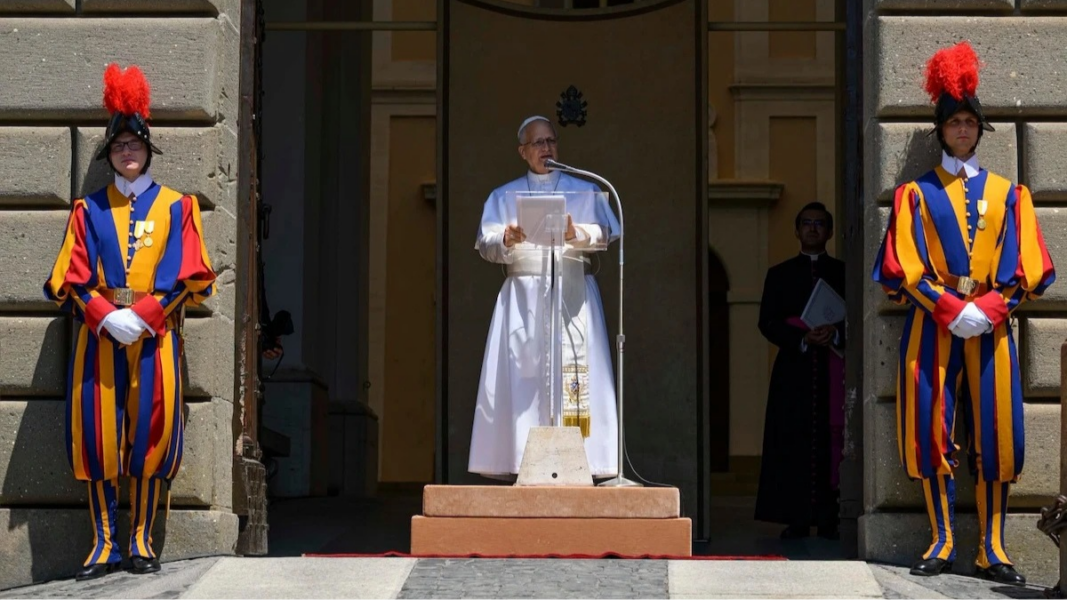
Pope Leo XIV warned this Sunday that the Kingdom of God is not imposed through power, force, or human success, but grows silently, like a seed or like yeast in the dough. During the recitation of the Angelus in Freedom Square in Castel Gandolfo, the Pontiff invited Christians to abandon the temptation of expecting spectacular interventions from God and to learn to recognize his discreet action in everyday life, even amid evil.
Reflecting on the parables of the wheat and the tares, the mustard seed, and the yeast, Leo XIV emphasized that this way of God’s acting must also become the style of the Church: a Church that does not impose itself with arrogant judgments or by force, but serves with humility, patience, and trust in the action of grace. After the introduction, the Pope spoke the following words:
Dear brothers and sisters, happy Sunday!
After the parable of the sower, Jesus continues to speak to the crowds through some images: the good wheat and the tares, the mustard seed, and the yeast in the flour (cf. Mt 13:24-43).
These are three short parables whose purpose is to evoke the entry of the Kingdom of God into history, its action in the lives of men, the way it grows, spreads, and transforms the world from within. With these stories, Jesus wants us not to fall into the temptation of thinking of God as a powerful figure who imposes himself by force, occupies space to dominate, and arrives triumphantly. On the contrary, God prefers smallness, a sign of his discreet love, which leaves us free to welcome or reject him, which seeks to make its way even amid the tares, which acts in a hidden and invisible way like the smallest of all seeds, which ferments and makes the dough rise without making noise.
Brothers and sisters, with these parables Jesus tells us something important about the way God acts in our lives and in history. Sometimes we expect something spectacular; we desire a God who intervenes from on high, immediately uprooting the tares of evil. We imagine a strong and powerful God and, unfortunately, we also adapt our way of being Christians and of being Church to this image. Instead, the Kingdom of God spreads even amid the tares and asks us for a gaze capable of perceiving the good that springs even in the darkness of evil, without judging everything immediately; it comes like the smallest of seeds and therefore requires the patience to accompany processes, recognizing it in the smallness of daily life and in the simplicity of ordinary life; it grows invisibly, like yeast in the flour, and thus frees us from discouragement and invites us to have confidence even when it seems to us that God is absent. Because, in reality, He always accompanies us and his love is always at work for our good.
This style of God must also become the way in which, whether as individuals or as a Church, we live the reality around us. We are called to adopt an evangelical style, without hastily opposing with arrogant judgments, without trying to impose ourselves with power and force, without losing trust in God’s work. It is a matter—as the then-Cardinal Ratzinger said—of submitting ourselves to the logic of the seed, which is not that of success or greatness, but asks us to become small and to serve the life of people (cf. Address at the Jubilee of Catechists and Religion Teachers, 10 December 2000). In this way, we ourselves will become like a small seed of the Gospel that germinates and like a leaven of love that transforms the dough of the world.
Let us invoke the Blessed Virgin Mary, who knew how to welcome the seed of the Word in her humility, so that she may sustain us on our journey and intercede for us.
After the Marian prayer, Leo XIV renewed his greeting to the residents of Castel Gandolfo and thanked them for the welcome he is receiving during the days of rest he is spending in the town. The Pontiff also welcomed the numerous pilgrims who had come from various countries to take part in the Angelus.
The Pope once again expressed his concern for the conflicts that continue to affect various regions of the world and invited the faithful not to forget the victims of war. “Let us not forget those who suffer and die because of conflicts,” he urged, encouraging the joining of prayer with concrete commitment to peace.
He then greeted several groups present in Freedom Square, including the Cenacle Community of Mother Elvira, gathered in Saluzzo for the Feast of Life; the New Families Movement of the Focolare, participating in its International School; the Mexican students of the APRA Summer School; and the members of the Catholic Worldview Fellowship.
Leo XIV also extended a special greeting to the young adults of Regnum Christi who are taking part in the International Course for Formators, as well as to the pilgrims of the so-called “Pilgrimage of the Lion,” accompanied by Bishop Anthony Percy, Auxiliary Bishop of Sydney (Australia).
The Pontiff likewise greeted the families and children of the work of the Sisters of Charity of the Assumption in Rome, the young people of the parish of San Salvador in Jerusalem, the youth group of the parish of San Agustín in Bovolenta, and the pilgrims of the Liturgical Academy of Rzeszów, before wishing everyone present a happy Sunday.