


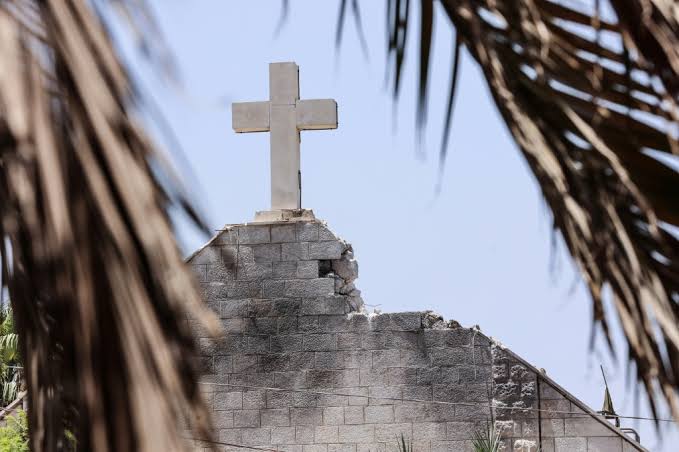
A year after the Israeli attack that killed three people at the Holy Family parish in Gaza, the Catholic community will once again gather to pray for the victims, the wounded, and peace. The celebration will take place this Sunday, July 19, while the Strip remains marked by bombings, destruction, and a humanitarian emergency that has not ended.
The parish priest, Father Gabriel Romanelli, has announced a special Mass for those who died on July 17, 2025 and for their families. The commemoration will also be a prayer for forgiveness and for the end of a war that has reduced entire neighborhoods to rubble and turned even the most basic movements into a daily ordeal.
Three killed in the attack on the parish
The attack on July 17, 2025, killed Saad Issa Kostandi Salameh, the parish caretaker, aged 60; Foumia Issa Latif Ayyad, 84, who was in a Caritas tent used as a psychological support center; and Najwa Abu Dawud, who died hours later from her injuries.
Father Romanelli was also slightly wounded in one leg and had to be taken to a hospital. The impact spread terror among the many people who were sheltering inside the parish grounds.
Three days later, during the Angelus on July 20, 2025, Leo XIV expressed his deep sorrow over what had happened, named the victims, and renewed his call for peace and respect for humanitarian law.
“We will pray for the souls of those who died on that sad day,” Romanelli said. The parish will also pray “for the wounded, for their families, for forgiveness, and for peace.”
Violence continues despite the ceasefire
The commemoration comes as violence persists in various parts of the Strip, despite the ceasefire still in effect.
On Thursday, July 16 alone, several Israeli army operations killed at least five people. These included drone strikes on a vehicle west of Khan Younis, bombings on displaced persons’ tents on the beaches of Gaza City, and gunfire in the Zeitoun and Tuffah neighborhoods.
The humanitarian emergency has not ended either. Nearly a million displaced people continue to live in tents and makeshift shelters, now also under the high summer temperatures.
“The streets of Gaza are destroyed”
Father Romanelli has described a city where even the shortest journeys have become extremely difficult.
“The streets of Gaza are destroyed,” he explained. In some places it is only possible to advance a few meters, and the asphalt has disappeared. “There are potholes, debris, rubble, twisted metal, and broken glass.”
Added to the destruction is the price of fuel. A liter of diesel costs about $13.50, while gasoline reaches $27.
The situation directly affects the parish’s activities, which tries to take children daily to the summer school at the Oratory of St. Joseph. To prevent them from becoming isolated, the community financially supports some of the few buses and minibuses still operating, so they can pick up children, young people, and families.
80 % of infrastructure remains destroyed
Bishop William Shomali, vicar general and Latin patriarchal vicar for Jerusalem and Palestine, has warned that 80 % of Gaza’s infrastructure remains destroyed.
It is not only buildings. Water and electricity networks have also been severely damaged, while numerous schools and universities have disappeared or are unusable.
Shomali noted a slight improvement in food supplies, which now enter from Israel and are then sold inside the Strip.
The Latin Patriarch of Jerusalem, Cardinal Pierbattista Pizzaballa, observed during his June visit that the markets were somewhat better stocked than during his previous trip, made shortly before Christmas.
The parish prepares to reopen its school
Amid this scenario, the Latin Patriarchate of Jerusalem hopes to reopen the parish school of the Holy Family in September, with capacity for around a thousand students.
The reopening will allow many children to return to studying after months of war, displacement, and fear.
“This way, the children will at least not remain on the street,” Shomali explained. “It is important that they return to studying, to try to bring them slowly back to normality and help them overcome the trauma of war.”
A year after the attack, the parish in Gaza continues to do what it can amid the ruins: pray for its dead, care for the wounded, take the children to school, and keep alive a community that refuses to disappear.