


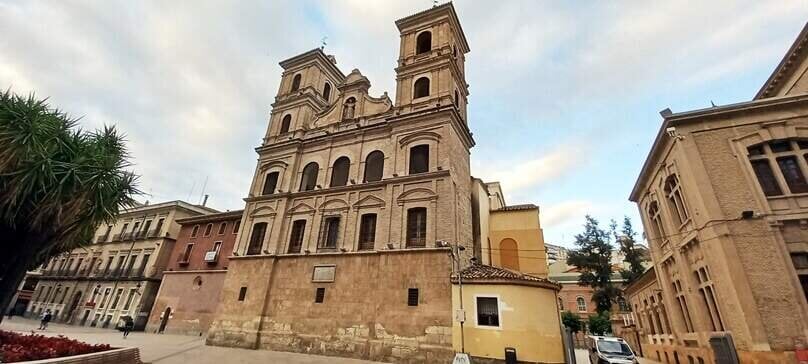
The Society of Jesus is undergoing a new process of reorganization in Spain marked by the decrease in the number of religious and the scarcity of vocations. In just three months, the Jesuits have announced the closure of five communities and stable works in different parts of the country, a decision that the order itself attributes to the impossibility of maintaining its presence with the current personnel.
The most symbolic case has been that of Murcia, where on June 16 an uninterrupted presence of almost five centuries came to an end. According to El Debate, the provincial of Spain, Father Enric Puiggròs SJ, signed together with the bishop of Cartagena, Mons. José Manuel Lorca Planes, the agreement that ends the stable Jesuit community in the city, acknowledging that “for now” it is no longer possible to maintain a religious community there.
Murcia ends almost 500 years of Jesuit presence
The first Jesuits arrived in Murcia in 1555, barely fifteen years after the founding of the Society of Jesus by St. Ignatius of Loyola and still during the lifetime of its founder. The closure of this community constitutes one of the most significant decisions within the current reorganization process of the Jesuit province of Spain.
At the farewell event, Puiggròs explained that the decision responds to the reorganization process that the order has been developing for years as a consequence of the reduction in the number of available religious.
Five closures in a few months
The closure of Murcia has not been an isolated event. In recent weeks, the stable presence of the Jesuits has also ceased in the parish of San Esteban del Mar, in Gijón, entrusted to the Society for 59 years; in the residence of the Colegio del Salvador in Zaragoza; and in the community of the Clot neighborhood, in Barcelona.
The Jesuit community of Santiago de Compostela will soon be added to these closures, with its closure scheduled for next August.
The succession of these announcements reflects a process of concentration of communities that the Society considers necessary to adapt its presence in Spain to the current vocational reality.
A crisis affecting religious life
Although the situation of the Jesuits is especially significant due to the historical weight of the order in the Spanish Church, the phenomenon is not exclusive to the Society of Jesus.
In recent years, numerous religious congregations, both male and female, have reduced their territorial presence due to the aging of their members and the scarcity of new vocations, a trend that affects Spain and other countries in Western Europe in a generalized way.
In their communications, the Jesuits present these closures as a new stage in their apostolic mission and emphasize that Ignatian spirituality will continue to be present through schools, institutions, apostolic works, and numerous lay people linked to the tradition of St. Ignatius. However, the progressive closure of religious communities also reflects the vocational crisis affecting a large part of consecrated life in the West.