


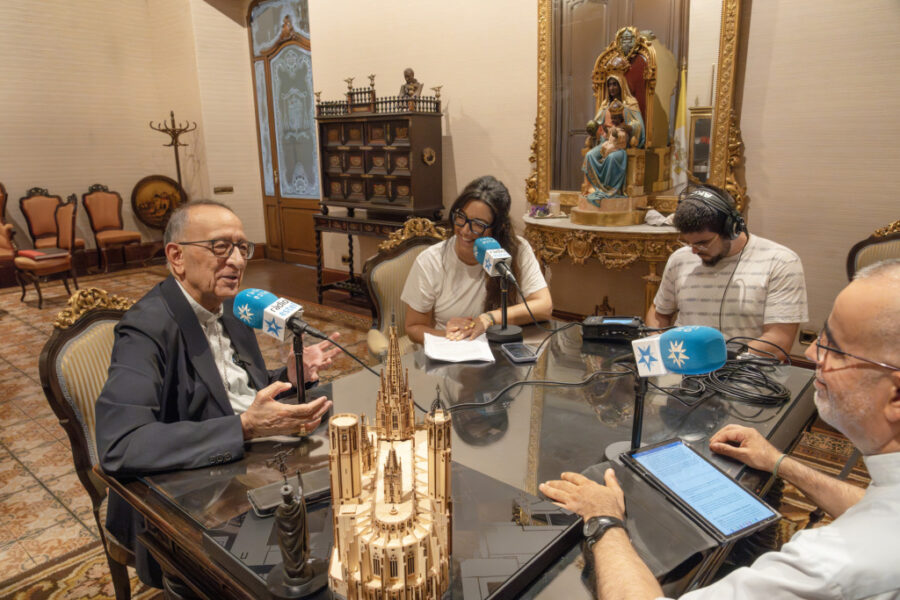
The Archbishop of Barcelona, Cardinal Juan José Omella, has taken stock of the pastoral year in an extensive interview given to Ràdio Estel, marked by the visit of Leo XIV to Spain and by various current ecclesial matters. During the conversation, the cardinal supported the Pontiff’s actions regarding the Priestly Fraternity of St. Pius X (FSSPX), defended the application of the protocols in the investigation of Cardinal Cristóbal López Romero, confirmed that he expects the appointment of his successor “as soon as possible” and gave a very positive assessment of the first months of the new pontificate.
“Leo XIV has given us a great lesson”
Omella stated that the Pope’s apostolic visit has left a “precious seed” in the Church in Spain and affirmed that it is now up to the faithful to make his teachings bear fruit.
In his view, one of the most significant moments of the trip was the address delivered by Leo XIV before the Spanish Parliament.
“In his speech in the Congress of Deputies, Leo XIV gave us a great lesson on how to work for the common good and how to live diversity in communion,” he said.
The archbishop described the Pontiff as “a man who is very well prepared intellectually,” with extensive pastoral experience gained over decades in Peru and a serene vision of reality. “He observes the wounds of the world with an always benign and kind gaze, offering a response from the Gospel and from humanity,” he noted.
Omella also highlighted the simplicity with which the Pope lives community life. He recalled that during his stay in Barcelona they shared meals, prayer and daily life at the Episcopal Palace, an experience that, he said, allowed him to get to know a particularly human side of the Pontiff.
“If they do not want to come, let them not say they are the Catholic Church”
One of the issues addressed during the interview was the recent crisis between the Holy See and the Priestly Fraternity of St. Pius X.
Omella recalled that for years the Church has tried to restore full communion with the fraternity founded by Archbishop Marcel Lefebvre, although those efforts have not been successful.
“There has been a trajectory of many years trying to achieve rapprochement and unity, but unfortunately we have not succeeded,” he stated.
The cardinal defended Leo XIV’s actions and summarized the message that, in his opinion, the Pope has addressed to the FSSPX:
“The Pope has been courageous. He extends his hand to them, but he also sends a message that essentially says: ‘If you do not want to come and meet us together in Jesus Christ, go your own way, but do not say that you are the Catholic Church.’”
Nevertheless, he expressed his hope that full communion may one day be restored.
“Let us hope that we may live in communion. We pray that unity may triumph,” he added, describing the current separation as “a hemorrhage” for the Church.
“Let justice say who is right”
The Archbishop of Barcelona also referred to the preliminary investigation opened by the Vatican into Cardinal Cristóbal López Romero, Archbishop of Rabat, following allegations of alleged inappropriate behavior with adult women.
Omella explained that, upon learning of the news, he personally telephoned the cardinal.
“I called him and told him that I was praying for him,” he recounted.
At the same time, he defended that the protocols established by the Church must follow their course and that it is up to justice to clarify the facts.
“We must be just, demanding and responsible in our actions. If someone denounces us, let justice say who is right. I wish that in all areas of society it were done this way. It is the only way to resolve such serious and painful problems,” he affirmed.
Awaiting his successor
Omella, who turned 80 on April 21 and is no longer a cardinal elector, acknowledged that he is already awaiting the appointment of the new Archbishop of Barcelona.
“At this moment I am the oldest active bishop in the Spanish Episcopal Conference. It is my turn. I am waiting for the Pope to say who my successor is. I hope it will be as soon as possible,” he said.
Asked about the profile he would like for his successor, he avoided making personal considerations.
“Whoever is appointed, we will accept him and I ask that he be accepted, just as I felt welcomed when I arrived. What matters is to respect the person, work with him and collaborate,” he stated.
He trusts in the beatification of Antoni Gaudí
The cardinal also expressed his confidence that the beatification of Antoni Gaudí may take place soon.
“We are all waiting for it,” he said, while recalling that, after the visit of Leo XIV and the inauguration of the tower of Jesus Christ at the Sagrada Família, the figure of the Catalan architect has gained even greater international projection.
According to Omella, Gaudí “has reached the heart not only of Catalans, but of the whole world,” not only because of his artistic genius, but also “because of his life and his witness of love for God and for the poor.”
Taking stock of his more than ten years at the head of the archdiocese, the archbishop said he would like to be remembered as a pastor who worked for unity and communion. “If we walk together, we will make Catalonia and Barcelona a wonderful reality,” he concluded.