


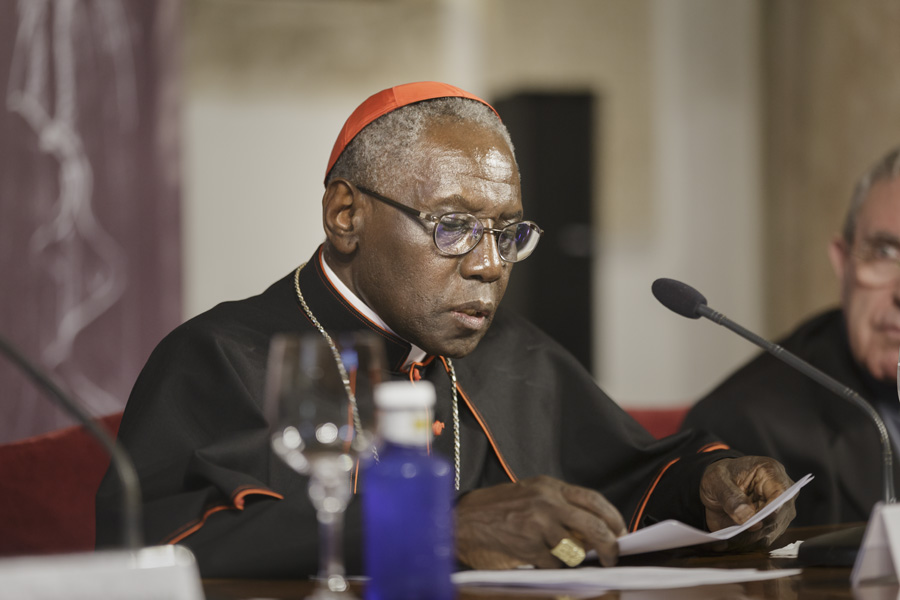
Cardinal Robert Sarah denounced on Wednesday in the European Parliament that the European Union is promoting a new form of “ideological colonization” over Africa by imposing abortion, gender ideology, and so-called sexual and reproductive rights as a condition for international cooperation. During his speech at the colloquium Europe and Africa, held in Brussels, the Guinean prelate repeatedly appealed to the magisterium of Leo XIV, Benedict XVI, and Francis to call for a relationship between both continents based on respect for cultural sovereignty and natural law.
Sarah was invited by MEPs Paolo Inselvini and Nicolas Bay to speak at this meeting, organized at the European Parliament headquarters to reflect on relations between Europe and Africa. His speech, with a marked anthropological, political, and religious content, focused on defending human dignity and criticizing what he described as the instrumentalization of language and international cooperation to impose certain ideological agendas.
“Words no longer mean what they say”
The cardinal began his intervention by asking whether Europe and Africa still share the same meaning of fundamental concepts such as “human rights,” “family,” “freedom,” “dignity,” or “gender.”
“Can we still understand each other? Do the words we use—human rights, dignity, development, freedom, health, gender, family—still mean the same thing to those who pronounce them in Brussels, Strasbourg, Kampala, or Conakry?” he asked.
As a starting point for his reflection, he cited words recently spoken by Leo XIV before the diplomatic corps accredited to the Holy See.
“We need words to once again express certain realities unequivocally. Only then can an authentic dialogue without misunderstandings resume,” he recalled, making the Pontiff’s approach his own.
From there, he argued that numerous terms used today in international documents have ceased to describe reality and have become tools of cultural transformation.
“Expressions such as ‘sexual and reproductive health’ often designate access to abortion; ‘gender equality’ may mean the deconstruction of the sexual difference between man and woman inscribed in the human body,” he stated.
“A cultural and economic neocolonialism”
Sarah asserted that this change in language is not merely a terminological issue but an instrument of political pressure.
“A treaty, a resolution, or an action plan that uses imprecise and ambiguous vocabulary is not an instrument of cooperation, but an instrument of perversion and silent power,” he declared.
According to the cardinal, whoever controls the meaning of words “in fact controls the outcome of the negotiation,” which leads to “a form of cultural and economic neocolonialism.”
In this context, he warned that many African countries are receiving pressure to modify their legislation on matters related to abortion, family, or sexual identity as a condition for accessing international cooperation or funding programs.
“When human rights are invoked to impose legal categories foreign to our history, our faith, our culture, and our anthropological vision, we are no longer facing cooperation between equals,” he maintained.
A critique supported by the magisterium of three Popes
The prelate structured much of his lecture around the thought of Benedict XVI, Francis, and Leo XIV.
From Benedict XVI, he especially recalled his defense of the Logos and reason as the foundation of political and legal life, as well as his warnings about gender ideology and relativism.
“When Europe constructs rights separated from the truth about man, reason itself is deformed,” he stated.
He also evoked Francis’s denunciations of “ideological colonizations” and drew on Leo XIV’s recent encyclical Magnifica humanitas to warn of the danger of reducing the human person to a mere technical, economic, or statistical datum.
Criticism of the Samoa Agreement and European policy toward Africa
Sarah devoted a significant part of his intervention to analyzing various instruments of cooperation between the European Union and African states, including the Samoa Agreement and various resolutions adopted by the European Parliament.
In his view, through these mechanisms Europe uses trade, financing, and development aid to influence the national laws of numerous African countries.
“Here appears in a verifiable way the ideological colonization: the use of trade and finance to intervene in the criminal and family legislation of a sovereign state, directly violating the principle of self-determination of peoples,” he stated.
The cardinal insisted that Africa must be considered an interlocutor with its own identity and not a continent to which cultural models conceived in Europe are exported.
“Europe has much to learn from Africa”
Far from limiting himself to criticism, Sarah defended the need for cooperation based on mutual respect, subsidiarity, and solidarity.
“The Church does not ask Europe to stop helping Africa; it asks that the culture of power be transformed into a civilization of love,” he stated.
He also added that European secularization today makes Africa a spiritual reference for the West.
“Europe, aged and weary, has much to learn and receive from Africa,” he assured, highlighting the vigor of faith, family life, and vocations in numerous African countries.
A call to the European Parliament
In the final part of his intervention, Sarah invited European institutions to review the language they use when addressing issues related to family, life, sexuality, or human rights.
“Conduct a serious examination of conscience. Listen to Africa. Respect its cultural sovereignty. Offer cooperation that is free, not conditioned by ideological agendas,” he urged the MEPs.
The prelate concluded with an appeal directed directly at European political leaders.
“I am not asking you for an act of faith, but an act of reason. Check whether the words you pronounce truly honor the human person, the family, and the freedom of peoples. If so, Africa and Europe will walk together. If not, no treaty, however well drafted, will be able to bridge that distance.”