


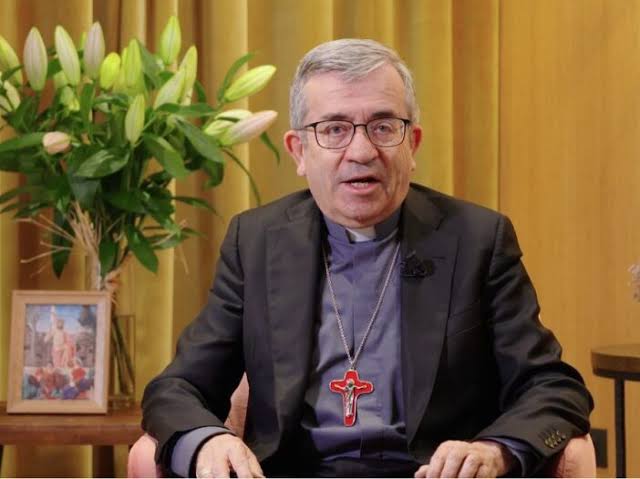
The president of the Spanish Episcopal Conference, Mons. Luis Argüello, has defended his way of participating in public debate after the controversy sparked by statements made during a summer course of the Pablo VI Foundation, which prompted a letter from the Minister of the Presidency, Félix Bolaños, and numerous reactions in the political and media spheres.
In an extensive interview given to Javier Arias for Religión Confidencial, conducted when the controversy was beginning to take shape, the Archbishop of Valladolid states that he seeks to maintain a dialogue with all political forces and attributes part of the impact of his interventions to the way the media operate.
“The media live off the headline and the click”
Argüello explains that he usually speaks without reading written speeches and that his presentations cover different aspects of the same issue, which, in his view, makes it easier for an isolated phrase to shape public perception.
“The media have an unbeatable rule of the game: they live off the headline. And now, in the digital age, they live off the click. As a result, headlines tend to be eye-catching, generally out of focus,” he states.
He adds that a half-hour intervention can end up reduced to a single phrase and that this selection conditions the subsequent interpretation of his words.
“For some I am a dangerous leftist and for others a terrible reactionary”
The president of the Episcopal Conference maintains that he tries to offer an integral vision of social issues, linking anthropology, economics and politics.
“Depending on where you catch me in my speech, for some I am a dangerous leftist, because I usually speak against capitalism, and for others I am a terrible reactionary because I speak in favor of life, I do not recognize the right to abortion and I defend the family as the union between man and woman,” he points out.
In this context, he considers that an approach inspired by the social doctrine of the Church does not always fit into the logic of political polarization.
He also addresses the Society of Saint Pius X
During the interview, Argüello also refers to the recent episcopal consecrations carried out by the Priestly Fraternity of Saint Pius X (FSSPX). He states that “whenever a rupture occurs in ecclesial life it is a source of pain” and maintains that the origin of the conflict is not primarily in the liturgy, but in the non-acceptance of the Second Vatican Council.
He also recalls that the appointment of bishops has traditionally been linked to confirmation by the Bishop of Rome and affirms that the recent consecrations “break not with the Church of Vatican II, but with the Church prior to Vatican II.”
The interview, published in two parts, also addresses issues such as synodality, family pastoral care, the reorganization of parishes in Spain and the cause for the beatification of Isabella the Catholic.