


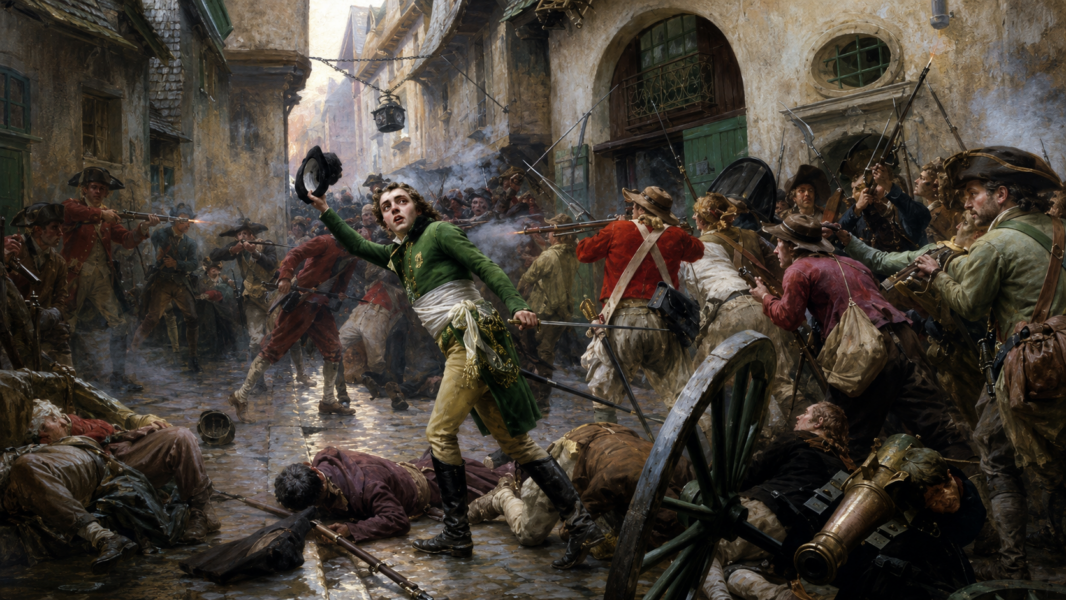
In July 1789, France celebrated with unprecedented pomp the second centenary of the Revolution. While the academies intoned the hymn to liberty, equality and fraternity, a handful of dissenting historians recalled an uncomfortable truth: that those same principles had served to devastate an entire region just a few years after being proclaimed. The region was called the Vendée. Its inhabitants were called “brigands.”
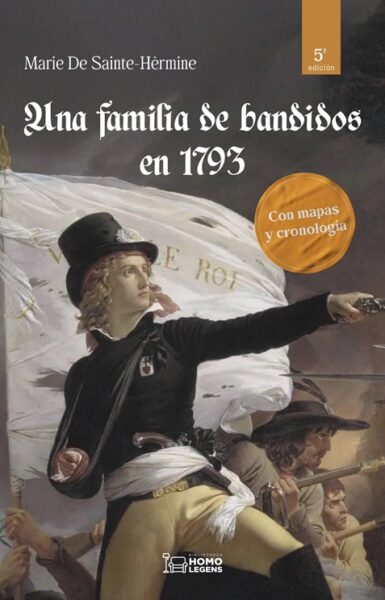
That derogatory nickname gives the title to the book that Bibliotheca Homo Legens has just reissued for the fifth time: A Family of Brigands in 1793, the memoirs of Marie de Sainte-Hèrmine, a woman who was sixteen when the Convention launched five armies— one hundred and twenty thousand men—against the western provinces of France. It is not an essay or an academic reconstruction. It is the first-person account of someone who saw it with her own eyes and survived to tell it to her grandchildren.
A war that began because of the priests
The origin of the uprising dismantles the myth of a noble and reactionary revolt. The peasants of the Bocage had welcomed the Revolution of 1789 without particular suspicion; they even took part in the purchase of confiscated ecclesiastical property. The break came in 1791, when the Civil Constitution of the Clergy—condemned by the Holy See—forced priests to submit to a truly schismatic church and expelled from their parishes those who refused. The villagers responded by hiding “their priests,” who continued to officiate in forests and barns.
The definitive spark was the compulsory conscription of 1793. One thing was to tolerate anti-Christian ideas in silence; quite another to give one’s own blood for the regime that persecuted its priests and had guillotined its king. Without leaders, without military experience, without organization, the peasants rose up. And they found their leader not in an aristocrat greedy for privileges, but in a peddler, Jacques Cathelineau, whom they would call “the saint of Anjou.”
“Destroy the Vendée”
Against all odds, the rebels won many battles. They took Saumur and Angers. Fury erupted in the Convention: “Destroy the Vendée!” exclaimed Bertrand Barère. What followed was not repression, but a plan of extermination. After the annihilation of the Catholic and Royal Army at Savenay, General Westermann wrote to Paris a phrase that sums up the enterprise: he had left “not a single prisoner to reproach myself with; I have exterminated them all”.
In Nantes, Jean-Baptiste Carrier drowned ten thousand civilians in the Loire. Turreau’s “infernal columns” set entire villages ablaze, destroyed crops and massacred populations that no longer posed any military threat. The toll, according to historian Reynald Secher—whose doctoral thesis at the Sorbonne popularized the term “Franco-French genocide”—: one hundred and seventy thousand dead and the destruction of twenty percent of the region’s buildings. Then came the second death, that of oblivion: school textbooks dismissed the episode, when they mentioned it at all, in a single paragraph.
The testimony of a survivor
Against that unmarked grave, Sainte-Hèrmine’s book sets the concrete memory of a family, the Serants, and their peasants. What is astonishing about the account is not only the heroism, but the absence of hatred. A faith without ostentation presides over every page and forbids them to hate those who massacre them. The narrator closes her notebooks with a sentence addressed to her grandchildren that encapsulates the whole book: “there is only one irreparable misfortune: to betray duty and lose one’s soul”.
With a prologue by Carlos Esteban and an epilogue by Alberto Bárcena, the work is read with the tension of an adventure novel and the gravity of knowing that it all really happened. As Esteban writes in the prologue, if it is true that for a Catholic history is a succession of defeats, it is also true that Christ is the Lord of history and has already conquered the world.
New feature of the fifth edition: maps and chronology
The main novelty of this fifth edition is an apparatus that transforms the reading. The work now includes a general chronology of the French Revolution—from the regicide of January 1793 to the decisive battle of Cholet in October—that places each scene of the narrative in its exact context. It also adds maps of the region and of the Galerna campaign, the most tragic phase of the war, with the main battles and the defeats that marked the collapse of the Catholic and Royal Army. The reader no longer gets lost among the names of generals and localities: one can follow, on the map and on the calendar, how the catastrophe unfolded.
Added to this is a cast of main characters—from the Serant family to the leaders of both armies—that serves as a permanent guide. It is the most complete and readable edition of a text that, since 2018, has been winning readers in Spain.
A Family of Brigands in 1793
Marie de Sainte-Hèrmine · Prologue by Carlos Esteban · Epilogue by Alberto Bárcena · 5th edition · Bibliotheca Homo Legens · 562 pages · 16,90 € · homolegens.com