


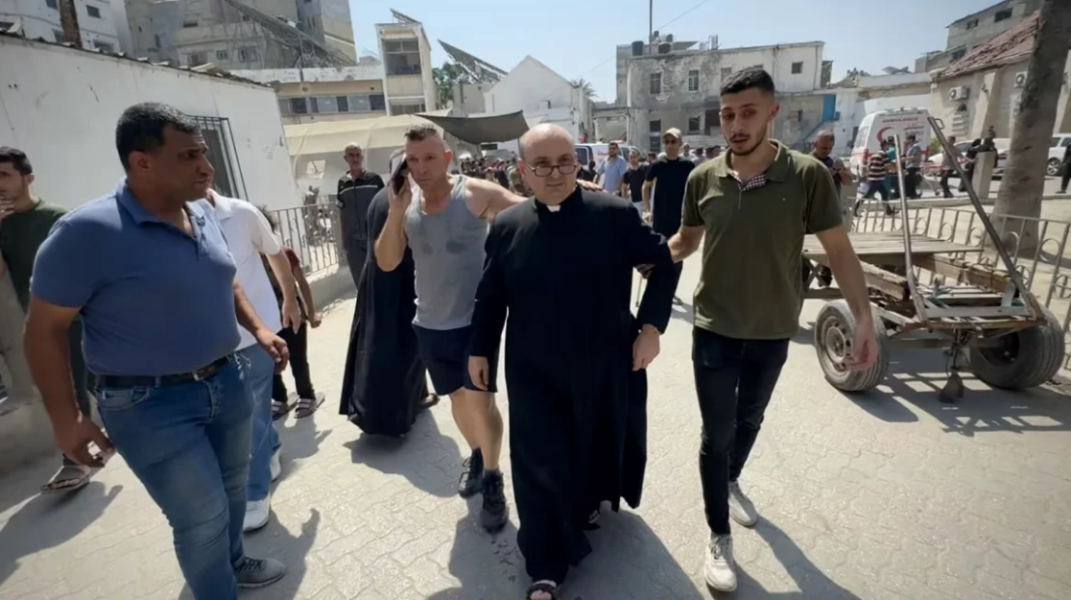
The war in the Gaza Strip has reached one thousand days since the attack carried out by Hamas against Israel on 7 October 2023, a conflict that, despite the ceasefire signed in October 2025, continues to leave a deep mark on the civilian population. From the only Catholic parish in the enclave, Father Gabriel Romanelli has issued a new appeal to the international community not to remain indifferent to the suffering of Gaza’s inhabitants, especially children.
In statements collected by Ayuda a la Iglesia Necesitada (ACN) and Vatican News, the parish priest of the Holy Family laments that “the world has turned its back on a million boys and girls in Gaza, without intervening to stop the killings and mutilations.” For the Argentine priest, the anniversary of these one thousand days of war should serve to reactivate diplomatic efforts and move toward “a just peace,” based on the dignity of every person, without distinction of religion, nationality or social condition.
The Christian community also pays a high price
Although Christians represent a small minority in the Strip, the war has also hit this community hard. Before the outbreak of the conflict, 1,017 Christians, both Catholic and Orthodox, lived in Gaza. Since then, sixty have died, a figure that represents approximately six percent of the Christian population of the enclave.
According to Romanelli, twenty-three of those deaths were the direct result of Israeli bombings or sniper fire. The rest occurred because of the impossibility of accessing medical treatment amid the health-care collapse the Strip has suffered for months.
Meanwhile, the Holy Family parish continues to shelter hundreds of displaced people who find there one of the few places to receive material assistance, spiritual support and a minimum of security.
A humanitarian crisis that keeps worsening
The situation of the population as a whole continues to deteriorate. Data released by ACN estimate that more than 20,000 children have died since the beginning of the war, while some 245,000 suffer or are at risk of malnutrition. In addition, around 800,000 people have had to leave their homes.
The real number of victims could be even higher, since it is unknown how many people remain under the rubble of buildings destroyed during the fighting.
The lack of electricity, drinking water and fuel makes daily survival difficult. Obtaining a simple container of water can require several hours of waiting, while millions of people survive in makeshift camps set up on land without minimum sanitary conditions.
“Those who live in tents have nothing; the ground is sandy and soaked with wastewater,” Romanelli describes when recounting the conditions in which a large part of the displaced population lives.
Pizzaballa: “There are cities that no longer exist”
After a recent visit to Gaza, Cardinal Pierbattista Pizzaballa, Latin Patriarch of Jerusalem, offered an equally bleak testimony about the situation in the territory. According to him, cities like Rafah have been practically destroyed and the population is forced to move through streets turned into paths surrounded by wastewater.
The patriarch also denounced the deterioration of sanitary conditions, with skin and gastrointestinal epidemics that especially affect children, as well as the proliferation of rats in the displacement camps.
Added to this panorama is the difficulty of bringing in essential materials. Although the entry of food has increased slightly in recent weeks, restrictions continue on numerous products considered dual-use. According to Pizzaballa, these include such basic items as school desks, notebooks, pencils or glass to repair windows.
The Church keeps hope alive
Alongside humanitarian aid, the Church insists that the reconstruction of Gaza will also require deep attention to the psychological suffering accumulated during these almost three years of war. Health-care personnel and church leaders warn that thousands of mothers and children will need specialized support to overcome the traumas caused by the conflict.
Despite the devastation, Romanelli assures that the Christian community continues to pray and accompany those who remain in the Strip. His message, when one thousand days of war are completed, is also a call not to resign oneself to violence.
Cardinal Pizzaballa agrees that a lasting peace will not depend solely on the end of military operations. In his view, it will be necessary to overcome years of discourse marked by exclusion and confrontation, recovering a culture of mutual recognition that makes genuine reconciliation possible.