


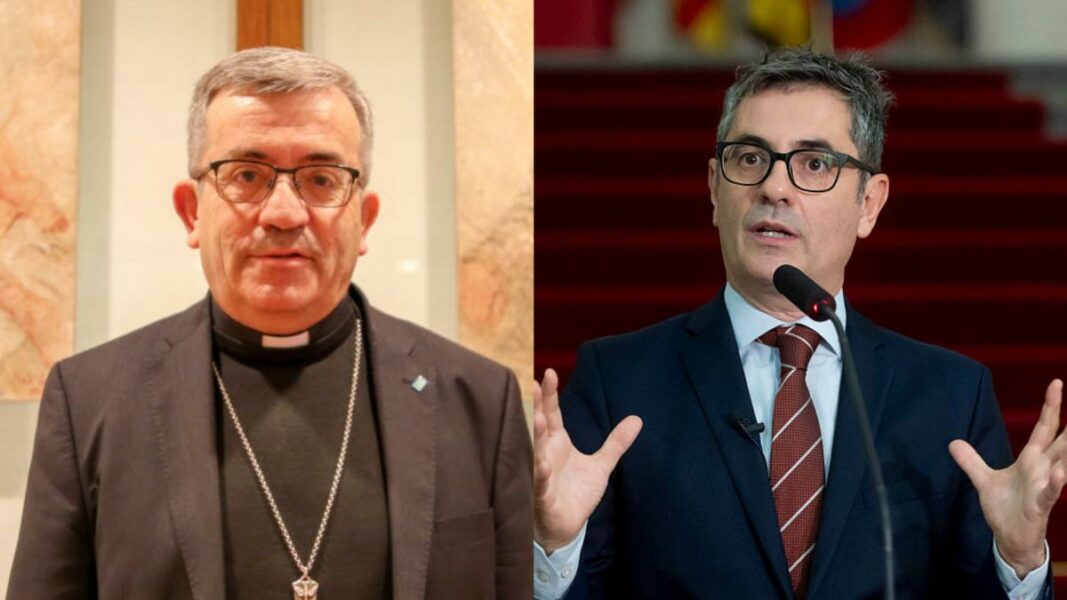
The Minister of the Presidency, Félix Bolaños, has sent a letter to the president of the Spanish Episcopal Conference (CEE) and archbishop of Valladolid, Luis Argüello, in response to the statements the latter made on Thursday at the closing of the Summer School organized by the CEE, the Pontifical University of Salamanca and the Pablo VI Foundation, held at the latter’s Madrid headquarters under the title “The collapse of democracy. The opportunity for a geopolitics at the service of the human being”.
Argüello’s words
During his speech, without notes, Argüello called for the “regeneration” of democratic systems based on a shared “ethical reference” and, citing Saint Augustine—an author invoked, he recalled, by both Leo XIV and Benedict XVI—stated: “When a State forgets ethics it becomes a band of thieves, and I rest my case”.
Immediately afterwards, the prelate qualified the scope of the quotation: “I rest my case, looking at you and at myself. Because, if we have cheated on our tax returns, or asked for an invoice under the table… how can you demand anything from your public representatives? Because ethical principles apply to everyone.”
In the same conference, the president of the bishops criticized liberal democracies for having turned into “welfare democracies” that seek “passive citizens bought with subsidies,” and warned that the State should not “become a secular Caritas that hands out alms.” He also referred to Spanish legislation of the last decade on sex and gender, which he sees as “a project of anthropological deconstruction,” and questioned that “conversion therapies are banned at the same time that affirmative therapies are consolidated.”
Bolaños’s response
Hours later, the Minister of the Presidency sent a letter to the archbishop of Valladolid—first reported by eldiario.es and to which Europa Press has had access—in which he expresses his “surprise” at statements he considers “offensive, both from a personal and institutional point of view,” and describes the prelate’s reasoning as “unjust” and “deeply counterproductive.”
“Allow me to ask you a question. What would you think if a member of the Government described the entire Church as ‘a band of sexual aggressors, I rest my case’? Obviously that would be false and deeply unjust,” the minister writes.
Bolaños states in the letter that in the numerous occasions on which the two have spoken he has “never” engaged in “a disqualification of that magnitude,” and invites the president of the CEE to ensure that relations between the Government and the Church are “marked by moderation, respect and justice rather than by exaggeration and partisanship in favor of the forces of the right and the far right.”
The minister cites as an example of “productive and respectful collaboration” the recent visit of Leo XIV to Spain, which he describes as a “resounding pastoral and social success,” and closes the letter by quoting the Pontiff’s words during that trip: “Those who hold public office have a special obligation to guard the word in order to disarm language.” Bolaños is “convinced” that those words will be able to “inspire” Argüello to “rectify his public statements.”
A disagreement that goes back further
This is not the first exchange of letters between the two. Bolaños had already sent a previous letter to the president of the CEE demanding “political neutrality of the Church,” after Argüello stated in an interview with La Vanguardia that he “would prefer his interlocutor to be different political forces.” Last summer, the archbishop referred to the constitutional mechanisms of a motion of no confidence, a vote of confidence or early elections as a way out of the “institutional deadlock,” although he later denied having entered the political arena and accused the media of “distorting” his words.
Both representatives signed the agreement between the Government and the Church for the reparation of victims of abuse on 30 March.