


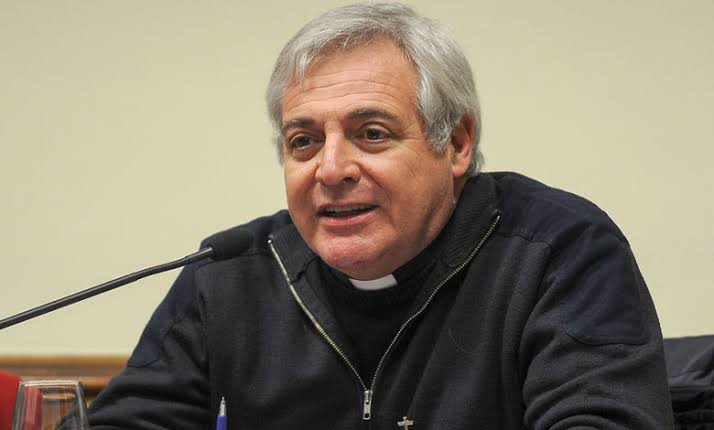
Father Giulio Albanese, a Combonian missionary, advisor to the Secretariat of State and director of Cooperation for the Vicariate of Rome, has offered his interpretation of the homily delivered by Leo XIV during his visit to Lampedusa. In an interview published by La Stampa, the priest states that the Pontiff’s message is not limited to the migration issue, but raises a reflection on the identity of the Church, the evangelizing mission and the responsibility of Christians in the face of human suffering.
According to Albanese, Leo XIV’s preaching places the parable of the Good Samaritan at the center of his message and turns the Mediterranean into a place where humanitarian, political and spiritual questions converge. “In Lampedusa the Gospel is not an idea: it is wounded flesh stretched out at the edge of history,” he says, describing the sea as a space where “the sea of tourists” and that of “shipwrecks, mothers without children and children without graves” coexist.
“Being Catholic does not mean being tribal”
One of the aspects Albanese most insists on is the meaning of the term “Catholic.” In his view, Leo XIV’s homily recalls the universal character of the Church and questions any attempt to identify Catholicism with a particular culture or community.
“Catholic does not mean tribal, Western or coinciding with a particular culture or border,” he states. In his opinion, the term katholikós expresses precisely the opposite: a vocation open to the entire human family.
From this perspective, he maintains that love of God cannot be separated from love of neighbor, and that the latter is not defined by belonging to a specific group, but by the need he presents to whoever encounters him.
The parable of the Good Samaritan
For Albanese, the key to the papal homily lies in the parable of the Good Samaritan. He considers that the Gospel story not only invites the practice of mercy, but also constitutes a wake-up call to those who live the faith.
“The priest and the Levite are not atheists or enemies of the sacred: they are religious men,” he notes. Therefore, he interprets the text as directly challenging the Church itself when it risks losing sight of mercy in the exercise of religion.
In this context, he recalls another of the expressions used by Leo XIV during his visit: “Neighbors are not born: they are made,” an affirmation he interprets as an invitation to approach every person, regardless of their origin or condition.
Universal fraternity and evangelization
During the interview, the priest distinguishes between ecclesial communion and universal fraternity. The first, he explains, is born of baptism and sacramental life; the second is founded on creation, since every person has been created in the image of God.
From this distinction, he maintains that attention to those fleeing war, poverty or persecution is not a secondary activity for the Church.
“Universal fraternity does not replace evangelization: it makes it credible,” he states.
Albanese links this idea to the teaching of Saint John Paul II, recalling that the Church is at the service of the Kingdom of God and that its mission transcends the visible borders of the ecclesial community.
A reflection also on Europe
The advisor to the Secretariat of State likewise considers that Leo XIV’s visit contains a challenge directed at Europe. In his view, the Pope did not merely ask people to be moved by the deaths in the Mediterranean, but to assume a political responsibility capable of responding to that reality.
Albanese acknowledges that the migration issue raises challenges related to security, integration and social sustainability. However, he maintains that this complexity should not become a reason for indifference.
In his opinion, politics is called to transform compassion into institutions capable of protecting the dignity of persons and offering stable responses to those in situations of vulnerability.
A Church open to encounter
In the final part of the interview, Albanese interprets that the Lampedusa homily also constitutes a reflection on the Church’s own life.
“The Church is herself when she goes out and listens; she is sick when she makes an island of herself, confusing prudence with closure,” he states.
In his view, Leo XIV’s message goes beyond the migratory phenomenon to raise a question about the way the Christian community lives the Gospel. “Being Catholic means safeguarding the communion of the Church without restricting human fraternity, proclaiming Christ not against man, but for man,” he concludes.