


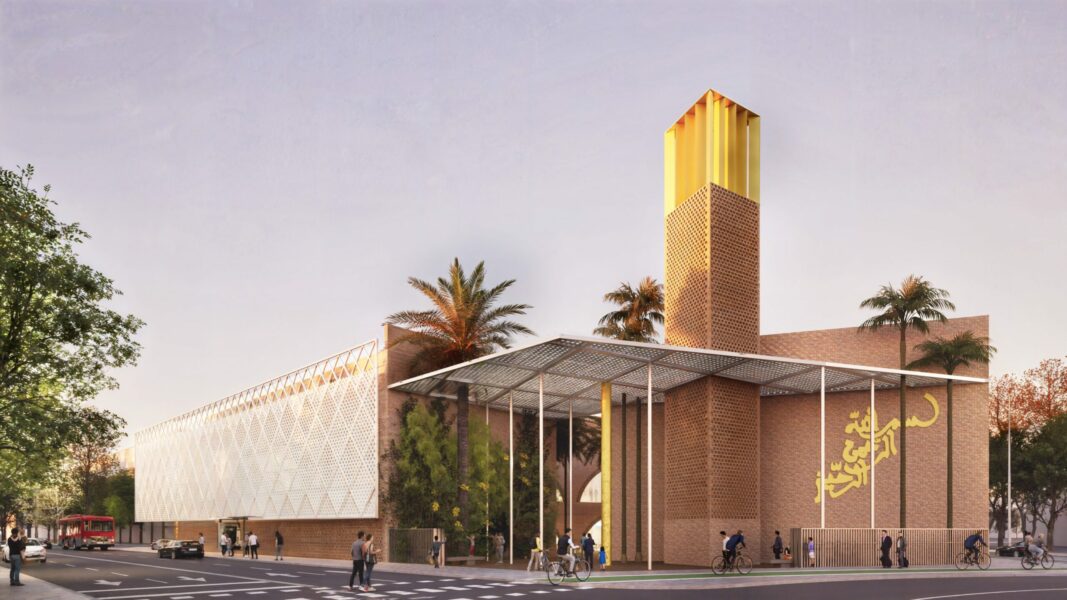
The construction of the first major purpose-built mosque in Seville could take a decisive step this Friday. The Urban Planning Commission of the Seville City Council is scheduled to rule on the building permit for the project promoted by the Fundación Mezquita de Sevilla, an initiative that, after more than two decades of unsuccessful attempts, now faces the final phase of its administrative processing.
The project envisages the construction of an Islamic cultural centre on a private plot of approximately 2,500 square metres located next to the Polígono Sur, between Poeta Manuel Benítez Carrasco and Ronda Nuestra Señora de la Oliva streets, adjacent to Parque José Celestino Mutis.
According to El Confidencial, the approval initially planned for this week had to be postponed due to a computer issue that prevented the file from being put to a vote. The City Council has indicated that the matter will be addressed again at Friday’s meeting.
A complex with mosque, cultural centre and other services
The planned complex will include a mosque with capacity for 400 to 500 people, occupying roughly 20 % of the built surface area. The remainder of the building will house classrooms, meeting rooms, a café, coworking spaces, landscaped courtyards and other cultural and social facilities.
According to ABC de Sevilla, the planned investment exceeds ten million euros and will be funded through private financing. The plot has also been acquired by the Fundación Mezquita de Sevilla itself, in order to avoid the difficulties that thwarted previous projects on publicly owned land.
The foundation’s vice-president, Jalid Nieto, told ABC that the future complex aims to be “a centre open to the city of Seville and to all Sevillians” and stressed that the funding will be “entirely with private funds, without interference from governments.”
The Fundación Mezquita de Sevilla has also published infographics of the future centre, although it notes that the designs are not final and that architectural, decorative and interior details will be defined at a later stage. The design was created by Sevillian architect Guillermo Vázquez Consuegra and envisages contemporary architecture inspired by Andalusian heritage elements, incorporating decorative references to the Giralda and a minaret.
More than twenty years of unfinished projects
The aspiration to build a major mosque in Seville is not new. The first attempt dates back to 2004, when the City Council approved the transfer of a plot in the Los Bermejales neighbourhood for the construction of an Islamic temple.
The initiative was never carried out due to neighbourhood opposition and a subsequent ruling by the High Court of Justice of Andalusia. Other sites were later considered, including Santa Bárbara and Pino Montano, which also failed to materialise.
Currently, the Muslim community has around thirty oratories spread across various neighbourhoods of Seville, most of them housed in commercial premises or adapted industrial units, but there is no purpose-built building dedicated specifically to this purpose.
Political debate surrounding the project
The processing of the file has reopened the political debate in Seville City Council. The Vox parliamentary spokesperson, Manuel Gavira, stated that his party will “do everything possible” to halt the project, arguing that it favours the expansion of Islam in the city. The municipal group has also questioned the timeliness of the initiative and has requested greater public information on the file.
For its part, the Fundación Mezquita de Sevilla maintains that the project complies with urban planning regulations and recalls that it is an initiative promoted entirely by a private entity on private land. The organisation also argues that the complex is intended to serve as a space for worship, education and cultural activity for Seville’s Muslim community.
A city marked by its religious history
During the Islamic period, Isbiliya had two major mosques, of which vestiges still remain: the remains of the courtyard of the former great mosque, integrated into the Church of the Saviour, and the Giralda, the former minaret of the Almohad great mosque, later incorporated into the Cathedral after the city’s reconquest by Ferdinand III in 1248.
If the Urban Planning Commission grants the permit, the Polígono Sur project will become the first major purpose-built mosque to complete its administrative processing at present.