


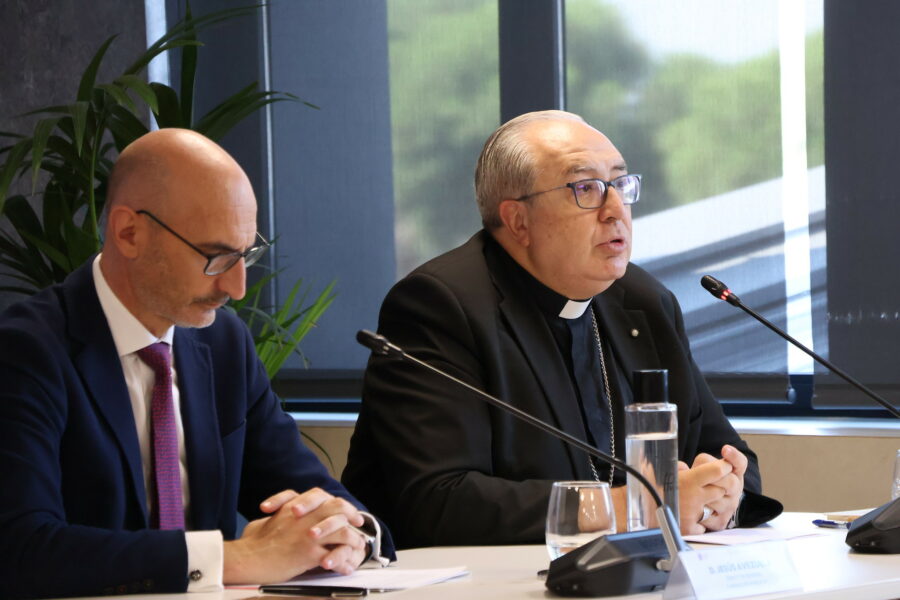
Msgr. Francisco César García Magán has warned that some discourses on immigration, even when they come from people who consider themselves members of the Church, are difficult to justify from the Gospel and the Social Doctrine of the Church.
The secretary general of the Spanish Episcopal Conference made this statement during the inauguration of the Summer School organized by the Spanish Episcopal Conference, the Pontifical University of Salamanca and the Pablo VI Foundation, which is being held from July 7 to 9 in Madrid under the motto “The collapse of democracy. The opportunity for a geopolitics at the service of the human being”.
Reflecting on the centrality of human dignity in political life, García Magán recalled one of the ideas expressed by Leo XIV during his recent apostolic journey to Spain: “A person is more important than the passport they carry.” From that statement, he made an explicit reference to the migration debate.
“Certain positions, certain discourses or certain comments, which are supposedly made from within the Church, or rather, by people who call themselves members of the Church, are difficult to justify from the Gospel and the Social Doctrine of the Church,” he stated, specifying that he was referring “to the issue of migration and to the issue of welcome and the defense of the dignity of all human beings.”
“Experiments against democracy ended very badly”
During his intervention, the secretary general of the CEE also warned of the growing questioning of representative democracy both in Spain and in other countries.
In his view, “siren songs” are proliferating that propose replacing the current democratic system with other models of political organization, forgetting the lessons of history.
“Throughout history, when there have been experiments of this kind, whether from one side or the other, they have generally ended badly. In Europe we have witnessed experiments that concluded in a very dangerous way for the dignity of the human person,” he noted.
Recovering politics as an exercise of charity
García Magán explained that the Summer School aims to take up one of the main teachings of Leo XIV during his visit to Spain: recovering politics as service to the common good and once again placing the person at the center of public life.
“The center of political life, the center of social life and the center of democracy is the human being,” he affirmed, also claiming “the ethical and good character of the political vocation” and recalling that Paul VI, John Paul II, Francis and Leo XIV have defined politics as “an exercise of social charity.”
The Social Doctrine of the Church, a pending subject
The secretary general of the Episcopal Conference also lamented the scant knowledge that exists of the Social Doctrine of the Church even within ecclesial circles.
García Magán went so far as to describe it as “the poor relative” of ecclesial magisterium and called for greater commitment both from the lay faithful and from priests to study and spread this doctrinal heritage, especially regarding the presence of Christians in public life and the promotion of the common good.
A program focused on the challenges of current democracies
The Summer School program will continue over the coming days with lectures and round tables dedicated to issues such as liberal democracy, the rise of populism, political polarization, geopolitics, the presence of Christians in public life and the contribution of the Social Doctrine of the Church to the common good. Topics such as digital democracy, social friendship, the crisis of multilateralism and the ethical and anthropological challenges facing Western societies will also be addressed.
Among the participants are the apostolic nuncio in Spain, Msgr. Piero Pioppo; the philosopher Victoria Camps; former minister José Manuel García-Margallo; academic Gustavo Beliz; the bishop of Mondoñedo-Ferrol, Msgr. Fernando García Cadiñanos; and the president of the Spanish Episcopal Conference, Msgr. Luis Argüello, who will deliver the closing lecture entitled “The response of democracies to the ethical and anthropological challenges of society”.