


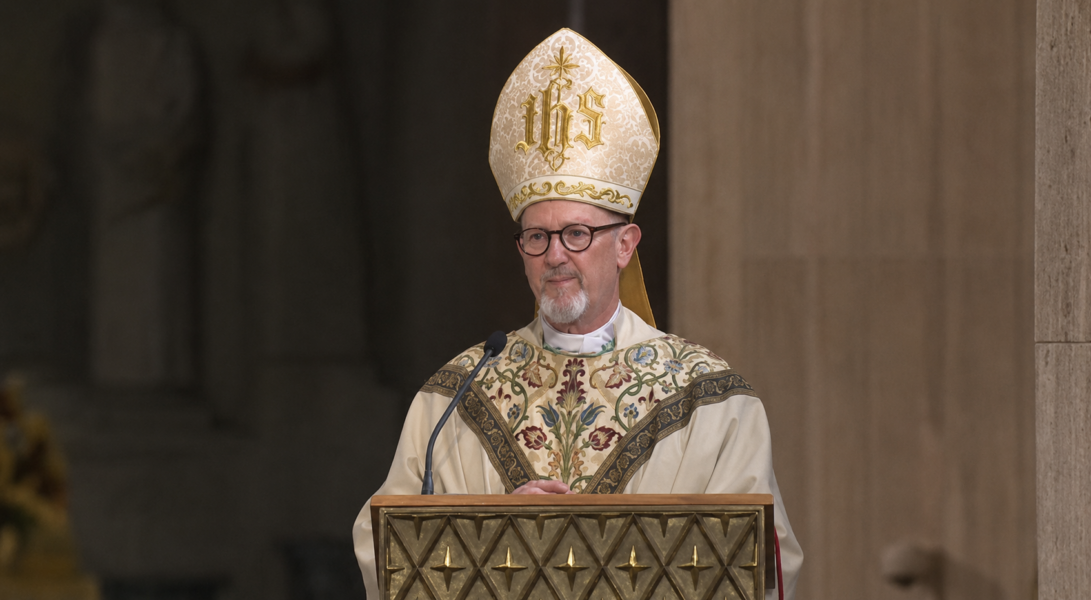
Bishop James Conley, of the U.S. diocese of Lincoln (Nebraska), has defended the growing interest in the traditional liturgy among the new generations and has encouraged the faithful drawn to the Vetus Ordo to remain in full communion with the Church, avoiding attendance at celebrations of the Priestly Fraternity of Saint Pius X (FSSPX).
In an interview given to the program EWTN News In Depth, the prelate addressed both the role of the Priestly Fraternity of Saint Peter (FSSP) and the announcement of the episcopal consecrations planned by the FSSPX, which Rome has warned would provoke a schism.
“Young people seek reverence and transcendence”
Conley explained that the FSSP has maintained close collaboration with the diocese of Lincoln for more than twenty-five years, where the fraternity’s North American seminary and a parish dedicated exclusively to the celebration of the traditional Mass are located.
Far from presenting the coexistence of both forms of the Roman rite as a source of tensions, the bishop assured that there is a relationship of full collaboration between the diocesan seminaries and priests and those of the fraternity.
“There has been great harmony and a kind of mutual enrichment between those who prefer the traditional Mass and those who prefer the ordinary form. There is no tension between the two,” he stated.
According to Conley, the appeal of the traditional liturgy responds above all to a spiritual search among the new generations.
“There is a resurgence of interest in everything traditional, especially among young people. I see it in my own diocese. They seek reverence, they seek transcendence, they seek beauty in the liturgy,” he affirmed.
“One cannot attend the FSSPX”
Asked about the announced episcopal consecrations of the Fraternity of Saint Pius X without a pontifical mandate, the bishop was categorical.
“It is very sad because, in the history of the Church, whenever there is an episcopal ordination without a papal mandate, a schism occurs. It always causes a rupture, a division,” he stated.
Conley recalled the effort made by Benedict XVI to restore dialogue with the fraternity after lifting the excommunications of the four bishops consecrated by Marcel Lefebvre in 2009, and lamented that the FSSPX has ultimately decided to proceed with new consecrations.
“An act like this clearly breaks the apostolic bond with Peter,” he added.
The bishop also agreed with the recent statements of Cardinal Gerhard Müller, who had affirmed that Catholics should not participate in Masses celebrated by priests of a community that places itself in a situation of schism.
“I agree with His Eminence. Simply put, one cannot attend,” Conley responded.
More priests to celebrate the traditional liturgy
For the bishop of Lincoln, the solution does not consist in the faithful seeking communities separated from Rome, but in increasing the availability of traditional celebrations within full ecclesial communion.
He recalled that, in addition to the presence of the Priestly Fraternity of Saint Peter, there are diocesan priests in his diocese authorized by the Holy See to regularly celebrate Mass according to the 1962 Missal.
He also highlighted that the FSSP seminary maintains around ninety seminarians each year and ordains a dozen new priests, which will make it possible to meet the growing demand of the faithful interested in this liturgical form.
“The goal should precisely be this: to respond to the needs of those who desire this form of the Mass. People should not feel obliged to attend a community or a priest who has broken with Peter,” he maintained.
“The Novus Ordo is also becoming more traditional”
Five years after the promulgation of Traditionis custodes, Conley stated that he perceives an evolution in the way the ordinary form of the Roman rite is celebrated.
A member of the board of directors of the Benedict XVI Institute for Sacred Liturgy, the bishop considers that a more traditional sensibility is growing even among those who habitually celebrate the Novus Ordo.
“I think we are seeing a trend toward a more traditional celebration even in the Novus Ordo, and I think that is a good thing,” he affirmed.
In this context, he encouraged the faithful who desire a more solemn liturgy not to lose patience.
“Do not abandon the Church or jump ship. I think there are many reasons for hope,” he concluded.