


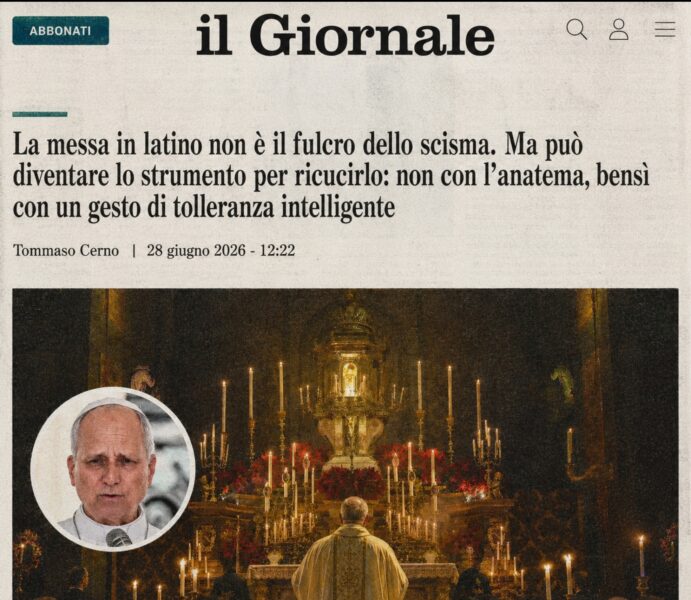
Il Giornale, one of Italy’s leading daily newspapers, published an opinion piece on 28 June by journalist Tommaso Cerno entitled «La svolta pop della liturgia delle origini: perché il futuro parla latino» («The Pop Turn of the Liturgy of the Origins: Why the Future Speaks Latin»). The text argues that the return of the Latin Mass, far from being a step backward, could serve as a way to mend the rift with the Lefebvrian world.
Cerno starts from what he sees as a persistent misconception: the notion that Latin represents “the museum” and vernacular languages “the path to the future.” In his view, the context has changed since the Second Vatican Council:
«In the days of Vatican II, people were emerging from the inaccessible: the faithful wanted to understand. Today they live on codes, acronyms, formulas, memes: mystery does not frighten, it attracts. What if Latin, instead of being “obscure,” became pop? A language that belongs to no one and that, paradoxically, can therefore belong to everyone.»
The author links this appeal to a demand he attributes mainly to younger generations:
«Many young people are not looking to “understand everything”: they seek to experience something that has not already been pre-digested. An experience less like a neighborhood assembly and more like a true rite: few speak, many listen; meaning is conveyed through the body, through rhythm, through silence.»
On the ecclesial level, Cerno distinguishes between the liturgical question and the doctrinal one. He recalls that «Lefebvre’s schism was not merely a liturgical dispute: it was a short-circuit of authority, identity and fear of change», and that the 1988 episcopal consecrations and the excommunications «are still there.» From this distinction he formulates his proposal:
«Why not send a signal to those who want the Latin Mass and wish to remain faithful to the Pope? Removing restrictions for the “loyal” would not be a reward for nostalgia, but an investment in communion.»
The article concludes by qualifying the scope of the proposal and summarizing its thesis:
«The Latin Mass is not the crux of the schism. But it could become the instrument to mend it: not with anathema, but with a gesture of intelligent tolerance. Tradition as fuel, not as a fetish.»
The full text can be read on the Il Giornale website.