


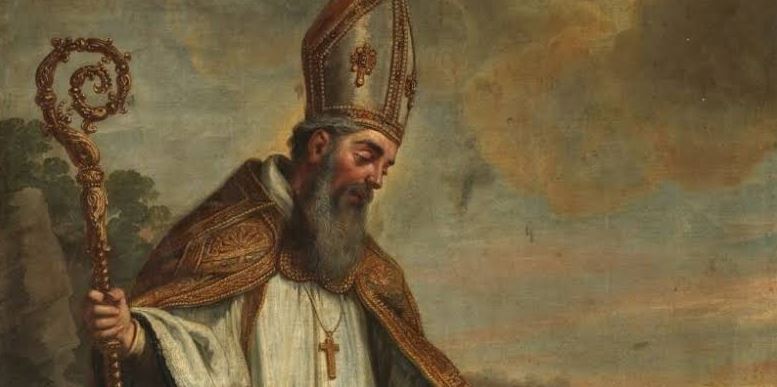
Two previously unknown sermons by Saint Augustine of Hippo have been identified in a twelfth-century manuscript preserved in Poland, a discovery that expands the corpus of writings by one of the most influential Church Fathers in the West. According to reports from the University of Würzburg and various specialized media outlets, the new texts address a particularly enigmatic passage from the Old Testament: King Saul’s consultation with the medium of Endor, narrated in the First Book of Samuel.
The discovery was made by Professor Christian Tornau, a Latinist at the University of Würzburg (Germany), who is already working with specialists from the Corpus Scriptorum Ecclesiasticorum Latinorum (CSEL) on the critical edition of the sermons, scheduled for publication at the end of 2026.
A twelfth-century manuscript concealed two unknown works
The research began in 2024, when the Bad Doberan Monastery Association requested Tornau’s collaboration to study a medieval manuscript that originally belonged to that German abbey and is now preserved at the monastery of Pelplin in Poland.
The codex contains six sermons attributed to Saint Augustine of Hippo. However, a detailed analysis confirmed that two of them had never been identified by specialists.
“Two of the six sermons are previously unknown writings by Saint Augustine,” Tornau explained when announcing the discovery.
Saint Augustine reflects on the medium of Endor
The two recovered sermons focus on one of the most debated episodes in Sacred Scripture: King Saul’s visit to the medium of Endor before the battle against the Philistines.
The biblical account describes how Saul, failing to receive an answer from God, turns to a necromancer to summon the prophet Samuel. For centuries, this scene has raised a far-reaching theological question: whether Samuel truly appeared by an extraordinary permission of God, or whether the entire event was of a demonic nature.
According to Tornau, this very question lies at the heart of both sermons.
“How can a necromancer invoke the spirit of a prophet? This raises the problem of theodicy: how can an omnipotent God permit such a thing, or is He not truly omnipotent?” the researcher summarizes.
The first sermon was delivered during the Sunday liturgy and concludes by presenting the various possible interpretations. The second, preached the following Wednesday, develops and confronts those explanations without imposing a single answer.
A characteristic method of the Bishop of Hippo
According to Christian Tornau, this approach of presenting several interpretations before reaching a conclusion reflects one of the distinctive features of Saint Augustine’s pedagogical method.
“The style, the humor, and the content clearly indicate that the sermons were genuinely written by Saint Augustine,” the German professor stated.
For the researcher, the value of these texts lies not only in their documentary novelty but also in the deeper insight they provide into how the Bishop of Hippo taught his faithful and addressed complex questions of biblical interpretation.
Authenticity subjected to examination
The authenticity of the sermons underwent an especially rigorous review because, in the past, some writings attributed to Saint Augustine turned out to be forgeries.
For this reason, Tornau and specialist Clemens Weidmann gathered around twenty experts in patristic Latin literature in Vienna to analyze the texts. After studying the language, style, and content, the specialists unanimously concluded that both sermons truly belong to the Doctor of the Church.
The researchers believe that the twelfth-century manuscript probably derives from a much older copy preserved at Amelungsborn Abbey in Lower Saxony. However, the destruction of that library during the Thirty Years’ War prevents absolute confirmation of this origin.
A new contribution to the legacy of one of the great Church Fathers
Christian Tornau has acknowledged that the discovery does not match the magnitude of the one made in Mainz in 1990, when thirty previously unknown writings of Saint Augustine came to light. Nevertheless, he considers that the addition of these two sermons represents a significant contribution to the knowledge of one of the fundamental figures in Christian theology.
Saint Augustine of Hippo (354–430), bishop, philosopher, and Doctor of the Church, exerted a decisive influence on the formation of Western Christian thought. Works such as The Confessions and The City of God continue to be essential references for Catholic theology, philosophy, and spirituality. The emergence of new authentic texts, even if exceptional, therefore constitutes an event of notable interest for patristic studies and for understanding the doctrinal tradition of the Church.