


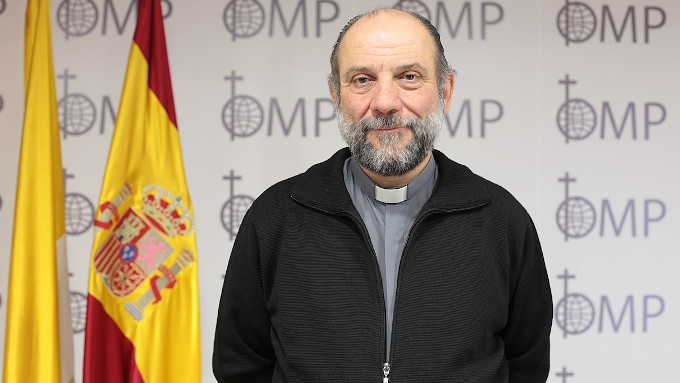
«The Pontifical Mission Societies are not an NGO». With this statement, the national director of OMP Spain, José María Calderón, wanted to underline this Thursday the identity of the institution when presenting the Activity Report for 2025. Beyond the figures, he insisted that the mission of OMP consists in sustaining the evangelization of the Church in mission territories and in reminding that all the baptized are called to take part in it.
The presentation of the Report began with a message of closeness and prayer for the victims of the earthquake that has shaken Venezuela. Next, Calderón presented the main data of the activity carried out during the past year in the areas of awareness-raising, formation, support for missionaries and economic cooperation.
Spain continues to be one of the great supporters of the missions
During 2025, the faithful in Spain contributed 15,638,883.03 euros to the Pontifical Mission Societies, an amount that is making it possible to sustain 1,119 projects in mission territories.
Thanks to this collaboration, Spain continues to be the second country in the world, only behind the United States, in financial contributions to the Church’s missions.
However, Calderón wanted to prevent these figures from being interpreted solely in economic terms.
«We help those parts of the Church that need support, but not only as a work of charity, but so that all the faithful feel co-responsible for the mission and make it possible for the proclamation of the Gospel to reach everyone», he explained.
Nearly 10,000 Spanish missionaries are proclaiming the Gospel today
The Report also highlights another of the great strengths of the Spanish Church: its 9,842 missionaries, present on the five continents.
«We cannot forget our missionaries», Calderón stated, recalling that their work constitutes one of the main faces of the Church’s presence in the 1,131 mission territories around the world.
The director of OMP insisted that evangelization «depends on everyone» and underlined the effort the institution makes to awaken missionary awareness among Spanish Catholics through the various campaigns it organizes each year.
Catechists and laypeople, protagonists of the mission
During his intervention, Calderón also focused on those who daily sustain the life of many Christian communities.
He especially highlighted the work of catechists, whom he described as authentic references for their peoples and communities.
«They reach places where priests often cannot reach and keep alive the faith of those around them», he noted.
He also highlighted the growth in the number of laypeople who leave as missionaries, a reality that is making it possible to continue the evangelizing presence of the Church where many religious congregations today have fewer members due to the aging of their communities.
Fifty years of mission in Chad
The presentation concluded with the testimony of the Comboni missionary Alejandro Canales, who has dedicated nearly fifty years to the first evangelization in Chad, one of the poorest countries on the African continent.
He recalled that his first years were devoted to learning the language, culture and customs of the people to whom he had been sent, convinced that only from that knowledge was it possible to authentically proclaim the Gospel.
«I came to understand the people, their culture and their language», he explained.
With emotion, he took stock of a lifetime dedicated to mission.
«I can only give thanks to the Lord for this adventure that began when I was young and that has grown over the years», he stated.
When he arrived in Chad, the Church was barely beginning to take root in that region. Today there are already eight parishes, the fruit of decades of evangelizing work. «Our goal has always been to bring the Gospel in depth», he concluded.
The Report presented this Thursday shows the weight that Spain continues to have in the universal mission of the Church. Behind the economic figures are thousands of priests, religious brothers, religious sisters and laypeople who proclaim the Gospel in places where the Christian presence is barely beginning to take root and where the support of the whole Church remains indispensable for sustaining the mission.