


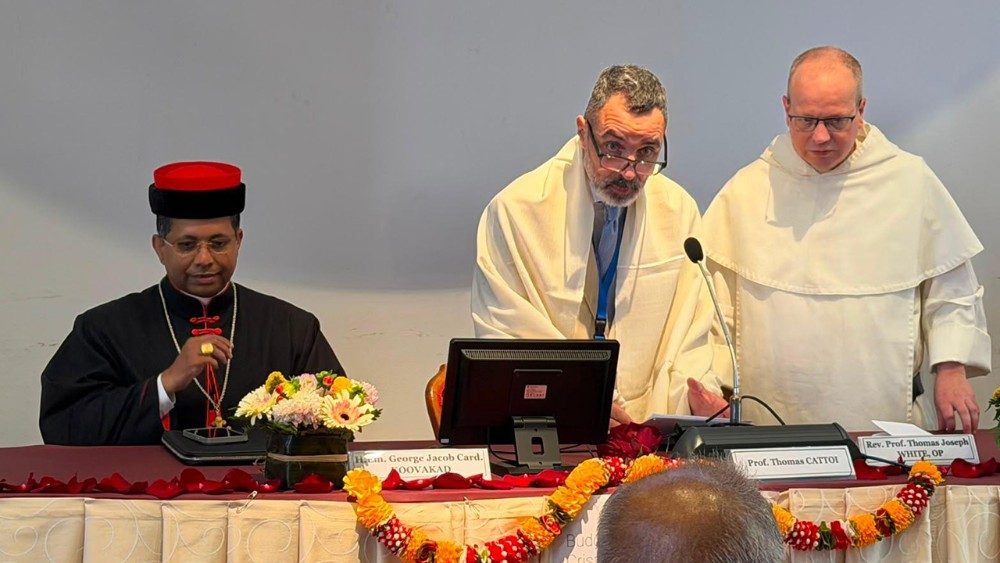
The Dicastery for Interreligious Dialogue has brought together in Rome representatives of Christianity and various Eastern religions present in Europe to reflect on coexistence among religious communities and the possibilities for cooperation in different social spheres. The meeting is part of the interreligious dialogue policy promoted by the Holy See in recent decades.
The conference was held on June 23 and 24 at the Pontifical University of Saint Thomas Aquinas (Angelicum) under the theme “Buddhists, Christians, Hindus, Jains and Sikhs in Europe: Building Fraternity through Dialogue and Collaboration”.
An initiative of the Dicastery for Interreligious Dialogue
According to the Vatican, the meeting brought together religious leaders, academics and researchers belonging to Christianity and the Buddhist, Hindu, Jain and Sikh traditions.
The initiative is part of the activities promoted by the Dicastery for Interreligious Dialogue with the aim of strengthening relations among the various religious communities present in Europe and fostering spaces for cooperation in the face of common social challenges.
The sessions took place in a climate “of respect, mutual listening and openness,” allowing participants to exchange experiences and reflect on the challenges currently facing European societies.
Koovakad: “fraternity” is not a utopian idea
Cardinal George Jacob Koovakad, Prefect of the Dicastery for Interreligious Dialogue, opened the meeting. In his address, he argued that “fraternity” among believers of different religions should not be seen as an abstract or unattainable ideal, but as a reality that can be built through mutual knowledge and concrete collaboration.
He explained that the growing religious diversity in Europe poses new challenges for the continent’s societies. In light of this reality, he maintained that dialogue among religious communities can help foster coexistence and reduce tensions in increasingly plural contexts.
Koovakad also stressed that interreligious dialogue does not mean abandoning one’s own religious convictions. On the contrary, he stated that encountering people from other traditions can help deepen one’s own identity and better understand the beliefs of others.
Europe, scene of growing religious diversity
During the conference, it was highlighted that Europe is undergoing an increasingly visible religious and cultural transformation. The organizers noted that the growing presence of Buddhist, Hindu, Jain and Sikh communities is part of the new European religious landscape and requires new forms of relationship among believers of different traditions.
In this context, the meeting addressed issues related to religious freedom, social cohesion, peaceful citizenship and the possibilities for cooperation among religious communities.
Participants also analyzed the role that religions can play in the face of phenomena such as social fragmentation, cultural tensions and the loss of common references in broad sectors of European society.
Interreligious dialogue as a tool for coexistence
Participants stressed the importance of dialogue and cooperation among believers to foster mutual understanding, solidarity and hope.
The text also states that “fraternity” is a fundamental element for building cohesive and peaceful communities, especially in societies marked by growing cultural and religious diversity.
Attendees also argued that believers can contribute to the well-being of society through concrete initiatives aimed at promoting peace, social harmony and mutual assistance, without renouncing the convictions proper to each religious tradition.
Commitment to new collaborative initiatives
Finally, participants reaffirmed their commitment to a “culture of encounter” and to strengthening collaboration among religious communities present in Europe.
They also expressed their hope that such initiatives will help promote “fraternity,” peaceful coexistence and cooperation for the common good—objectives that were central to much of the reflections developed during the two days held in Rome.