


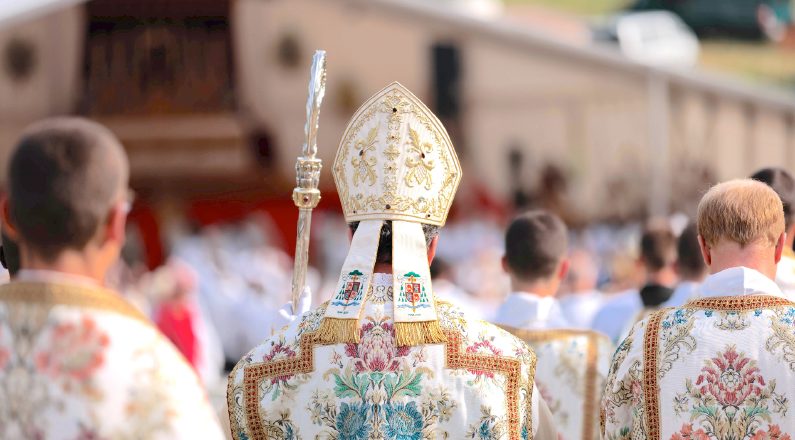
The Priestly Fraternity of Saint Pius X (FSSPX) will celebrate the consecration of new auxiliary bishops on 1 July in Écône, a ceremony that has aroused interest in various ecclesiastical circles both because of its significance for the Fraternity and the particular canonical situation that continues to mark its relations with the Holy See. With a view to this event, Father Nicolas Cadiet has published a detailed explanation of the ancient rite of episcopal consecration that will be used during the ceremony.
The celebration will follow, according to Cadiet, the 1962 Roman Pontifical in its entirety, preserving a ceremonial that is scarcely seen today in the ordinary life of the Church and that reflects a liturgical tradition developed over the centuries.
The incorporation into the episcopal college
Episcopal consecration represents the fullness of the sacrament of Holy Orders and the incorporation of a new bishop into the college of the successors of the Apostles. For this reason, the tradition of the Church provides for the participation of three bishops in the ceremony: a principal consecrator and two co-consecrators.
Before the Mass begins, the rite includes the reading of the apostolic mandate and a public examination of the candidates. During this interrogation, the future bishops profess the Catholic faith and express their willingness to assume the responsibilities proper to the episcopal ministry.
Although historically the election of bishops took various forms in the life of the Church, the reading of the pontifical mandate became over time an essential element of episcopal consecration ceremonies.
The central moment of the consecration
After the Mass has begun, the ceremony follows its usual course until after the Alleluia. It is then that the rites proper to episcopal ordination begin.
The consecrating bishop briefly recalls the functions of the episcopate: to teach doctrine, to govern the Christian people, to administer the sacraments and to safeguard the life of the Church.
The Litany of the Saints is then sung, invoking the intercession of the entire heavenly Church upon the candidates.
Cadiet recalls that one of the most characteristic gestures of the traditional rite is the placing of the Book of the Gospels upon the head and shoulders of the future bishops. This gesture symbolises that their entire life and ministry must be conformed to the Gospel they are called to proclaim.
While the Evangeliary remains upon them, the three bishops lay hands on them, pronouncing the words «Accipe Spiritum Sanctum» («Receive the Holy Spirit»). Together with the consecratory prayer, this gesture constitutes the sacramental core of episcopal ordination.
The anointing and the symbols of the episcopate
After the laying on of hands, the ceremony continues with the anointing of the heads of the new bishops with the Holy Chrism while the hymn Veni Creator Spiritus is sung.
The consecratory prayer asks for them the virtues necessary for the exercise of their ministry: fidelity in preaching, apostolic zeal, prudence in governance and strength to guide the faithful.
Subsequently, the anointing of the hands and the presentation of the principal episcopal insignia also take place.
The crozier symbolises the pastoral mission of leading the people of God. The ring represents the spiritual bond between the bishop and the Church, while the Book of the Gospels recalls the obligation to transmit Christian doctrine faithfully.
These rites outwardly express the mission that the Church entrusts to those who receive the fullness of the priesthood.
The concelebration and the enthronement
Once the consecration is completed, the new bishops join the consecrator in the continuation of the Mass.
The traditional liturgy provides that they all consecrate one and the same host and one and the same chalice, visibly underscoring the unity of the episcopal priesthood.
After the final blessing they receive the mitre and other pontifical vestments, and are then enthroned in a ceremony that symbolises the pastoral authority received.
The celebration concludes with the singing of the Te Deum, the blessings imparted by the new bishops and various traditional gestures of gratitude towards the consecrating bishop.
A ceremony marked by tension with Rome
The consecrations scheduled for 1 July will take place amid growing tension between the Priestly Fraternity of Saint Pius X and the Holy See.
The Prefect of the Dicastery for the Doctrine of the Faith, Cardinal Víctor Manuel Fernández, stated in April that he already has a decree prepared in the event that the Fraternity proceeds with the consecrations. Subsequently, Leo XIV publicly urged the FSSPX to desist from this step and issued an appeal to preserve ecclesial communion: «Do not do this. Let us try to live the communion of the Church».
One week before the ceremony, the Fraternity continues its preparations with no public indication of a reversal. The event in Écône will be observed with particular attention both in Rome and in traditional circles, in view of the possible canonical consequences that could arise from its celebration.