


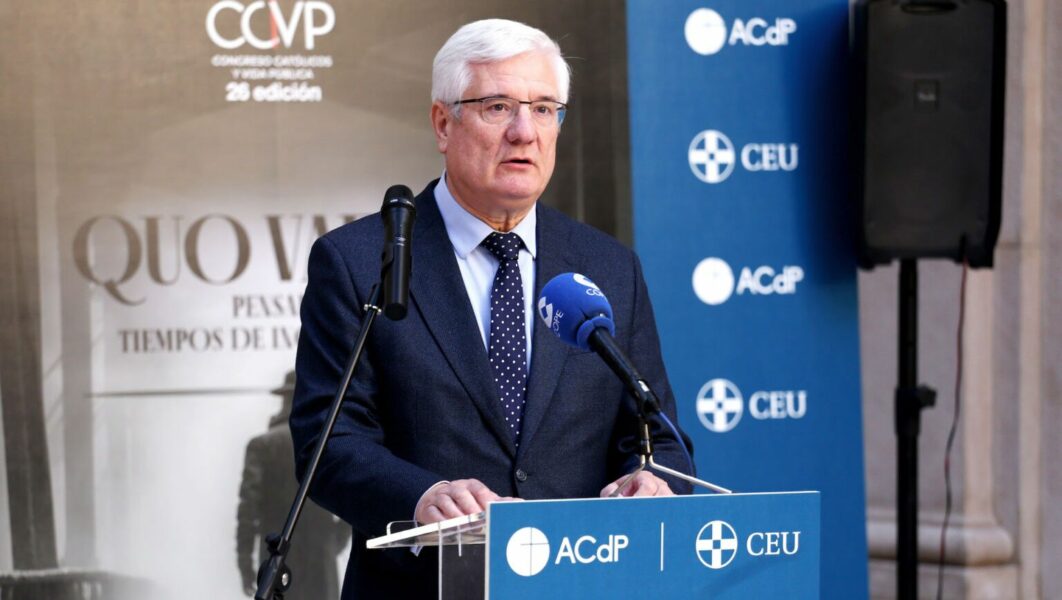
A month after this outlet first reported on the internal movement within the Asociación Católica de Propagandistas to succeed Alfonso Bullón de Mendoza, the picture is beginning to clear. And the conclusion, according to sources familiar with the process, is less epic than some had hoped: there is no grand battle of models, nor a decisive doctrinal dispute, nor a clear alternative regarding the future of the ACdP. Above all, there is a fight over names, internal balances and the distribution of power.
Bullón’s succession is inevitable. The current president cannot run again after having exhausted the two statutory terms. The Extraordinary General Assembly is scheduled for 18 July and, barring a surprise, will have to choose between four candidates: José Masip, Rafael Rodríguez-Ponga, Juan Carlos Hernández Boades and Raúl Mayoral.
The key, according to the sources consulted, is that José Masip would be the candidate chosen by Alfonso Bullón to ensure an orderly transition. It would not, however, have been the outgoing president’s first ideal choice. Within the ACdP it is noted that Bullón would initially have preferred Elío Gallego, but that Bullón believed—rightly or wrongly—that the latter had no real chance of winning. In that scenario, Masip would have become the viable candidate to preserve the continuity of the stage now coming to an end.
Masip thus appears as the man of the possible succession. Not necessarily as the candidate of a new project, but as the formula to prevent the system built over these years from blowing up. His candidacy conveys continuity, knowledge of the house and the ability to gather sufficient support in an election that, for now, does not appear to be marked by major substantive debates.
The case of Rafael Rodríguez-Ponga confirms that impression. Although he may initially have presented himself as an alternative with a more political and institutional profile, internal sources significantly downplay that difference. “They are the same,” summarises one voice familiar with the process. The dispute between Masip and Rodríguez-Ponga would therefore not be a confrontation over what the ACdP should be in the coming years, but over who should preside over it.
The point is relevant because it neutralises the reading of an ideological election. Masip and Rodríguez-Ponga would not represent two incompatible models regarding the CEU, the public presence of the Association or El Debate. The difference would lie more in the individuals, in the networks of support and in the ambitions of each sector than in a genuine alternative of direction.
The case of Juan Carlos Hernández Boades is different. The Sevillian and former director general of the CEU in Andalusia, his candidacy is indeed read in internal sectors as an option for rupture, or at least as an attempt at a sharp turn. The sources consulted link him to the possibility of returning to earlier stages of the ACdP, those of Romero and Caramelo, interpreted by those sectors as a time much more tilted toward internal left-wing positions and a loss of the current profile.
But Boades, according to the same sources, would have hardly any chance of winning. His candidacy serves to shake up the board, recall grievances and express a certain discontent, but it does not appear to have enough strength to secure the presidency. In practice, his role may end up being more testimonial than decisive, unless a highly fragmented result allows him to condition some subsequent negotiation.
The fourth candidate, Raúl Mayoral, continues to occupy a peculiar position. Documentation of his candidacy has already circulated in which he presented himself with a strong associative and spiritual emphasis, insisting on the need to recover the “supernatural spirit” of the propagandists. But within the ACdP several interpret his candidacy not so much as an operation to win, but as a manoeuvre to be present in the subsequent distribution.
According to internal sources, Mayoral would be “stirring things up” to assert himself in a possible second round or in a later negotiation with the candidate who has the best chances. The objective, according to that reading, would be to secure a relevant position in the new stage, especially the general secretariat. It would not be so much about reaching the presidency as about demonstrating sufficient strength for the future president to have to take him into account.
The overall picture leaves an election more boring than expected. There are four candidates, but not four projects. There are internal movements, but no deep discussion about the role of the ACdP in the Church and in Spanish society. There are legitimate ambitions, personal calculations, old wounds and territorial balances, but little visible programmatic substance.
And amid all this appears the great question that most worried people both outside and inside the Association: El Debate. The outlet relaunched under Bullón’s mandate has become one of the central pieces of the ACdP’s public presence. Its future was, in theory, one of the great unknowns of the succession. In practice, according to the sources consulted, Bieito Rubido can rest easy.
The prevailing impression is that, whoever wins among the candidates with real chances, the El Debate project is not threatened. Neither Masip nor Rodríguez-Ponga appear to represent a break with the outlet. And Boades, who could indeed imply a deeper change of orientation, would not have enough strength to impose himself. The result is clear: El Debate would continue to have its position, its budget and its role within the ACdP structure guaranteed.
Bullón’s succession may alter names, positions and internal balances, but it does not appear to call into question the journalistic project that has been consolidated in these years. In other words: the battle may be intense inside the Association, but it does not threaten the material pillars of the newspaper.
The 18 July election thus points to continuity with nuances. Masip would be the organic continuity blessed by Bullón in the absence of viability for other profiles. Rodríguez-Ponga would compete on very similar ground, more for leadership than for model. Mayoral would seek strength to negotiate his place in the new stage. Boades would embody a possible pendulum swing, but without real options of carrying it out.