


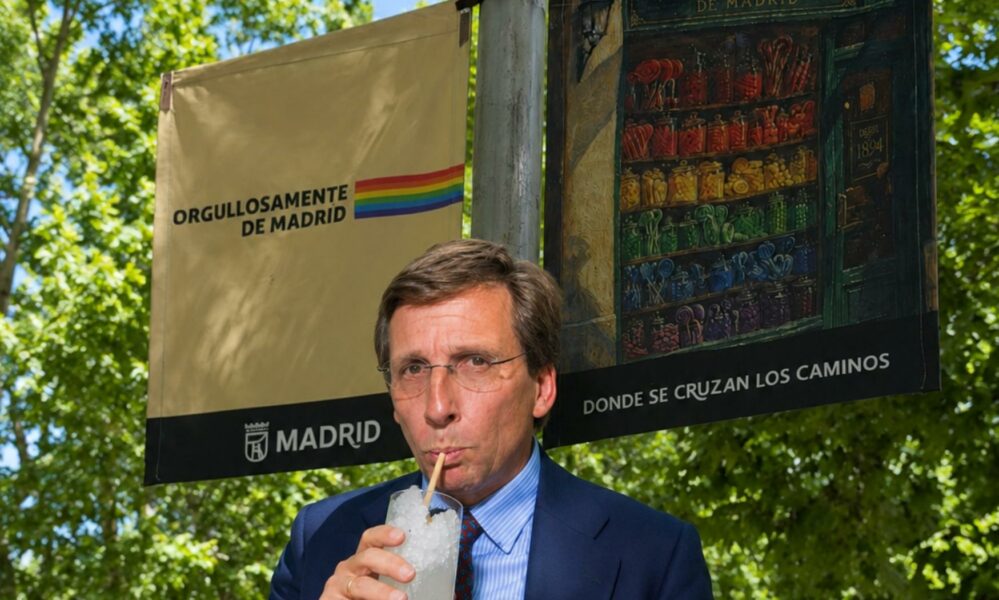
Madrid took exactly two weeks to go from proudly displaying the image of the Successor of Peter to filling its streets with LGBT Pride symbolism. The same lampposts that announced the visit of Leo XIV now show an institutional campaign that publicly celebrates a vision of sexuality and the human person incompatible with Catholic doctrine.
This is not an aesthetic anecdote or a simple succession of advertising campaigns. It is a political, cultural, and moral contradiction that deserves to be pointed out.
Because cities speak through their symbols. And symbols reveal what a society considers worthy of promotion.
The Pope as an Institutional Photograph
In the days leading up to the visit of Leo XIV, Mayor José Luis Martínez-Almeida did not spare praise for the Pontiff.
He described him as a “moral compass for the times we live in”. He recalled with emotion the private audience he had with him. He recounted the advice he personally received from the Holy Father: “Be courageous,” “never betray your principles,” and “dignity and life must always be defended.”
Excellent words.
The question is how long they last.
Because admiration for the Pope is easy when it translates into photographs, official receptions, and institutional statements. What is truly difficult is accepting the public consequences of what he teaches.
Recent European history is full of political leaders who praise the Pope when he speaks of peace, solidarity, or fraternity, but who are far less enthusiastic when the Church recalls the truth about marriage, the family, human life, or sexuality.
It is the old temptation of turning the Pontiff into a decorative figure: venerating his image while ignoring his message.
Two Incompatible Visions
Defenders of these campaigns usually present the matter as a question of coexistence between different sensibilities.
But that is not the problem.
The Church does not teach that there are two equally legitimate visions of human sexuality between which each citizen may freely choose. The Church holds that there is a truth about man inscribed in his very nature and that certain behaviors objectively depart from that order.
That is why the contradiction is evident.
It is not possible to present Leo XIV as a moral reference for the city and, at the same time, use institutions to normalize and publicly celebrate behaviors that the Church itself considers objectively disordered.
We are not facing a difference of nuances.
We are facing two opposing conceptions of the human being.
What the Flags Teach
Flags are never mere pieces of cloth.
They represent causes, identities, loyalties, and worldviews.
That is why it is significant that the images of the Pope have disappeared with almost symbolic speed to be replaced by an entirely different iconography.
Just a few days ago, Madrid presented to the world the image of a city proud to welcome the Successor of Peter. Today, institutions are pouring their efforts into a celebration whose ideological core questions essential elements of Christian anthropology.
The substitution is not accidental.
It reflects a deeper reality: Christianity can be accepted as cultural heritage, as historical tradition, or as a folkloric element. What is far more uncomfortable is accepting its moral demands.
As long as the Pope remains in the realm of ceremony, he receives honors. When his teachings come into conflict with contemporary cultural dogmas, they discreetly disappear from public debate.
Incoherence as the Norm
Perhaps the most striking thing of all is not the change of images in the streets.
What is truly revealing is the naturalness with which it occurs.
No one seems to perceive any contradiction between presenting the Pope as an indispensable moral reference and immediately afterward promoting an agenda that contradicts morally contradictory aspects.
No one seems to notice that both things cannot be equally true at the same time.
Madrid welcomed Leo XIV with all honors.
Two weeks later, the same streets offer a rather eloquent response about how much it was willing to listen to what he came to teach.