


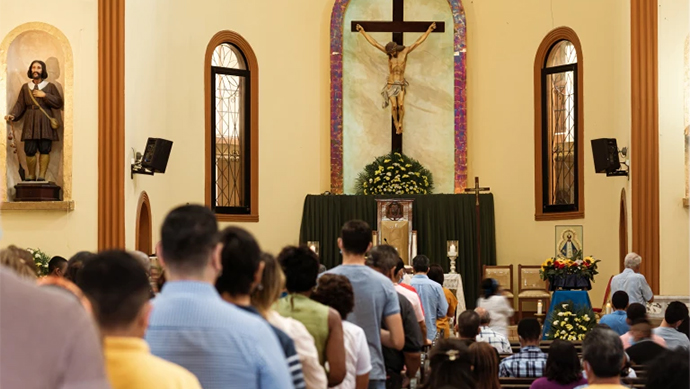
The delegation from the German Episcopal Conference that recently visited France to study the rise in adult baptisms returned with several conclusions that could have consequences for pastoral care in Germany. Beyond the record numbers of conversions registered in the neighboring country, the experts observed that French parishes are undergoing a transformation driven by the arrival of people seeking the faith on their own initiative.
Read also: German bishops study in France how the rise in conversions is transforming parishes
In an interview given to the German Catholic agency KNA, professors Katharina Karl, from the Catholic University of Eichstätt-Ingolstadt, and Jan Loffeld, from the University of Utrecht, explained the main lessons drawn from their trip, carried out together with a delegation from the German Episcopal Conference.
Parishes remain the gateway to the Church
One of the findings that most caught the visitors’ attention was realizing that, despite secularization and the weakening of many ecclesial structures, the parish continues to be the place where those who wish to approach the faith turn.
Loffeld explained that many catechumens end up finding their first real contact with the Church in the local parish. He even recalled the case of a person who spent weeks walking around a church before deciding to enter.
This observation has led the experts to warn against the temptation to consider traditional parish structures as outdated. Although many of them face difficulties, they continue to play a decisive role for those seeking spiritual answers.
New converts seek meaning and transcendence
According to the testimonies gathered during the visit, most of those requesting baptism are not motivated by cultural or family reasons, but by a personal search for meaning.
Katharina Karl explained that many people go through existential crises or feel a deep need for guidance in an increasingly complex society. In this context, they discover in the Christian faith an answer to fundamental questions about life, suffering, or the future.
Some of the new catechumens reported experiencing a sense of peace while participating in the liturgy, while others spoke of very intense spiritual experiences that prompted them to approach the Church.
The transmission of faith no longer depends on the family
Another observed change concerns the way faith is transmitted among new generations.
The experts found that many young people come to the Church through friends, colleagues, or contacts made on social media. In numerous cases, the family transmission of faith was interrupted one or two generations ago.
Although some catechumens mention the influence of their grandparents as a distant memory that awakened their religious interest, the predominant reality is that the spiritual search develops in a very personal way before leading to contact with a Christian community.
The catechumenate is transforming communities
The arrival of a growing number of adults also requires rethinking parish life.
French dioceses have developed specific catechumenate groups, personal accompaniment systems, and various rites of welcome aimed at integrating those preparing to receive the sacraments.
For Loffeld, this phenomenon is causing a true “catechumenal transformation” of communities. When a parish receives a significant number of baptismal candidates each year, it can no longer limit itself to integrating them informally, but must reorganize part of its pastoral activity to accompany them adequately.
A lesson for the Church in Germany
Both Karl and Loffeld insist that the French experience cannot be mechanically copied in Germany. However, they believe it offers valuable lessons for a Church that is also facing a growing cultural distance from Christianity.
The two experts emphasize the need to strengthen welcome, improve accompaniment processes, and learn to listen to the concrete questions of those who knock on the Church’s doors without presupposing in advance what their concerns are.
The main conclusion of the trip can perhaps be summarized in a simple observation: even in a deeply secularized society, there are still people seeking God. The question, the German experts point out, is whether the parishes will be prepared to receive them when they arrive.