


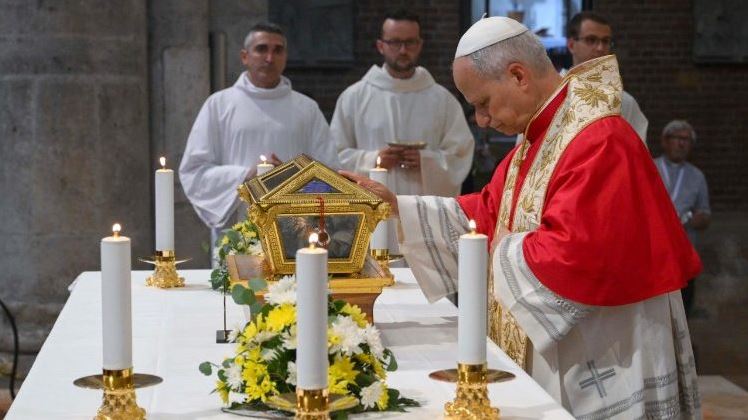
During his pastoral visit to Pavia this Saturday, Leo XIV carried out one of the most significant stages of the day at the Basilica of San Pietro in Ciel d’Oro, where the relics of Saint Augustine rest. After visiting the National Centre for Oncological Hadrontherapy (CNAO) and meeting with patients, families and healthcare staff, the Pontiff proceeded to the historic Augustinian church to meet with the religious community, venerate the relics of the Doctor of the Church and deliver a homily focused on the transmission of the faith, secularization and the need to return to Christ as the foundation of all ecclesial action.
Before the celebration, Leo XIV held a meeting with the Augustinians of the convent. There he recalled that “Saint Augustine does not belong to us; he belongs to the Church” and stated that the holy bishop of Hippo “has much to offer in this time.” The Pope also noted that the numerous pilgrims who visit the basilica demonstrate that contemporary man continues to seek God, and therefore considered it necessary to continue offering “the message of love for Christ and love for the Church” present in Augustinian thought.
Subsequently, before some 1,800 faithful gathered inside and outside the basilica, Leo XIV presided over a celebration of the Word of God and venerated the relics of Saint Augustine. During the homily, the Pontiff addressed some of the challenges currently facing the Church, especially in a context marked by secularization and difficulties in transmitting the faith to new generations.
Homily of Leo XIV at the Basilica of San Pietro in Ciel d’Oro:
Your Eminence,
Your Excellencies, dear brothers in the episcopate,
dear priests and deacons,
dear religious, religious sisters and seminarians,
my Augustinian brothers,
brothers and sisters:
I am pleased to be here among you and I thank the bishop, Monsignor Corrado Sanguineti, and Father Joseph Farrell, Prior General of the Order of Saint Augustine, for the words of welcome they have addressed to me.
I am pleased by all I have heard about this Church in Pavia: a community of ancient tradition that remains alive and present in the city and in the territory, attentive to the signs of this time and its challenges, without allowing itself to be discouraged by difficulties, by the secularized context and by the problems in the transmission of the faith.
Not to be discouraged requires a gaze animated by the spirit of faith, which helps to read reality in a way deeper than what appears at first sight and to avoid falling into a negative and pessimistic attitude, incapable of generating new life. The gaze that is asked of us—and that the Holy Spirit grants us—is that of Jesus. In the midst of difficulties and misunderstandings, He sees the provident hand of the Father in the lilies of the field and in the birds of the sky; He nourishes hope in the small seed that grows and invites us to lift up our eyes to contemplate the fields already white for the harvest.
Pope Francis encouraged us to this spiritual reading of reality when he wrote in Evangelii gaudium: “The gaze of faith is capable of recognizing the light that the Holy Spirit always pours forth in the midst of darkness. Our faith is called to discover the wine into which water can be transformed and the wheat that grows in the midst of the weeds.”
Illuminated by the hope of the Gospel and taking as our starting point the words of the Apostle Peter, who calls the Lord’s disciples “living stones,” let us ask ourselves: how can we today, here in Pavia, be a living Church?
The Apostle’s first indication is essential: to remain united to Christ, the living stone, rejected by men but chosen by God. Christ is the foundation of the spiritual edifice; He is the cornerstone on which our ecclesial journey, pastoral action and evangelization rest.
Being built and building in Christ preserves us from the risk of scattering ourselves and wearying ourselves in secondary matters, perhaps good, but which do not touch what is essential. We are called to be realistic and we know that in the life of parishes and of a diocese there are many urgencies and commitments. Nevertheless, everything must return to the center, always built from the cornerstone and avoiding that our actions end up centered solely on ourselves and on our efforts.
Since the center is Christ, we all drink from the same source and submit our commitment to the discernment that arises from His light and His Word. Thus grows a Church that walks united, capable of renewing itself without dividing, in which all recognize one another as brothers and work with joy in the service of the Kingdom of God.
This implies something important: we must learn to be Christian communities centered on what is essential, even if that means renouncing some structures and certain securities of the past. What is essential is to live with Christ and spread His Gospel.
I recommend this first of all to priests, who at times may suffer inner dispersion or weariness from their many tasks. Always return to the center, unify everything in your relationship with the Lord and discover in Him the joy of priestly fraternity and of pastoral work shared with the laity.
I also recommend it to religious brothers and sisters, who know the difficulty of updating their charisms, but who need constantly to return to Christ and share the gifts received with other communities and with the entire diocesan Church.
Remaining united to Christ enables us also to face the current problems related to the transmission of the faith and religious practice. In a time when many people seem to have lost their spiritual taste or no longer find the Christian proposal attractive, we are called above all to proclaim the Gospel, a joyful and liberating proclamation of Jesus Christ that shows the beauty of the faith for personal life and for society.
Today there is a growing need to accompany people in the discovery or rediscovery of the faith. Therefore we must proclaim the core of the Gospel: Jesus Christ, who in His incarnation, death and resurrection reveals to us the mystery of God and also the mystery of man.
In this context, the figure of Saint Augustine shines with a particular light. His thought, the story of his conversion and his spirituality remind us of the value and primacy of interiority: “Do not go outside yourself; return to yourself: the truth dwells in the inner man.”
The need to return to oneself, not to scatter oneself in external fragmentation and to find a meaning that orients life and relationships is a requirement common to all. Today it reappears in multiple forms, especially among young people.
When our witness of faith is coherent and passionate, we ourselves become living stones that form the spiritual edifice which is the Church. United to Christ, we can offer each day spiritual sacrifices through a life woven of prayer and service to our neighbor.
Dear brothers and sisters, as living stones we are called to be a Church rooted in the territory, which walks amid the difficulties and hopes of the people, expert in the art of listening and accompanying.
I know that you are already animated by this pastoral passion and I invite you to cultivate it without discouragement, seeking to reach everyone with the joy of the Gospel, valuing the best of your history and exploring new possibilities of encounter.
May the Most Holy Mary, Mother of the Church, obtain for you the ardent desire to live and witness to the Gospel. And in venerating the relics of Saint Augustine, I ask that he, together with Saint Syrus, always intercede for this Church and for the city of Pavia.
Thank you.