


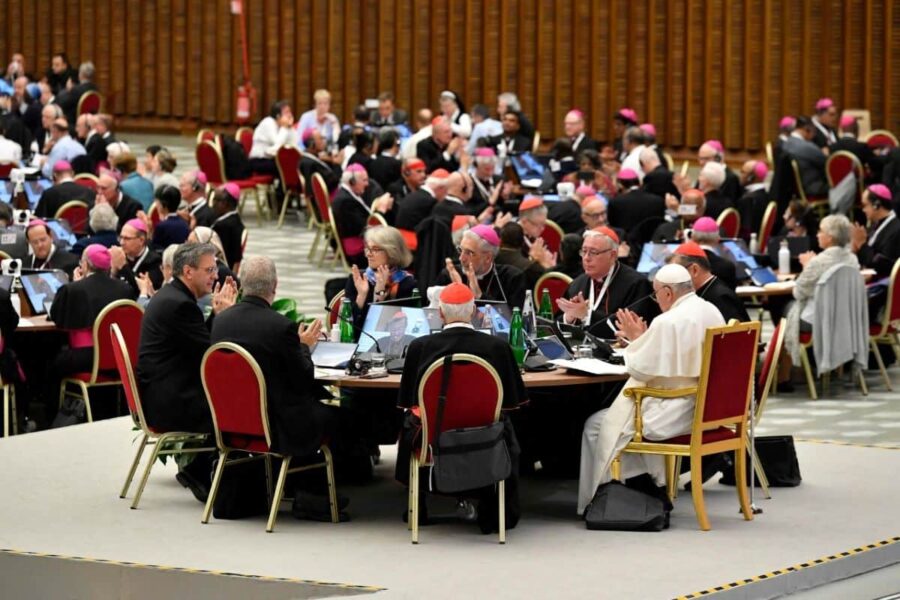
The General Secretariat of the Synod has published a new working document detailing the path the universal Church must follow until the celebration of an Ecclesial Assembly at the Vatican in October 2028, an initiative aimed at evaluating the implementation of the conclusions of the Synod on Synodality and at promoting new synodal structures and practices at all levels of ecclesial life.
The text, titled Towards the Assemblies 2027-2028. Stages, Criteria and Instruments for Preparation, establishes a phased process that will begin in the dioceses and culminate in a major ecclesial gathering in Rome, under the responsibility of Pope Leo XIV, thus continuing the path opened during the pontificate of Francis.
Four Stages to Implement the Synod
The document presents a precise timetable to be carried out over the next two years. During the first half of 2027, evaluation assemblies will be held in each diocese and eparchy. In the second half of that year, national and regional meetings organized by the episcopal conferences will take place. Subsequently, during the first months of 2028, continental assemblies will be held, before the Ecclesial Assembly scheduled for October of the same year at the Vatican.
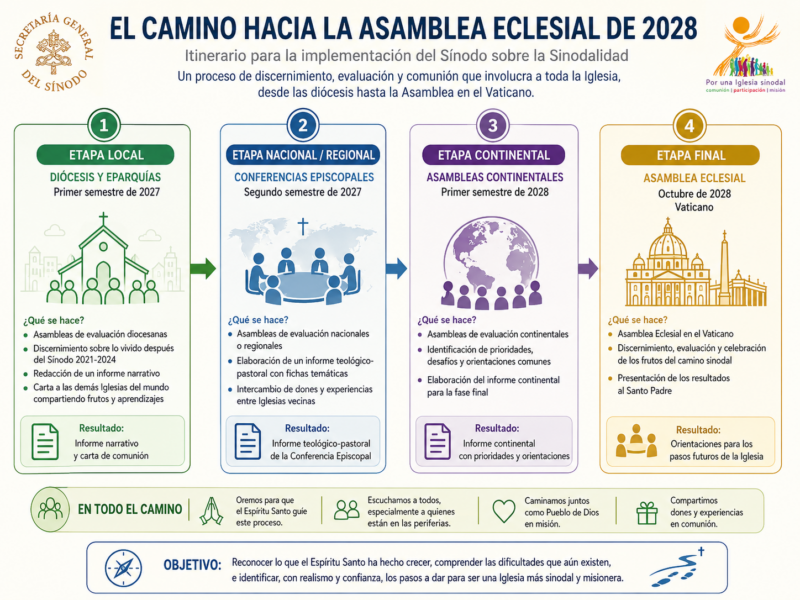
According to the General Secretariat of the Synod, the goal is not to repeat the consultations carried out between 2021 and 2024, but to assess what concrete transformations have emerged in the life of the Church following the approval of the Synod’s Final Document.
Greater Role for the Laity in Ecclesial Structures
Among the areas that dioceses will need to examine are issues that sparked wide debate during the synodal process. The document calls for evaluating the access of lay faithful to leadership roles that do not require the sacrament of Holy Orders, the functioning of participatory bodies, processes of communal discernment, and the development of new forms of ecclesial co-responsibility.
It also requests the study of the promotion of ministries and charisms, the missionary renewal of parishes, formation in synodality, ecumenical and interreligious relations, and the participation of associations and movements in the life of local Churches.
The text also explicitly mentions the need to pay attention to the participation of women, young people, the poor, and people living in situations of marginalization.
Reports, Evaluations, and New Guidelines
Each diocese will be required to prepare a narrative report on the changes experienced after the Synod and to draft a letter addressed to the other Churches of the world, sharing the fruits obtained. Subsequently, the episcopal conferences will prepare theological-pastoral reports with thematic sheets on various aspects of ecclesial life.
Among the topics to be analyzed are synodal formation in seminaries, the functioning of episcopal conferences, the role of theology faculties, and the participation of consecrated life in the synodal dynamic.
The continental phase will aim to identify common priorities and orientations for each region of the world, taking into account the cultural, social, and religious challenges specific to each continent.
An Ecclesial Assembly under the Guidance of Leo XIV
The process will culminate in October 2028 with an Ecclesial Assembly at the Vatican. The document emphasizes that this will not simply be an administrative meeting, but a moment of discernment, celebration, and evaluation of the fruits of the synodal journey begun years earlier.
The General Secretariat of the Synod explains that the results of all stages will be presented to the Holy Father, who will receive the conclusions of the process to guide the Church’s future steps. The text also insists that the Assembly must reflect a “missionary and synodal” Church, capable of developing new forms of participation and presence in the contemporary world.
With this roadmap, the Vatican makes clear that the synodal process did not conclude with the sessions held in Rome in 2023 and 2024, but now enters a new phase aimed at translating its proposals into the concrete life of dioceses, episcopal conferences, and ecclesial structures throughout the world.