


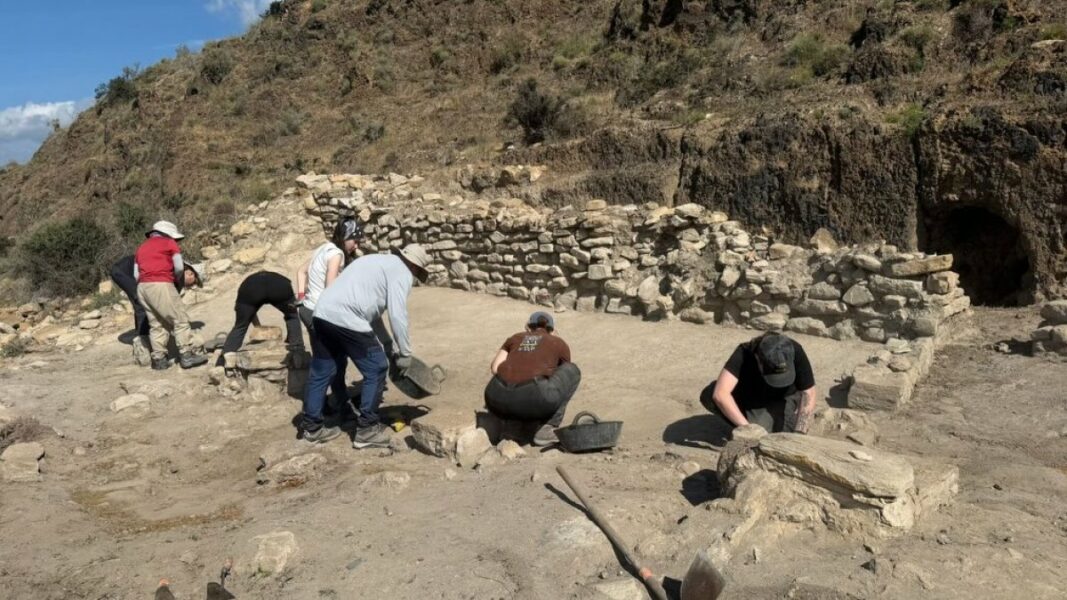
Archaeological excavations carried out at the Cabezo María site, in the Almerian town of Antas, have confirmed the existence of a large Byzantine monastic complex inhabited between the 5th and 8th centuries, a discovery that sheds new light on the presence and expansion of Christianity in the Iberian Peninsula during Late Antiquity.
The work, directed by specialists from the MEMOLab biocultural archaeology laboratory at the University of Granada, has made it possible to document new structures that reinforce the hypothesis put forward during the campaign begun in 2025: Cabezo María would not have been a simple rural settlement, but an important monastic centre with religious, economic and social influence over wide areas of the south-eastern peninsula.
One of the oldest basilicas in southern Hispania
Among the most significant discoveries is a monumental three-aisled basilica oriented towards the east, considered by researchers to be one of the oldest Christian temples located south of the Ebro River.
The excavations have reached the building’s original level and brought to light architectural elements of great value, including the remains of the columns that separated the aisles and a wide access staircase that connected the temple with the surrounding valley.
The monumentality of the complex confirms the importance this enclave held at a time when Christianity continued to consolidate its presence in various territories of Hispania, following the disappearance of Roman imperial authority in the West.
A large, well-organised religious community
The archaeologists have also identified new facilities intended for the daily life of the monastic community. Among them stands out a large refectory connected to storage and kitchen areas already documented in previous campaigns.
In addition, rooms carved directly into the volcanic rock of the hill and other spaces have been located, suggesting the existence of a numerous community composed not only of monks but also of people dedicated to support tasks and auxiliary services.
The dimensions of the complex point to a stable and long-lasting organisation capable of exerting considerable influence over the surrounding territory.
Connections with Egypt, Syria and the Holy Land
One of the most striking aspects of the find is the abundance of materials from various points in the eastern Mediterranean.
Among the recovered remains are luxury ceramics that arrived from Egypt, Syria, Palestine, Lebanon or Tunisia, a circumstance that reveals the integration of this enclave into the commercial and cultural routes of the period.
These findings also confirm the intense relationship that Hispanic Christian communities maintained with other centres of the Mediterranean world during the centuries when the Byzantine Empire retained a presence in part of the south of the Peninsula.
A possible focus for the spread of Christianity
The project leaders consider that the size of the complex and the wealth of the materials found allow them to suggest that Cabezo María may have played a prominent role in the spread of Catholic Christianity in the south-eastern peninsula during the Byzantine period.
This is a still little-known period in the history of Spain, situated between the end of the Roman world and the subsequent Islamic expansion, in which Visigothic presence, Byzantine influence and various doctrinal controversies within Christianity coexisted.
The discovery helps to better understand how Christian communities of the time were organised and what their role was in shaping the cultural and religious configuration of Hispania.
A heritage site destined to be recovered
Beyond its historical and archaeological relevance, the discovery opens new perspectives for the conservation and enhancement of ancient Christian heritage in Spain.
Researchers are now working on the consolidation of the structures discovered and on future museum projects that will turn the site into a cultural landmark for the province of Almería.
While investigations continue, Cabezo María is already emerging as one of the most significant testimonies of the Christian presence in Late Antique Hispania and as further proof of the deep historical roots of the Christian faith in the Iberian Peninsula.
Source: La Crónica del Parque