


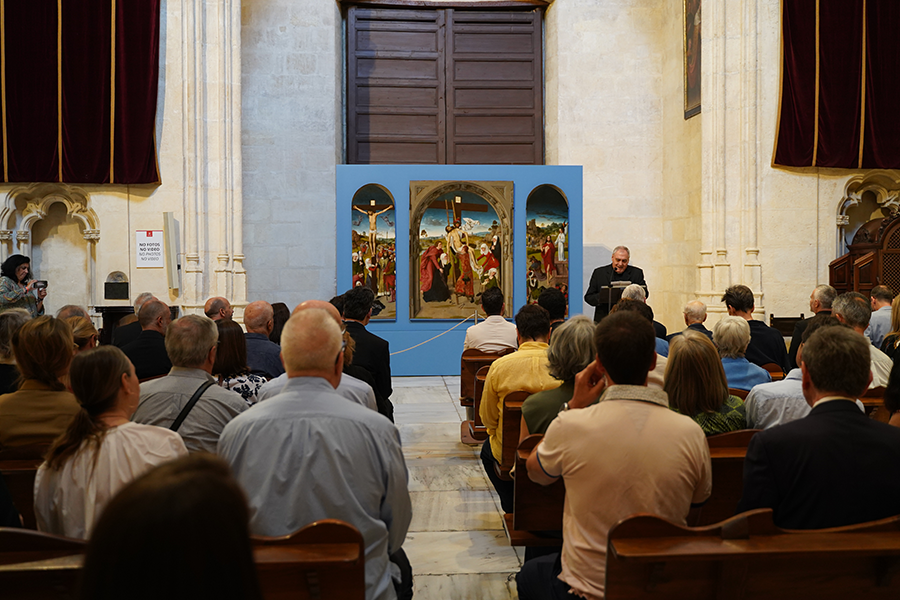
The Royal Chapel of Granada hosted this Wednesday the presentation of the Flemish triptych Descent from the Cross, a 15th-century work by Dieric Bouts that returns to the temple after a three-year restoration process carried out in Belgium. During the event, both the Archbishop of Granada, Monsignor José María Gil Tamayo, and the Chief Chaplain of the Royal Chapel, Manuel Reyes, highlighted the intense spiritual life of Isabella the Catholic and the importance these works held in her life of prayer.
According to the Archdiocese of Granada, the altarpiece was part of the devotional panels before which the Catholic Queen prayed. The work will remain on temporary display until September in an exhibition dedicated to the Flemish painter and will later return to its usual location in the museum-sacristy of the Royal Chapel.
A work linked to the spirituality of the Catholic Queen
During his address, the Archbishop of Granada emphasized the spiritual value of the restoration and recalled that Isabella the Catholic contemplated in this work the mystery of Christ’s Passion.
“May we also, through this restoration, learn the lesson that Queen Isabella always saw in it,” stated Gil Tamayo, inviting the faithful to rediscover the contemplation of Christ on the Cross and the depth of the life of prayer that characterized the monarch.
The piece represents the descent of Jesus Christ after the Crucifixion and constitutes one of the most outstanding examples of Flemish art preserved in the Royal Chapel, an institution founded by the Catholic Monarchs after the conquest of Granada.
Fray Hernando de Talavera and the spiritual formation of Isabella
For his part, the Chief Chaplain of the Royal Chapel highlighted the role played by Fray Hernando de Talavera, first Archbishop of Granada, in the Queen’s spirituality.
According to Manuel Reyes, the devotional panels served Isabella to foster a personal encounter with Jesus Christ, complementing the reading of the life of Christ, prayer, and the recitation of the Divine Office.
“The reading of the life of Christ and reliance on the beauty of the paintings were the elements lived, read, reflected upon, and contemplated in the domestic sphere,” noted the Chief Chaplain, who defined these works as a reflection of the sovereign’s sincere piety and profound faith.
The beatification of Isabella the Catholic remains an objective
During the event, the cause for the beatification of Isabella the Catholic was also recalled—an initiative opened decades ago that continues its process within the Church.
Manuel Reyes explained that the Chapter of the Royal Chapel maintains its commitment to this process and recalled that it was the Queen herself who chose Granada as the place for her burial.
“The Chapter is also committed to another goal: the beatification of the Servant of God Isabella I of Castile,” affirmed the Chief Chaplain, linking this initiative to the spiritual and historical legacy the monarch left in the city.
The presentation of the restored triptych has thus served not only to recover an important work of sacred art, but also to highlight the religious dimension of a historical figure whose cause for beatification continues to advance in the Church.