


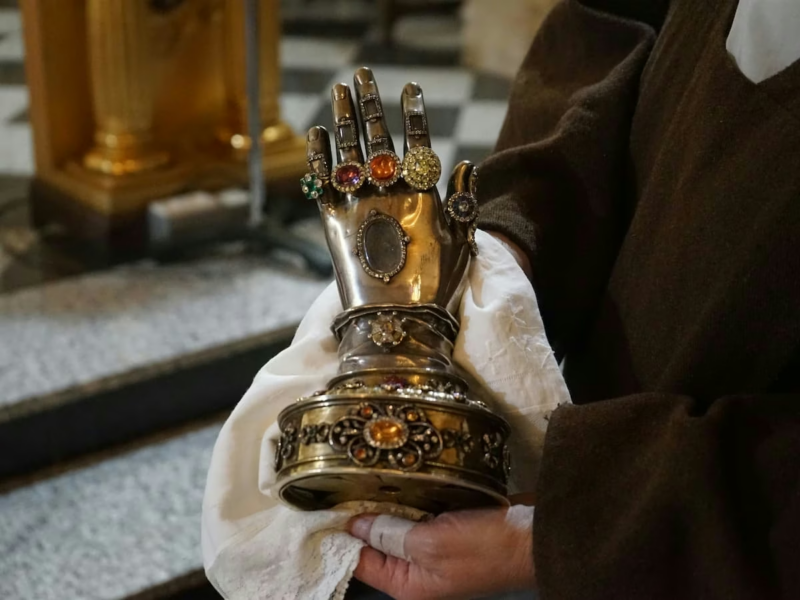
The Convent of La Merced in Ronda (Málaga), home to the incorrupt hand of Saint Teresa of Jesus, is facing a situation that threatens its continuity. According to the nuns themselves speaking to Cadena SER, the community currently consists of only four professed nuns, a number insufficient to guarantee the monastery’s permanence.
If the convent were ultimately forced to close, one of the most significant consequences would be the removal from Ronda of the famous Teresian relic, considered one of the most important and well-known in Spanish Catholicism.
A steadily shrinking community
The Discalced Carmelites explain that maintaining an open community of this kind requires at least six professed nuns. At present, the monastery is home to four sisters, one of whom is in fragile health due to a neurodegenerative disease.
The community comprises an 85-year-old nun from Ronda, the prioress born in Gibraltar, a Kenyan nun, and a Vietnamese nun. Despite the difficulties, the sisters insist they do not yet consider the closure of the convent inevitable.
“Things aren’t taken for granted until they happen. Tomorrow three nuns could arrive and the situation could turn around like a sock,” they explain.
What would happen to the incorrupt hand of Saint Teresa
The possible closure of the monastery has raised questions about the future of the incorrupt hand of Saint Teresa of Jesus, a relic that attracts thousands of pilgrims and visitors each year.
The community states that no decision has been made regarding its destination. However, they acknowledge that the relic would hardly remain in the convent if the community currently safeguarding it were to disappear.
“We don’t know where the hand will travel. These are decisions that are still up in the air and are by no means final,” the nuns affirm.
The presence of this relic has made the Ronda convent one of Spain’s foremost sites of Teresian devotion for decades.
A relic with a long history
The incorrupt hand of Saint Teresa was separated from the saint’s body shortly after her death in 1582. Over the centuries it passed through various locations until it became linked to the Carmelite communities connected with the founding of the Ronda convent.
During the Spanish Civil War the relic temporarily left its place of custody. It later remained for decades in the possession of Francisco Franco, who never questioned the Carmelites’ ownership of the relic. After his death, the hand was returned to the Ronda convent, where it has remained ever since.
The vocational crisis also affects contemplative life
The nuns stress that the convent’s problems are not financial. The community supports itself through the production of artisanal sweets and the donations it receives, so the threat to its continuity stems solely from the lack of generational renewal.
Two years ago the Carmelites launched a campaign to attract new vocations, but the results did not resolve the situation.
The case of Ronda reflects a reality affecting numerous Spanish monasteries and convents. The aging of religious communities and the scarcity of new vocations are forcing many contemplative orders to close historic monasteries or regroup their nuns into larger communities.
Meanwhile, the Carmelites of Ronda continue to await new vocations that will secure the future of a community that, next October, will mark 102 years of uninterrupted presence in the city.