


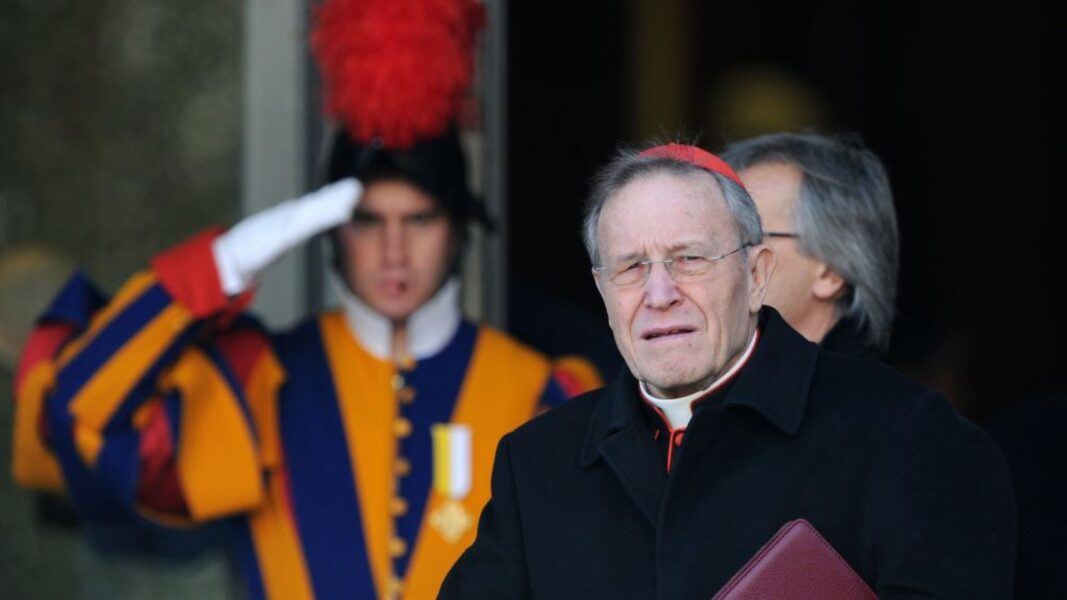
German Cardinal Walter Kasper, one of the most influential theological figures of the post-conciliar period and a protagonist in several ecclesial debates that have shaped the Church’s direction in recent decades, now believes that a large part of German-language theology has lost sight of its center: Jesus Christ. At 93, the cardinal laments that theological reflection has focused excessively on ecclesiological, ministerial, and structural questions, relegating Christology to a secondary place.
In statements to the Austrian agency Kathpress, on the occasion of the presentation in Vienna of his new book Jesus Christus auf der Spur, written together with theologian Jan-Heiner Tück, Kasper stated that it is necessary to return “to the center of Christian theology and to Christological questions.”
“Christology has been forgotten”
According to the cardinal, German theology has progressively narrowed until it became trapped in debates about the Church and ministries.
“People have become entangled in ecclesiological issues and the question of ministries. But that is too narrow. It would be important to return to the center of Christian theology and to Christological questions,” he said.
Kasper acknowledged that questions related to the Church are important, but insisted that the Christian response to contemporary man’s search for hope and meaning must start from Jesus Christ and not from structural reforms.
Criticism of the German Synodal Way
Kasper is one of the theologians who for years advocated greater decentralization in the Church and an expansion of the scope of action of local Churches. In fact, the famous debate he held in 2001 with then-Cardinal Joseph Ratzinger on the relationship between the universal Church and the particular Churches is a precursor to many of the tensions that today surround synodality and the German Synodal Way.
Today, in his view, there is the mistaken hope that the Church’s problems can be solved simply through organizational changes.
“It is expected that all the Church’s problems can be solved by making it more democratic,” he stated.
Although he clarified that he is not opposed to the participation and co-responsibility of the faithful, he considers it “theologically erroneous” to think that the renewal of the Church and of the faith can be achieved in that way.
Returning to the sources of tradition
The cardinal also defended the need for theology to recover a deeper awareness of its own intellectual and spiritual tradition.
“One cannot build a new theology on an empty meadow,” he noted. “We are within a great tradition and possess a living heritage.”
For Kasper, the Church Fathers and the great medieval theologians remain an indispensable source for contemporary reflection. Therefore, he called for greater attention to that patrimony and a renewed willingness to draw from the classical sources of the Christian faith.
Friendship with Christ as the center
The cardinal emphasized that any revitalization of Christology necessarily involves a serious reading of Sacred Scripture. In particular, he highlighted the importance of delving into the Gospel narratives to better understand the person of Christ.
Only through careful reading of the biblical texts and a true immersion in the situations described in the New Testament, he affirmed, can one arrive at establishing an authentic “friendship with Christ.”
Kasper’s reflection is difficult to overlook precisely because of who formulates it. The same cardinal who for years defended greater autonomy for local Churches now warns that German theology has become enclosed in discussions about structures, ministries, and forms of governance.