


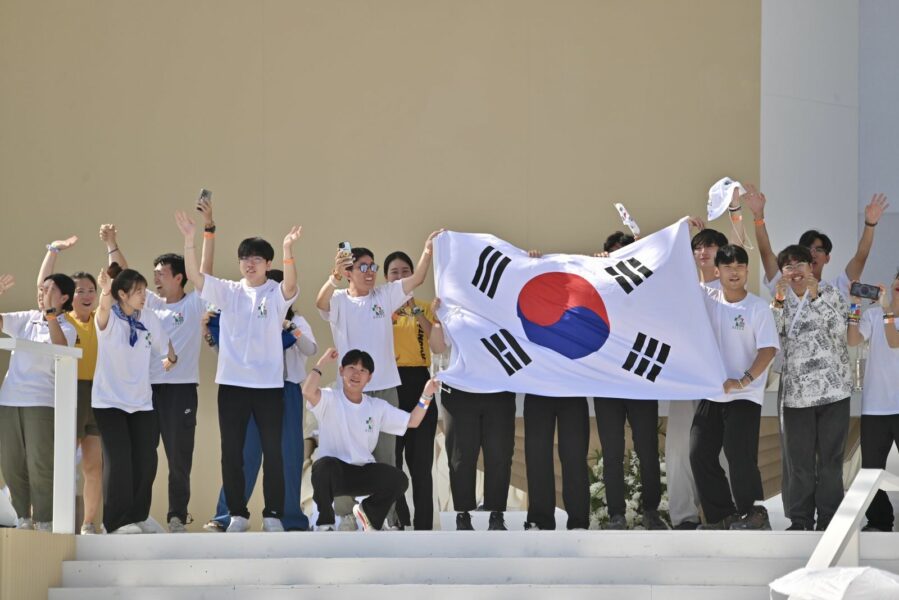
The Church of Korea wants the young people who will take part in World Youth Day Seoul 2027 to discover a story that defies all human logic: that of a Catholic community that survived more than a century of persecution, lost around 10,000 faithful to martyrdom, and yet managed to flourish until it became one of the most dynamic ecclesial realities in Asia.
In an interview given to The Pillar, the auxiliary bishop of Seoul, Kyung-Sang Lee, general coordinator of the upcoming WYD, explained that the organizers wish to present the testimony of the Korean Church to international pilgrims as a source of hope for those going through personal, family, or spiritual difficulties.
A Church born of the laity and tested by persecution
One of the most unique aspects of Catholicism in Korea is its origin. Unlike other countries, the Church did not arise primarily through the work of foreign missionaries, but through the initiative of Korean laypeople who discovered Catholic texts from Beijing and began to study and spread the faith.
That community grew rapidly, but soon faced harsh persecution that lasted for decades. Nearly 10,000 Catholics were martyred, and from a purely human perspective, the survival of the Church seemed improbable.
“From a numerical perspective, we would be a devastated Church, because most of the first believers were killed,” Lee explained.
However, far from disappearing, the Korean Church managed to rebuild and grow. The bishop acknowledges that this process remains, for many, a manifestation of the way God acts in history.
“It is very mysterious how God acted in the Church of Korea, how He rebuilt it and made it flourish and bear fruit,” he said.
The organizers want the WYD participants to know this historical experience. The intention is not only to convey knowledge about the past, but to show how faith can remain alive even amid seemingly insurmountable circumstances.
A call to hope for young people
Lee believes that the main spiritual fruit of World Youth Day will not depend on the program or organizational efforts, but on God’s action in the heart of each pilgrim.
For this reason, he insists that the organizers want to create a space where young people can personally encounter Christ and the Holy Father, allowing the Holy Spirit to act freely.
The bishop explained that he does not want to impose human expectations on the event, but rather to offer the conditions for each participant to live an authentic experience of faith.
WYD Seoul will be held under the motto chosen by Pope Leo XIV: “Take courage, I have overcome the world.” For the coordinator of the gathering, these words summarize both the historical experience of the Korean Church and the spiritual needs of many young people facing uncertainties, sufferings, and challenges in the contemporary world.
The wounds of Korea and the testimony of reconstruction
According to Lee, South Korea also offers a unique testimony of reconstruction after devastation. The country continues to live with the consequences of the Korean War, and the division of the peninsula remains an open wound between North and South.
Even so, he believes that the historical experience of the Korean people can offer a message of hope to a generation marked by uncertainty and conflict.
Artificial intelligence and dialogue between the Church and society
The bishop also referred to one of the major debates currently present in South Korean society: the development of artificial intelligence.
He explained that there is growing concern in academic, political, and social circles about ensuring that technological advances respect human dignity. In this regard, he pointed to the alignment between many of these concerns and the warnings recently issued by Pope Leo XIV on the need for artificial intelligence to remain at the service of the person and human values.
Lee believes that this coincidence can become a meeting point between the Church and Korean society, fostering new opportunities for dialogue and collaboration.
Trusting in providence during the pilgrimage
The WYD coordinator also encouraged future pilgrims to prepare spiritually to face the difficulties inherent in any large international pilgrimage.
Far from viewing setbacks as an obstacle, he believes they can become an opportunity to discover God’s action and learn to trust in His providence.
“I would invite them to face difficulties with courage,” he said. “We too have fears during the preparation, but I am not afraid. Every night I sleep well because I have experienced throughout my life how God acts in a miraculous way.”
For Lee, the history of the Korean Church precisely demonstrates that even in persecution, suffering, and apparent defeats, the Church remains faithful to Christ. This is the message of hope that Seoul wants to convey to the young people who will come to the next World Youth Day.