


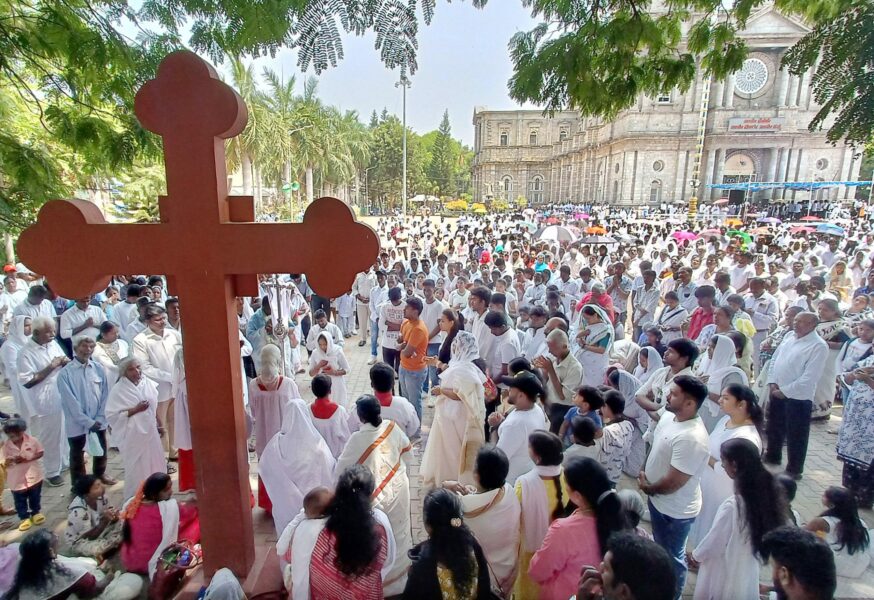
The discovery of the mutilated and dismembered bodies of six kidnapped Christians has heightened tensions in the Indian state of Manipur, where two predominantly Christian communities are caught in a spiral of violence that threatens to trigger a new escalation of the ethnic conflict that has shaken the region for years.
The bodies were found on June 10 in Kangpokpi district, following an intense search operation involving hundreds of police officers, forensic teams, and tracker dogs.
A kidnapping that ended in tragedy
The six men were part of a group of civilians from the village of Leilon Vaiphei who had been abducted weeks earlier. The kidnapping occurred after an ambush in which three Baptist leaders from the Kuki community were killed.
The recovery of the bodies sparked mass protests in areas inhabited by the Nagas, while violence continued to spread across different parts of the state.
In retaliation for the kidnappings, Naga groups—native tribes—captured several members of the Kuki community. The last fourteen hostages were released on June 9 after the Indian federal government promised to push measures to end the hostilities.
Relations between the two communities, which share a strong Christian presence, have deteriorated sharply in recent months, fueling a cycle of cross-revenge that worries civil and religious authorities.
Fear of a new escalation of violence
Local sources fear that the murder of the six Nagas will provoke new reprisals. In fact, just a day after the bodies were found, two Kuki leaders were killed in an attack that took place before dawn in Kamjong district.
Armed men also stormed the town of Kultuh, where they opened fire indiscriminately and set several homes ablaze.
The violence is unfolding in a region that is particularly complex from an ethnic standpoint. Both the Nagas and the Kukis inhabit large areas of northeastern India and northwestern Myanmar, where territorial and political tensions have persisted for decades.
The Church denounces the loss of a sense of humanity
In response to the intensification of the clashes, Catholic leaders in the region have stepped up their calls for reconciliation.
Archbishop Emeritus of Imphal Dominic Lumon expressed deep regret over the situation and condemned the logic of reprisals fueling the conflict.
“I can only lament what is happening: this tit-for-tat, these attacks on villages, and these house burnings,” he told the U.S. outlet Crux.
According to Lumon, the region is experiencing a troubling loss of a sense of humanity. The prelate recalled that Christians are called to reflect the dignity of every person, even amid situations of great suffering.
“An eye for an eye can never end suffering; it only multiplies it, widening the circle of pain until justice itself begins to lose its meaning,” he warned.
The archbishop emeritus also stressed that true justice does not seek to destroy the adversary but to restore what violence has broken and to recognize the dignity that God has granted to every human being.
The proposal for a “Manipur Agreement 2026”
Meanwhile, the current Archbishop of Imphal, Linus Neli, issued a statement titled On the Protection of Human Life and the Pursuit of Peace, in which he expressed his deep sorrow over the victims accumulated after more than three years of conflict in the state.
The prelate condemned all forms of violence against the civilian population and stated that no cause can justify the killing of innocents.
Neli advocated replacing the logic of revenge with forgiveness, the search for truth, and restorative justice capable of rebuilding trust between the opposing communities.
He also stressed the importance of ongoing dialogue between tribes and ethnic groups, accompanied by mediation mechanisms that allow disputes to be resolved without resorting to violence.
The archbishop also linked peace to economic development, equal opportunities, and more inclusive participation in public life, noting that many tensions worsen when situations of exclusion and inequality persist.
Among his proposals is the gradual disarmament of armed groups, the strengthening of peacebuilding initiatives, and greater regional cooperation.
As a horizon for overcoming the crisis, Neli has raised the possibility of reaching a major reconciliation pact among all communities in Manipur, an initiative he has named the possible “Manipur Agreement 2026.”
The archbishop concluded his appeal by urging all residents of the region to reject violence, protect human life, and commit to dialogue and reconciliation, reaffirming the Church’s support for any initiative that promotes peace and the healing of wounds opened by the conflict.