


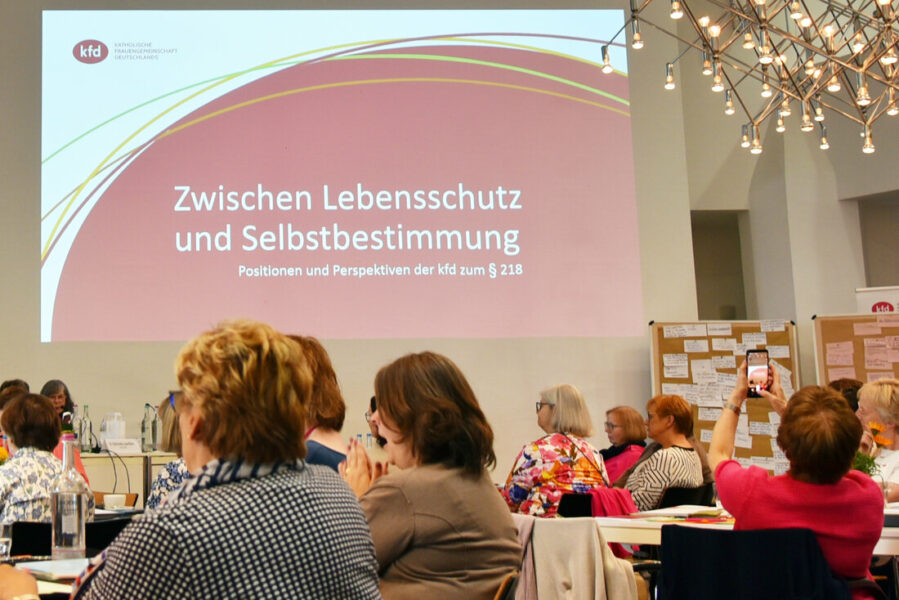
The Catholic Women’s Association of Germany (kfd), which presents itself as the country’s largest Catholic women’s organization with around 265,000 members, has approved a document calling for abortions to be performed also in hospitals run by the Church. The proposal, backed by the organization’s national assembly, represents a new challenge to Catholic teaching on the defense of human life and has provoked a strong reaction from Church representatives and pro-life movements.
The decision was adopted during the assembly held from June 4 to 6 in Mainz. The approved document addresses the debate on Article 218 of the German Penal Code, which regulates abortion, and proposes a series of measures ranging from public funding of abortions to expanded sex education and free access to contraceptives.
The kfd demands abortions in Catholic hospitals
The most controversial proposal in the document is the demand that Catholic hospitals perform abortions.
«The kfd demands that abortions also be possible in Catholic hospitals», the text explicitly states.
The organization argues that there are regional inequalities in access to abortion and believes these should be eliminated by increasing the availability of this service throughout the country.
It also calls for free contraceptives for the entire population, sex education from an early age, the creation of a responsible figure for these issues in each diocese, and guarantees that abortions will be funded by the healthcare system.
Although the document acknowledges that human life begins at conception, it argues that the right to life of the unborn must be considered alongside the woman’s right to self-determination, a formulation that departs from the Church’s consistent teaching on the inviolability of human life from its beginning.
The text also attacks various pro-life movements, accusing them of being linked to anti-feminist, authoritarian, or extremist positions, claims that have been rejected by the affected organizations.
«Completely unacceptable and intolerable»
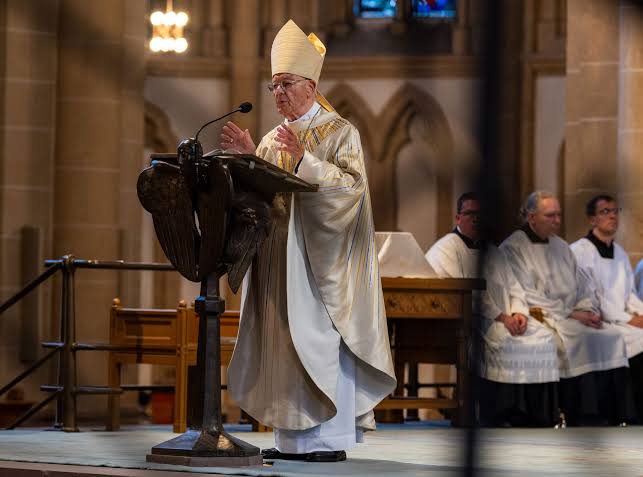
The strongest response came from Bishop Emeritus of Fulda, Heinz Josef Algermissen, president of the pro-life organization Seelsorge für das Leben.
«For a Catholic organization to seriously demand that the elimination of unborn children also be possible in Catholic hospitals is completely unacceptable and absolutely intolerable».
The prelate recalled that the Church does not consider abortion a medical service or a legitimate solution to an unwanted pregnancy.
«The elimination of an innocent and defenseless child in the mother’s womb does not constitute a medical service. An unwanted pregnancy is not a disease either».
Algermissen also criticized the proposal to fund abortions through health insurance.
«Attempting to shift the costs of eliminating unborn children onto all insured persons trivializes and undermines the prohibition of killing».
The bishop also rejected the appeal to individual conscience as a moral justification for abortion.
«If conscience offered such advice, it would simply demonstrate that it has not been properly formed».
Recalling recent words from Leo XIV on the need to protect all human life from conception until natural death, he concluded:
«A Catholic organization that distances itself from this understanding distances itself from the Church as the Mystical Body of Christ and, therefore, from Christ himself».
Two years of debate to question the Catholic position
The kfd itself explains that the document is the result of an internal reflection process that lasted more than two years and involved experts in medicine, ethics, law, and theology.
The organization acknowledges that the debate did not achieve full internal consensus. However, it decided to approve a text calling for profound changes both in German legislation and in the practice of Catholic institutions.
Moral theologian Stephan Ernst, professor at the University of Würzburg, viewed the document positively and considered that it reflects a discussion present in German society. Nevertheless, he admitted that the text does not convincingly explain how the defense of the unborn child’s life can be reconciled with the woman’s right to self-determination.
A new episode in the crisis of German Catholicism
The controversy occurs in a context marked by years of doctrinal tensions within the German Church. Various organizations linked to the Synodal Way have promoted proposals that question fundamental aspects of Catholic morality, especially in matters related to sexuality, family, and Christian anthropology.
The kfd has been one of the most active voices in these debates and on numerous occasions has defended positions far removed from the Church’s traditional teaching.
The approval of this document represents a further step in that direction. While the Church continues to teach that human life must be protected from conception until natural death, an organization that continues to present itself as Catholic now demands that Church-run hospitals participate directly in the practice of abortions.
The controversy once again highlights the deep fracture within certain sectors of German Catholicism and the growing distance between some of its organizations and the doctrine they claim to represent.