


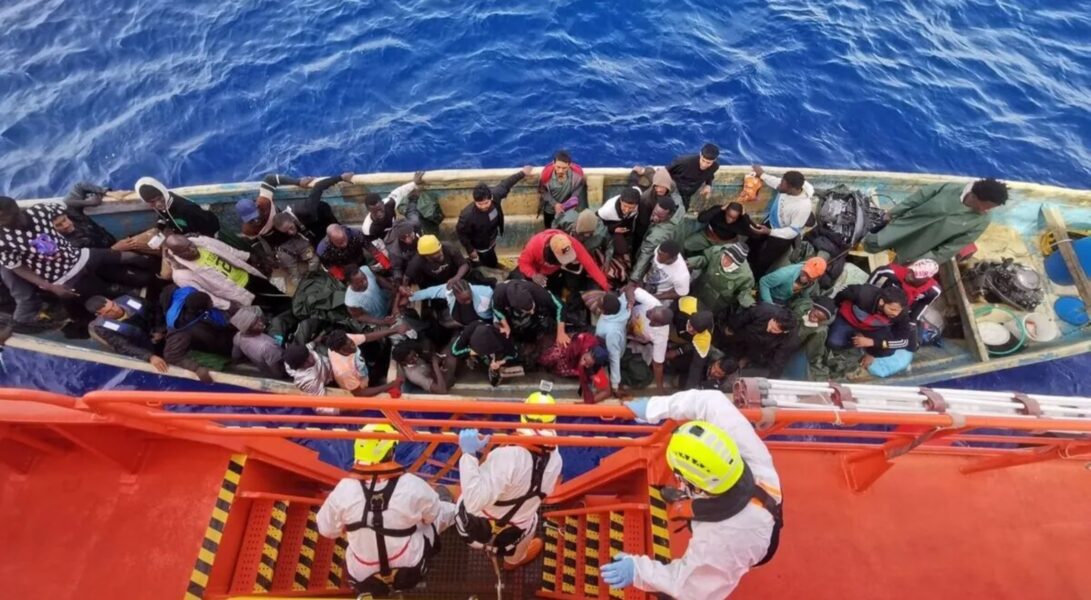
Coast Guard units in Mauritania have rescued 1,076 people in the country’s waters in just ten days, a figure that accounts for more than 80% of all rescues recorded this year and which authorities interpret as a reactivation of the Atlantic route after months of calm. The upsurge coincides with Pope Leo XIV’s apostolic visit to the archipelago, which has placed the migration drama and the culture of welcome at the centre of media coverage, and during which the Pontiff was also extraordinarily harsh on the smuggling networks: “monsters that haunt these seas,” “industries of death.”
The Atlantic route to the Canary Islands, virtually paralysed during the first five months of 2026, is showing clear signs of reactivation. On Tuesday 9 June, Ahmed Moulaye, director of the fight against irregular immigration at the Mauritanian Coast Guard, told the France-Presse (AFP) agency that “in the space of ten days, 1,076 migrants were rescued in Mauritanian waters”, 194 of whom were assisted by the Mauritanian National Navy on 31 May (AFP wire via Swissinfo, 9/6/2026).
Moulaye himself issued an unequivocal warning: “At this rate, arrivals could reach an unprecedented level this year.”
More than 80% of the year’s rescues in two weeks
The French version of the same AFP dispatch, also carried by Radio France Internationale (RFI), provides the figure that puts the phenomenon in perspective: since 28 May, exactly 1,187 people have been rescued in Mauritanian waters, bringing the total number of migrants assisted by the country’s authorities since 1 January to 1,417 (RFI, 9/6/2026; AFP via Marine & Océans, 9/6/2026).
In other words: more than 80% of all rescues recorded in Mauritanian waters so far in 2026 have been concentrated in the last two weeks, following several months of near-total inactivity on the route. The Coast Guard speaks of “a strong concentration of search-and-rescue operations in this recent period.”
The eight vessels intercepted since 28 May had departed from Gambia and Senegal. According to Pierre Beziz, a European diplomat posted in Nouakchott, none of their occupants reached the Canary Islands: “There have been zero arrivals in the Canaries, when an equivalent number was expected” (RFI/AFP, cit.). All those rescued were taken to the new Temporary Reception Centres for Foreigners (CATE) in Nouakchott and Nouadhibou, funded by the European Union.
The rescues, one by one, in official Mauritanian statements
The overall figure does not rest solely on the statements of one official: the rescues that make it up are documented in press releases from the Mauritanian Ministry of Fisheries and Maritime and Port Infrastructure, disseminated by the Europa Press agency:
- 31 May: the Mauritanian National Navy assisted a vessel carrying 194 people (AFP, cit.).
- 9 June: a cayuco with 124 people that had left Banjul (Gambia) on 2 June was intercepted off Nouamghar, some 200 km north of Nouakchott: 52 Gambians, 45 Senegalese, 15 Malians, 6 Guineans, 5 Ivorians and 1 Burkinabe, including 8 women and 13 minors (Europa Press via Infobae, 10/6/2026; La Razón, 11/6/2026; El Día, 10/6/2026).
- 11-12 June: a converted fishing boat carrying 77 people, all Guinean nationals including seven minors, was rescued off Nouadhibou. It had left Conakry on 29 May: two weeks in the Atlantic before interception (Europa Press via Infobae, 12/6/2026).
The triggers
According to the Mauritanian Coast Guard, the wave of departures began in late May, just days after Tabaski (Eid)—the Feast of the Sacrifice, the main Muslim celebration of the year in West Africa—after which crossings traditionally resume, further favoured by improved sea conditions with the arrival of summer (RFI/AFP, cit.).
A surge during the Pope’s visit: media focus on welcome
The increase in departures also coincides with Pope Leo XIV’s apostolic visit to the Canary Islands (11 and 12 June), the first by a Pontiff to the archipelago, expressly mentioned in the AFP wire itself. It should be noted that it is impossible to establish a certain causal link between the two phenomena—the intercepted vessels set sail from 28 May onwards—but the coincidence has placed the Atlantic route at the centre of public conversation at a time when the entire institutional and ecclesial discourse revolves around welcome.
On Thursday, from the quay of Arguineguín—the so-called “quay of shame” of 2020, renamed for the occasion the “quay of hope”—and in the presence of Prime Minister Pedro Sánchez and Canary Islands President Fernando Clavijo, the Pope delivered a speech entirely devoted to the migration drama: “Dear migrants: before saying anything else, I want to bow before your dignity. You are not numbers or files.” Leo XIV stated that “human dignity has no passport and does not lose value when crossing a border,” that “we cannot get used to counting the dead,” and reproached Europe for not being able to “proclaim human dignity and get used to the Mediterranean and the Atlantic being graveyards without headstones” (Vatican News, 11/6/2026; RTVE, 11/6/2026; full speech at COPE).
The Pontiff insisted that “welcoming the migrant cannot be something secondary or delegated only to a few volunteers” and that Christians cannot “pass by the cayucos and the pateras.” The message continued at the packed Mass in the Gran Canaria Stadium before almost 40,000 faithful—where he called for welcoming “the most needy, the defenceless and those unable to give anything in return”—and on Friday during his visit to the Las Raíces reception centre (Tenerife), where he proclaimed that “all of us, in some way, are migrants” (RTVE, 11/6/2026; El Mundo, 12/6/2026).
The other side of the papal message: extreme harshness towards the mafias
It would, however, be a biased reading to reduce Leo XIV’s message to welcome alone. In the same speech at Arguineguín, the Pope devoted some of his harshest passages precisely to the networks that organise these departures—the same ones behind the cayucos intercepted in recent days off Mauritania:
“Even today there are monsters that haunt these seas: mafias that traffic in despair, traffickers who enslave women and children, and the indifference of many that allows the poor to be swallowed up by exploitation or oblivion.”
Addressing the migrants directly, he exhorted them: “Do not entrust your existence to those who trade in it. Do not believe those who promise easy paradises in exchange for your body, your money, your silence or your freedom,” describing those promises as “siren songs” and “industries of death.”
Leo XIV also called for “real cooperation against traffickers” and “effective protection for victims,” demanded that transit countries “protect and not leave the weak in the hands of criminal networks,” and formulated a principle frequently forgotten in the migration debate: alongside the right to seek refuge, “there is also the right not to have to migrate: the right to remain in one’s own home without hunger, without war, without persecution, without violence” (full speech, COPE, cit.). The migration drama, he said, must become an “examination of conscience” also for countries of origin, which are called upon to “create conditions of peace, justice and development.”
The context: a route at historic lows that is becoming more lethal
The sudden surge in departures contrasts with official arrival figures. According to the latest bi-weekly report from the Ministry of the Interior, with data closed on 31 May, 3,184 migrants in 41 vessels reached the Canary Islands in 2026, a 71% drop compared with the same period in 2025 (10,983 people in 177 vessels) (Ministry of the Interior, Balances and Reports; Europa Press via elDiario.es, 1/6/2026).
Frontex, in its 15 May report, put the reduction in crossings on the West Africa route in the first four months of the year at 78%, “the sharpest decrease of all routes” into Europe (elDiario.es, 2/6/2026, citing the Frontex report).
The drop in arrivals has not made the crossing less dangerous; on the contrary. According to the report “Monitoring the Right to Life” published on 10 June by the collective Caminando Fronteras, 635 people have died on the Canary route between January and May 2026, and the fatality rate has doubled: one person dies for every five who reach land, compared with one in 7.4 in the same period of 2025 (EFE via La Provincia, 10/6/2026; Europa Press, 10/6/2026).
The reason is the southward shift of departure points: the strengthening of maritime controls in Senegal, Mauritania and Morocco—resulting from border externalisation agreements with Spain and the EU—has pushed cayucos to leave from Gambia and Guinea-Conakry, lengthening voyages to two weeks of navigation and multiplying the risk of shipwreck (AFP, cit.; Infolibre, 11/6/2026).
A high figure for 2026, far from the peaks of the crisis
To put the magnitude of the figure into perspective: the 1,076 people rescued in ten days represent a rate of around 108 people intercepted daily, compared with an average of 21 daily arrivals in the Canary Islands so far this year. It is, by far, the largest concentration of departures in 2026.
However, it remains very far from the volumes seen during the acute phase of the crisis: between January and April 2025 Mauritania intercepted more than 30,000 migrants and dismantled 88 trafficking networks, according to Mauritanian government data reported by El País and InfoMigrants (InfoMigrants, 25/7/2025), and in 2024 more than 25,000 people left the country, according to the Spanish National Security annual report (Dialogue Migration, 24/6/2025).
The current phenomenon is, therefore, a sharp reactivation after months of anomalous calm, not a historic record. The question—which Moulaye himself raises—is whether the pace of these two weeks will continue through the summer, the high season for crossings, and all this with one more piece of information on the table: on this very 12 June the European Pact on Migration and Asylum entered into force, whose practical application on the southern border continues to generate uncertainty among Canary Islands authorities (Canarias7, 11/5/2026). The next bi-weekly report from the Ministry of the Interior, with data up to 15 June, will show whether the departures are beginning to translate into arrivals in the archipelago.
Sources consulted
- AFP, “More than 1,000 migrants rescued off the coast of Mauritania in 10 days,” 9 June 2026. Statements by Ahmed Moulaye (Mauritanian Coast Guard) and Pierre Beziz (EU diplomat in Nouakchott). Spanish version: Swissinfo · Yahoo Noticias.
- AFP (French version, with expanded data: 1,187 rescued since 28 May; 1,417 in the year; post-Tabaski reactivation): Marine & Océans, 9/6/2026.
- RFI, “Plus de 1000 migrants ont été secourus au large des côtes mauritaniennes en dix jours,” 9 June 2026: link.
- Europa Press, press releases from the Mauritanian Ministry of Fisheries and Maritime and Port Infrastructure: rescue of 124 migrants off Nouamghar (10/6/2026) and of 77 Guinean migrants off Nouadhibou (12/6/2026).
- Speech by Leo XIV at Arguineguín quay (11/6/2026): full text at COPE · official report at Vatican News · RTVE · Infobae · El Nacional.
- Mass at Gran Canaria Stadium and visit to Las Raíces centre: RTVE, 11/6/2026 · El Mundo, 12/6/2026.
- Ministry of the Interior, “Bi-weekly report on irregular immigration — Cumulative data from 1 January to 31 May 2026”: Balances and Reports. Coverage: Europa Press via elDiario.es, 1/6/2026.
- Frontex, situation report of 15 May 2026 (78% reduction on the West Africa route), cited in elDiario.es, 2/6/2026.
- Caminando Fronteras, “Monitoring the Right to Life 2026” report (10/6/2026): EFE via La Provincia · Europa Press.
- Infolibre, “Fewer arrivals, but more deaths at sea: the migration reality the Pope will find in the Canaries,” 11/6/2026: link.
- Historical context of interceptions in Mauritania (30,000 between January and April 2025; 25,000 departures in 2024): InfoMigrants, 25/7/2025 · Dialogue Migration, 24/6/2025.
- Government of the Canary Islands, statements by spokesperson Alfonso Cabello on the May upsurge and the European Pact on Migration and Asylum: Canarias7, 11/5/2026.