


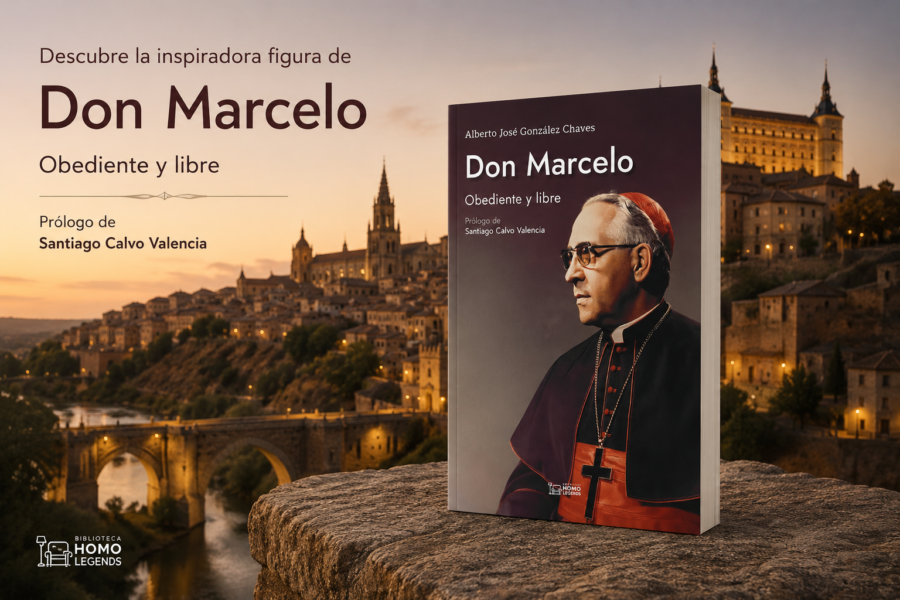
Next Monday, June 15, at 7:30 p.m., the publishing house Bibliotheca Homo Legens will present at its Madrid headquarters (C/ Nicasio Gallego, 9, local) Don Marcelo, Obedient and Free, the new biography of Cardinal Don Marcelo González Martín, Bishop of Astorga, Archbishop of Barcelona and Toledo, and Primate of Spain. The event, with free admission until full capacity, will bring together four voices to highlight the figure of one of the most lucid and contested bishops of the Spanish episcopate of the 20th century.
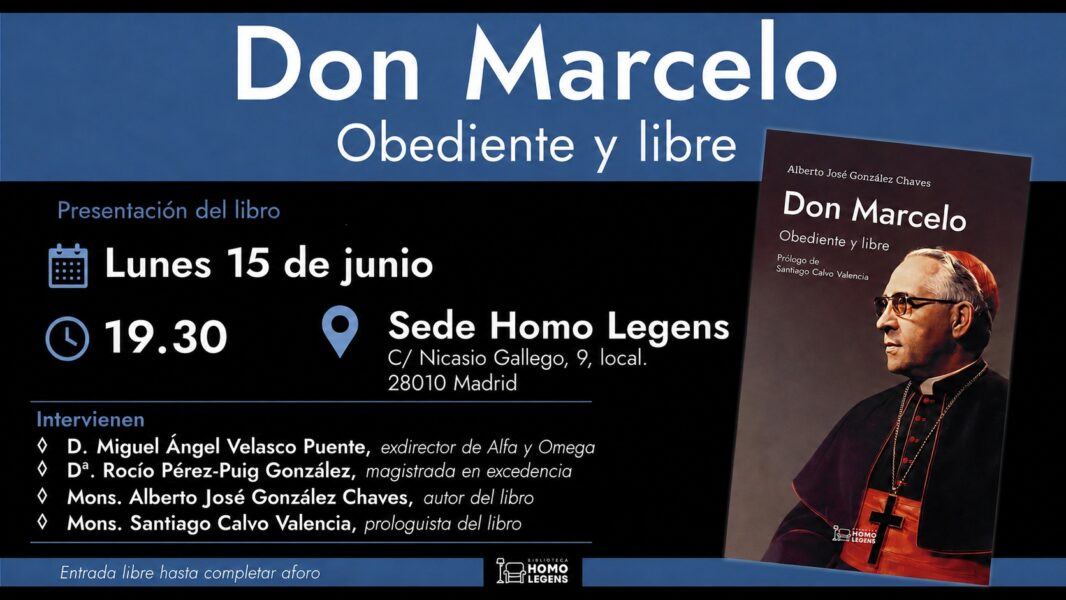
Taking part in the presentation will be Don Miguel Ángel Velasco Puente, former director of Alfa y Omega; Doña Rocío Pérez-Puig González, magistrate on leave; the author of the work, Monsignor Alberto José González Chaves, priest and doctor in Spiritual Theology; and the prologue writer, Monsignor Santiago Calvo Valencia, who was the cardinal’s personal secretary for forty-three years. Few biographies are so strongly supported by direct knowledge of the subject.
Written by Monsignor González Chaves —ordained a priest by Don Marcelo in 1995— the work is the brief, popular version of the major two-volume biography, Don Marcelo, Navigator and Sower, which the author co-wrote with Calvo Valencia and José Luis Galán Muñoz. What was necessary for study is not always accessible for ordinary reading: this distillation preserves the narrative drive and the inner truth of the character in a volume any reader can follow.
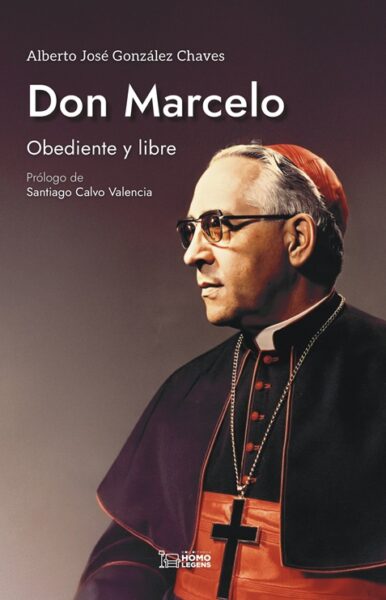
The subtitle encapsulates the book’s thesis. In a time that confuses freedom with insubordination and obedience with the abdication of those who no longer think, the life of Marcelo González Martín (Villanubla, Valladolid, 1918 — 2004) refutes that false dilemma. As a seminarian with brilliant studies, he had to abandon his doctoral thesis out of obedience; from that day until his death as a cardinal, he made the surrender of his will the source of an inner freedom that few men of his century attained.
That freedom translated into lucidity. In his 1978 pastoral letter on the Constitution, Don Marcelo warned that the formula “everyone has the right to life” would not prevent a parliamentary majority from legalizing abortion. And in his 1979 lecture he had foreseen that, once constitutional principles were embodied in ordinary laws, practices previously considered violations of fundamental rights would be legalized, “without stopping even at life.” Divorce was approved in 1981; abortion, in 1985. It was not supernatural prophecy, but the gaze of someone who read his time without deceiving himself.
Nor did he mince words about the substance. Of abortion he came to write that it was “the gravest immorality against the preservation of life,” “the most odious homicide,” because it involved the elimination of a defenseless human being by those who should protect him. These were years when publicly holding such positions came at a cost, even within the Church: the book does not hide his disagreements with the sector led by Cardinal Tarancón.
From the young seminarian of Valladolid to the reforming bishop of Astorga; from the courageous pastor of 1960s Barcelona to the great promoter of the Toledo seminary; from the conciliar father to the Primate who lived through the Transition up close. Don Marcelo loved the Church “from within,” without fears or compromises, uniting the defense of truth with immense charity toward the poor and absolute fidelity to the Chair of Peter. “Preserving the spirit of the past —he wrote— serves to continue creating in the present.”
Don Marcelo, Obedient and Free, is available in bookstores and at homolegens.com. The presentation will take place on Monday, June 15, at 7:30 p.m., at the Homo Legens headquarters (C/ Nicasio Gallego, 9, local, 28010 Madrid), with free admission until full capacity.