


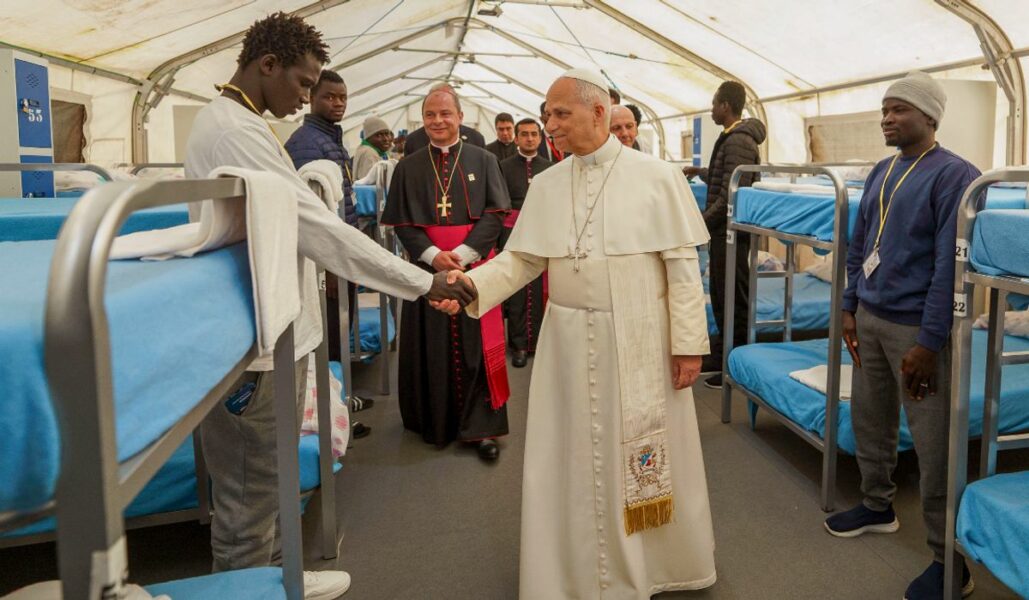
Pope Leo XIV arrived in Tenerife this Friday on the final day of his apostolic journey to Spain. The visit was strongly marked by immigration, an issue that had already featured prominently in his activities the previous day in Gran Canaria.
After landing at Tenerife North Airport, the Pontiff traveled to the Las Raíces reception center, one of the main facilities providing care for migrants arriving in the archipelago via the Atlantic route.
First-person testimonies
Before the Holy Father’s address, several participants spoke to explain the reality faced by the center and the experiences of those who have reached the Canary Islands after crossing the Atlantic.
The Bishop of San Cristóbal de La Laguna, Monsignor Eloy Santiago, recalled that the Canary Islands have become one of the main entry points for irregular migration into Europe and evoked the human drama of the Atlantic route, one of the most dangerous in the world. The prelate also highlighted that thousands of people have lost their lives attempting to reach the Spanish coast.
For his part, the director of Las Raíces noted that the facilities have welcomed more than 54,000 people since opening in 2021 and emphasized the work carried out by staff and organizations involved in assisting the newly arrived.
One of the most significant testimonies came from Bousso Diouf, a Senegalese woman who explained the reasons that drive many Africans to leave their countries of origin. “No one leaves their land, their family, and their roots by choice when they can live in peace,” she stated. Diouf noted that many residents of the center come from countries marked by poverty, violence, conflict, or lack of opportunities.
A young African migrant also spoke, describing the harsh conditions of the journey to the Canary Islands. In his account, he spoke of hunger, cold, despair, and the constant fear of death during the crossing. He also remembered those who did not survive the journey and denounced the actions of criminal networks that exploit the vulnerability of those seeking to reach Europe.
“Let us not be seen only as migrants, numbers, or documents, but as people with stories, dreams, families, and hope,” he urged during his remarks. “We are not asking for privileges. We are not asking for compassion. We are asking for respect, humanity, and the opportunity to live with dignity,” he added.
The Government validates its policies
Pope Leo XIV’s visit to the Las Raíces center also served as a showcase for the Government’s migration policy. During the event, the Minister of Inclusion, Social Security and Migration, Elma Saiz, defended before the Pontiff the model promoted by the Executive, based —in her words— on the principles of “humanity, regularity, and coexistence.”
In her address, Saiz presented the center as an example of Spain’s commitment to welcoming migrants and stated that Las Raíces represents “our country’s commitment to human dignity.” The minister also affirmed that Spain is “a country of immigrants” and maintained that integration must be built on shared responsibility between those who arrive and those who receive them.
“Those who arrive have the duty to participate, respect, and contribute; those who welcome have the responsibility to open spaces of belonging and dignity,” the minister declared before approximately 600 attendees. She also defended that “integration is not the renunciation of who we are, but the shared construction of who we want to be.”
Leo XIV: “The love of God knows no borders”
After listening to the testimonies, Leo XIV addressed the gathering mainly in French, a language understood by many of the migrants from West Africa. The Pope sought to convey a message of hope and closeness, centered on the dignity of the person and the universality of God’s love.
Taking advantage of the Solemnity of the Sacred Heart of Jesus, the Pontiff stated that “the love of God knows no borders, makes no distinctions, is given to all, and gathers us in unity.” He also affirmed that the wounds and sufferings of those who have undertaken long and dangerous journeys are not indifferent to the Church.
The Holy Father recalled the parable of the Good Samaritan and mentioned Saint Joseph of Anchieta and Saint Brother Peter as examples of people who left their homeland to bring the Gospel to other peoples. He also invited the migrants to contribute “the treasure of humanity, dreams, and culture” that they carry with them and to open themselves to encounter with the communities that receive them.
The full speech follows:
Dear brothers and sisters: Good morning!
I thank the Minister for her heartfelt words, as well as the Director of this Center.
Today the Church celebrates the Solemnity of the Sacred Heart of Jesus, which for Christians represents the merciful and infinite love of God for every human being. In this context, it is providential that we can meet, see one another, and above all know that, beyond our place of origin, the love of God knows no borders, makes no distinctions, is given to all, and gathers us in unity.
Looking at your faces and listening to your testimonies, I also think of your hearts, wounded by so many difficulties and also consoled by the love received through other open, generous, and merciful hearts. The Heart of Christ suffered and was pierced out of love, and was also comforted by compassionate people who came to relieve His pain.
To explain the universality of love, Jesus gave the example of the service rendered by a man of another people and another religion who took pity on the wounded and mistreated man (cf. Lk 10:25-37). Motivated by that love of God, which helps us to heal wounds and to be charitable toward those who suffer, Saint Brother Peter and Saint Joseph of Anchieta set out from these Canary Islands to proclaim the Gospel in America, opening new missionary horizons. They too were migrants who journeyed toward the unknown, carrying as their principal baggage faith, hope, and charity.
In those unknown lands, the migrant saints and missionaries knew how to give of what they had and also to welcome what was offered to them. I also invite you to offer the treasure of humanity, dreams, and culture that you have brought to these islands, and to be open to receiving what is offered to you. This exchange must also be lived responsibly, thinking of the future of generations to come, to whom we wish to bequeath the heritage of a civilization of love, in which migrations have an important word to say, because “they can be an occasion of encounter and mutual enrichment between peoples” (Magnifica humanitas, 81).
Dear brothers and sisters, we are all —in some way— migrants; we are all pilgrims on the way to our heavenly homeland. Let us help one another to make this journey more human for everyone, contributing whatever is within each one’s reach. In this regard, I thank the Government, the various institutions, and the many men and women of good will who make this concrete humanitarian assistance possible, restoring hope and dignity to so many people.
I was struck by the name of this reception center, “Las Raíces” (The Roots). My Predecessor, the beloved Pope Francis, who so longed to be with you, liked to use the image of roots to indicate the need not to forget our origins, to remain united, and to trust in the Lord. “For whoever trusts in the Lord ‘is like a tree planted by streams of water, that yields its fruit in its season, and its leaf does not wither’ (Jer 17:8)” (Christus vivit, 133). May this image of roots also help you to be firmly rooted in the Lord (cf. Col 2:7), so that no storm may separate you from His presence, which strengthens and gives life.
Dear friends, I carry you in my heart and in my prayers. May God bless you, bless your families, and all who do you good. And may the Blessed Virgin Mary, Consoler of migrants, always accompany and assist you with her maternal protection.
Thank you very much.