


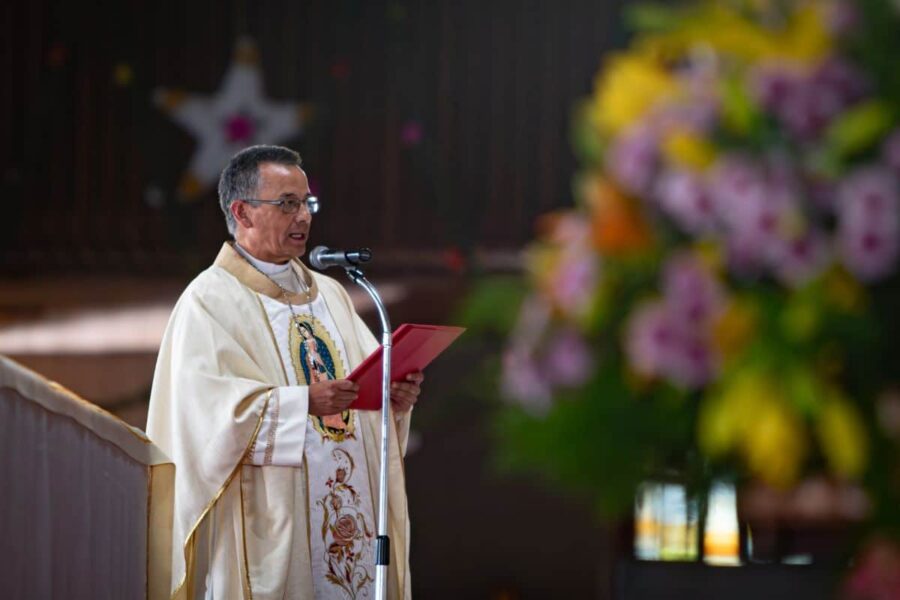
The reinstatement of Father Efraín Hernández by decision of Cardinal Carlos Aguiar Retes has revived unanswered questions about the management of Mexico’s principal Marian shrine. After months of internal complaints, canonical investigations, audits and the intervention of various ecclesiastical bodies, the case remains shrouded in a notable lack of clarity that concerns numerous faithful and members of the Guadalupano chapter.
The Basilica of Guadalupe, the spiritual heart of Mexico and one of the world’s most important pilgrimage centers, has been experiencing one of the most delicate institutional crises in its recent history for several months. What began as a series of internal complaints about the management of the then rector, Father Efraín Hernández Díaz, has escalated into a conflict involving the Guadalupano chapter, the Primatial Archdiocese of Mexico, the Mexican Episcopal Conference and the Apostolic Nunciature.
The recent decision by Cardinal Carlos Aguiar Retes to reinstate Hernández Díaz as rector of the shrine has reopened a controversy that many considered far from resolved.
The onset of an unexpected crisis
The first significant episode occurred in August 2025. Father Efraín Hernández informed priests of the First Pastoral Zone that he would be absent on vacation with the archbishop’s authorization. However, that absence extended for weeks without a clear explanation or formal communication to dispel doubts about his situation.
His absence began to generate concern among the canons of the Basilica, especially when ordinary chapter meetings and encounters with shrine staff were suspended.
The concern grew until, in September 2025, it culminated in a formal letter addressed to Cardinal Aguiar Retes. The chapter members believed there were sufficient grounds to alert about a situation they described as critical for the ordinary functioning of the Basilica.
The archbishop’s intervention
According to the reconstruction of events carried out by various specialized media, on September 20, 2025, Cardinal Aguiar personally received the documentation presented by the canons.
The following day he presided over a chapter meeting in which he reportedly communicated the seriousness of the accusations received. At that meeting, the issuance of decrees intended to remove Hernández Díaz as rector and transfer his faculties to the archpriest was announced.
The decision seemed to mark a turning point.
However, a few weeks later the situation began to change. Hernández Díaz himself announced that he had submitted his resignation as rector and episcopal vicar, although he retained his status as a canon. Subsequently, the case was referred to the judicial vicar of the archdiocese for a broader investigation.
That represented a significant shift from the initial perception of the gravity of the facts.
The chapter’s complaints
Over the months, the Guadalupano chapter expanded the documentation submitted to ecclesiastical authorities.
Among the concerns raised were issues related to the patrimonial administration of the shrine, financial management, the removal of reserved documentation, contracts deemed problematic, and an internal climate that some canons described as troubling.
One of the matters that generated the greatest concern was the management of access to the camarín where the tilma of Saint Juan Diego is kept.
According to the complaints filed, during Hernández Díaz’s tenure the number of openings of the camarín for visitor groups reportedly increased significantly. The complainants maintained that this could affect both the conservation of the image and the exceptional and reserved nature of that access.
The issue acquired particular sensitivity due to the spiritual, historical and symbolic value the tilma holds for millions of Catholics in Mexico and throughout the American continent.
The key November meeting
One of the most important moments of the case took place on November 13, 2025, during a meeting of the National Council for the Shrine of Guadalupe.
Representatives of the chapter, members of the Mexican Episcopal Conference, Apostolic Nuncio Joseph Spiteri and various ecclesiastical authorities participated in that meeting.
The canons then presented their concerns about the management of the Basilica and raised the need to strengthen transparency and oversight mechanisms.
It emerged from that meeting that there was widespread concern about the internal situation of the shrine and the need to protect both its spiritual heritage and its material resources.
The canonical investigation
Following the complaints, the archdiocese launched a preliminary investigation to determine the plausibility of the reported facts.
The investigation was conducted by the ecclesiastical tribunal under the supervision of the then judicial vicar, Monsignor Andrés Luis García Jasso.
Over several months, interviews, documentary analyses and collection of testimonies related to the administration of the Basilica were carried out.
At the same time, an external audit was commissioned, the results of which, according to reports, were prepared by the firm Deloitte.
However, neither the full conclusions of the canonical investigation nor the details of the audit have been made public.
That absence of information is precisely one of the main reasons for the controversy.
The unexpected return of Efraín Hernández
When many assumed the process would continue toward a definitive resolution, Cardinal Aguiar Retes surprised everyone by announcing in May 2026 the reinstatement of Efraín Hernández Díaz as rector of the Basilica and episcopal vicar.
The decision was communicated to the chapter and was justified, according to various sources, on the grounds that insufficient elements had been found to prevent his return to the position.
However, the measure generated bewilderment among those who had closely followed the case.
The main reason is simple: the detailed results of the investigation and the audit were never made public.
Nor has a thorough explanation been offered regarding the reasons that led from an initial removal to a complete reinstatement of responsibilities.
Questions that remain open
The controversy does not revolve solely around the figure of the reinstated rector.
The most relevant questions concern the management of one of the Catholic Church’s most important shrines.
What conclusions did the canonical investigation exactly reach? What did the external audit determine? Why was it initially considered necessary to remove the rector? What changed afterward to justify his return? Have the practices that prompted the initial complaints been corrected?
To date, none of these questions has received a detailed public response.
A matter that transcends individual names
Beyond individual responsibilities, the episode has highlighted the importance of transparency in the administration of ecclesiastical institutions that safeguard a spiritual heritage of enormous significance.
The Basilica of Guadalupe is not merely a church. It is the principal Marian shrine of the Americas, receives millions of pilgrims each year and constitutes one of the most important religious symbols in the Catholic world.
Precisely for this reason, any controversy related to its governance has a dimension that goes beyond personal or administrative conflicts.
As long as the lack of complete explanations about what occurred persists, the crisis can hardly be considered closed. The reinstatement of Efraín Hernández has restored administrative normality to the shrine, but it has not dispelled the doubts that for months led the chapter, various bishops and other ecclesiastical bodies to express their concern about the direction of the institution.
For now, the chronology is clear. What remains unclear are the definitive answers.
Source: Sursum-corda / Guillermo Gazanini Espinoza