


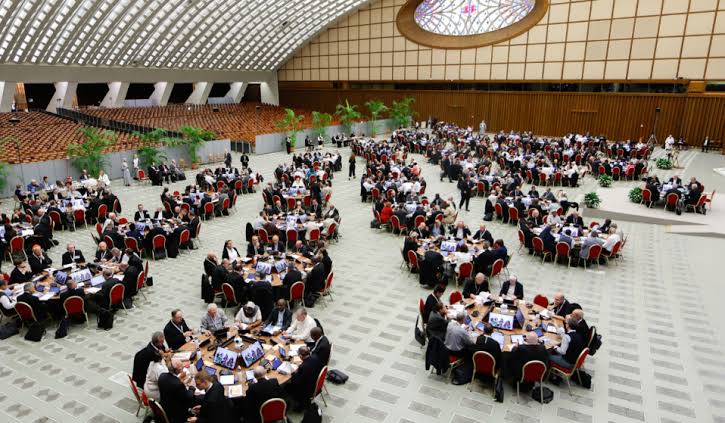
A group of Polish Catholic faithful has published an extensive open letter expressing their concern over the Final Document of the Synod on Synodality, approved in October 2024, which they accuse of favoring a transformation of the Church’s identity and of moving away from essential elements of Catholic doctrine.
The initiative was promoted by Dr. Artur Dąbrowski, president of Catholic Action in the Archdiocese of Częstochowa, together with other faithful who declare themselves “seriously alarmed” by some of the conclusions and orientations that emerged from the synodal process.
Criticism of the synodal model
In the document, the authors maintain that the Synod’s final text reflects approaches similar to those promoted by the German Synodal Way and warn of what they see as a trend toward doctrinal and pastoral decentralization of the Church.
The signatories state that certain formulations in the document could favor an understanding of the Church based on criteria of inclusion and consensus which, in their view, would ultimately replace permanent aspects of the deposit of faith.
The letter also questions the methodology used during the synodal sessions, especially the so-called “Conversation in the Spirit,” employed as an instrument of discernment in the working groups.
According to the authors, the system limits theological debate by reducing participants’ speaking time and avoiding direct confrontation of arguments. In their judgment, this hinders the articulated defense of Catholic doctrine and gives equal weight to doctrinally opposing positions.
Objections to the definition of synodality
One of the points that most concerns the signatories is the assertion contained in the synodal document that synodality constitutes a “constitutive dimension” of the Church.
The authors interpret this formulation as a risk of altering the traditional understanding of the Church’s divine constitution, founded by Jesus Christ and defined by its essential marks of unity, holiness, catholicity, and apostolicity.
They also express reservations about certain passages dedicated to the ministerial priesthood, arguing that some expressions could be interpreted as an excessive subordination of pastoral authority to participatory or consultative dynamics.
The liturgy, the sensus fidei, and ecumenism
The letter also devotes several sections to analyzing issues related to the liturgy, the role of the sensus fidei, and ecumenical dialogue.
The signatories consider the treatment given in the Final Document to central aspects of eucharistic doctrine insufficient and criticize the comparison drawn between the eucharistic assembly and the synodal assembly.
They also express concern over certain references to the sensus fidei, arguing that this concept can only be properly understood in communion with the Church’s Magisterium and not as a mere expression of sociological consensus within the ecclesial community.
On ecumenical and interreligious matters, the authors question certain approaches in the document, considering that they could dilute the Church’s proper missionary dimension and the centrality of Jesus Christ in salvation.
Call for a clear response from the bishops
The letter concludes with an appeal to the Church’s pastors to speak clearly on the content of the Synod’s Final Document.
The signatories believe that the issues raised affect fundamental aspects of Catholic identity and demand explicit responses that can dispel the doubts that have arisen regarding the interpretation of various passages of the synodal text.
The publication of this letter joins other critical reactions that have emerged in different countries following the conclusion of the Synod on Synodality, a process that continues to generate debate in various sectors of the Church concerning its theological, pastoral, and ecclesiological scope.