


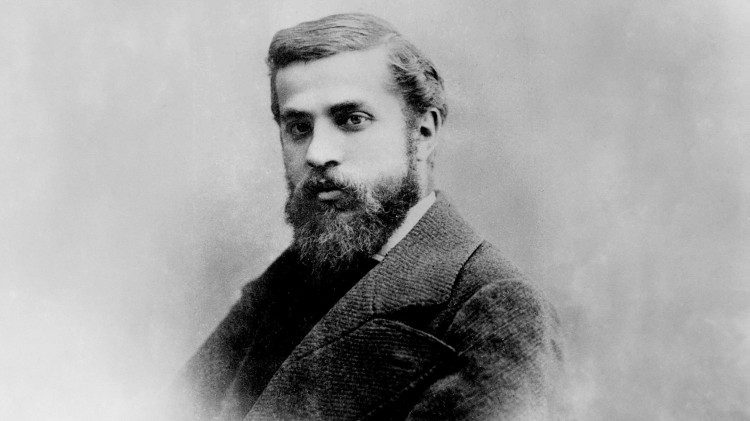
The Basilica of the Sagrada Familia hosts on June 10 one of the most prominent events of Pope Leo XIV’s apostolic journey to Spain. Coinciding with the centenary of Antoni Gaudí’s death, the Pontiff celebrates Holy Mass in the Barcelona temple and blesses the Tower of Jesus, the tallest of the structures designed by the Catalan architect.
The commemoration comes at a particularly significant moment for Gaudí’s cause for canonization—he has been declared venerable by the Church—and once again places the spotlight on the spiritual dimension of a work that the architect himself conceived as a great testimony of Christian faith.
A work conceived for the history of salvation
In an interview given to La Nuova Bussola Quotidiana, Italian architect Chiara Curti, president of the Associació Cultural Antoni Gaudí and one of the world’s leading specialists on the creator of the Sagrada Familia, highlights that the Catalan architect understood his work as a collaboration with God’s work.
“Gaudí designs with a method that is both ancient and new, creating a work that can enter into the history of salvation,” Curti explains.
The expert stresses that Gaudí’s originality lies not only in his technical or formal innovations, but also in his ability to conceive a building destined to transcend his own life and that of his generation.
“I am not the architect of the Sagrada Familia; I am a collaborator of the Creator,” Gaudí used to reply when asked about his role in the construction of the temple.
Hope as the foundation of the project
One of the aspects that most draws scholars’ attention is the confidence with which Gaudí approached a work whose completion he knew he would not live to see.
According to Curti, the architect designed a basilica that required technological advances still nonexistent in his time, convinced that future generations would be able to complete what he had only begun.
“His ability to conceive a cathedral that needed subsequent technological development demonstrates his hope in the future, in the generations to come, and in the good history of the world,” she states.
That confidence was also reflected in one of his best-known sayings: “My client is God, and God is never in a hurry.”
Light as the language of God
The specialist also highlights the central role that light plays in the architectural conception of the Sagrada Familia, a characteristic that led Gaudí to define the temple as a true “cathedral of light.”
For Gaudí, light was a manifestation of the divine presence and had to occupy an essential place in sacred architecture. That is why he designed a space in which the stained-glass windows, the building’s orientation, and the interior layout all contribute to creating a profoundly religious experience.
“What Gaudí does is recover the religious sense of man and propose it anew to contemporary man, who had lost the capacity for wonder,” Curti maintains.
An architecture that expresses faith
Beyond its monumental forms, the Sagrada Familia was conceived to visually convey the central contents of Christianity.
The architect recalls that the Eucharist has been celebrated in the crypt of the temple since the beginning of construction and highlights the presence of elements that constantly refer to the mystery of the Redemption.
She also points out a structural peculiarity of the building: much of its weight is concentrated in the upper zones, giving the impression of a structure that rises toward the sky.
“Gaudí has the ability not only to represent images, but to incorporate them into the very structure of the building,” she explains.
A legacy that continues to grow
One hundred years after the architect’s death, the Sagrada Familia continues to advance thanks to the contributions of millions of visitors and benefactors, preserving the expiatory character with which it was conceived.
For Chiara Curti, the basilica’s success demonstrates that the contemporary world continues to seek answers to the great spiritual questions.
“The Sagrada Familia lives from those who enter as tourists and leave as pilgrims,” she affirms.
The celebration presided over by Leo XIV and the blessing of the Tower of Jesus constitute one of the main events of the Gaudí Year and underscore the enduring relevance of an architect who understood his work not only as an artistic creation, but as a way of proclaiming faith through beauty.