


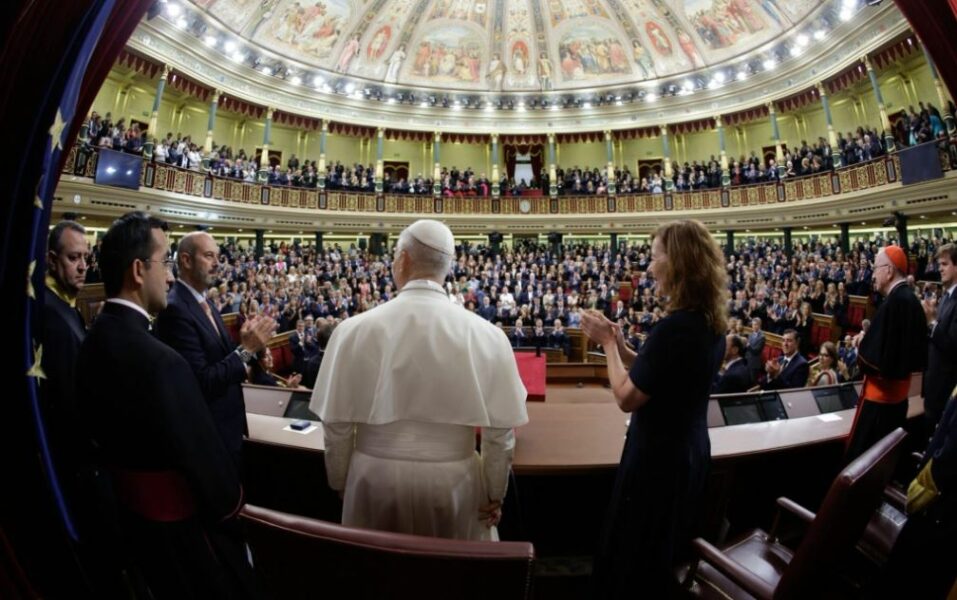
During the past few weeks we have expressed our reservations about this trip by Leo XIV to Spain. We did so because there was an evident risk of political instrumentalization. Because it seemed difficult to ignore that a government besieged by scandals, corruption and a growing loss of credibility could try to use the Pope’s presence as a media oxygen balloon. And because the context invited more skepticism than enthusiasm.
However, intellectual honesty also requires us to acknowledge when reality surpasses our own analyses. Before the Cortes Generales, Leo XIV delivered words that will remain etched in Spain’s political history: “Every human life must be recognized and protected from conception until its natural end.” This is not an ambiguous observation lost in a protocolary speech. It is a direct, unequivocal statement that is profoundly countercultural in today’s Spain.
The Pope pronounced it before deputies and senators of a nation where unrestricted abortion and euthanasia form part of the legal order to the point of the macabre. He pronounced it before those who have promoted, voted for or defended those laws. He pronounced it in the very heart of legislative power. And he pronounced it without concessions, without circumlocutions and without hiding behind comfortable formulations. Moreover, he explicitly asked the chamber: “Can a community be called fully just if it leaves in the shadows the unborn child, the elderly, the sick, those who suffer in silence or those who depend entirely on the care of others?” It was a question directed at the conscience of the legislators and, in reality, at the whole of Spanish society.
This does not make the debatable aspects of the trip disappear. The errors, omissions or decisions that can legitimately be criticized do not disappear either. Nor does the risk that some may try to appropriate the visit for media purposes. All of that will continue to exist and will continue to deserve analysis. But it would be unfair not to recognize what happened.
For a few moments, all those leaders accustomed to speaking in the name of progress, rights and human dignity had to listen to a truth they did not control, that they had not written themselves and that they could not reinterpret at their convenience. They had to listen to the fact that human life deserves protection from conception until natural death. They had to listen to the fact that the weakest still have rights even when they become inconvenient for the dominant ideological projects.
Therefore, while maintaining the reservations, criticisms and disagreements that may exist regarding other aspects of the visit, today it is appropriate to recognize an evident fact. When the Successor of Peter stands before a Spanish parliament that supports abortion and proclaims without complexes the defense of every human life from conception until its natural end, something happens that transcends the political moment. Something happens that restores to the public sphere a fundamental truth about human dignity.
Perhaps, despite the errors. Despite the doubts. Despite the reservations. Perhaps it was all worth it.