


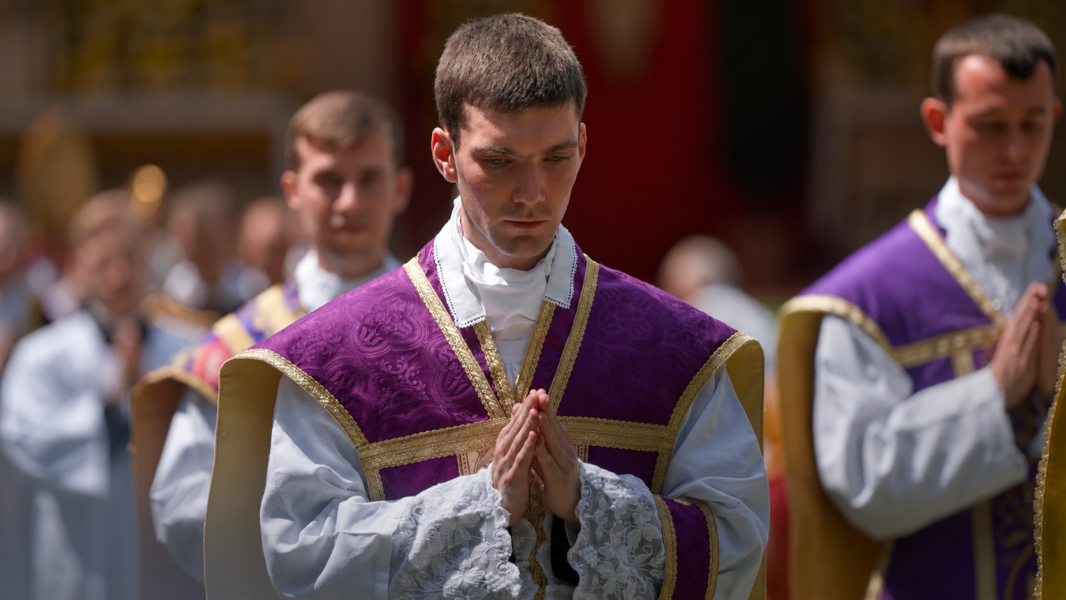
The Priestly Fraternity of Saint Pius X has premiered the first episode of Traditio, an ambitious documentary series that opens the doors to the internal life of its seminaries for the viewer. Far from focusing on ecclesial controversies or canonical debates, this first installment centers on the priesthood and those preparing to receive it, showcasing with extraordinary cinematic quality the day-to-day life of traditional priestly formation.
For more than an hour, the documentary follows several seminarians and deacons at different stages of their path to ordination. The narration takes place mainly at the International Seminary of Saint Pius X in Écône, located in the Swiss canton of Valais, the historic birthplace of the Fraternity founded by Archbishop Marcel Lefebvre; the Seminary of Our Lady Co-Redemptrix in La Reja, in the province of Buenos Aires, where Spanish-speaking seminarians are formed; the Seminary of Saint Thomas Aquinas, in Dillwyn (Virginia, United States), intended for vocations from the English-speaking world; and the International Seminary of the Sacred Heart of Jesus in Zaitzkofen, in Bavaria (Germany), the house of formation for German-speaking candidates. The film allows a glimpse into the daily life of these centers with an unusual closeness.
One of the great strengths of Traditio is precisely its ability to show the normalcy of a reality that is often viewed from the outside only through controversies. The camera follows the seminarians in the classrooms, in prayer, during meals, in recreation, in liturgical ceremonies, and in moments of fraternal fellowship. All of this is filmed with photography of enormous beauty, with carefully composed shots and an aesthetic sensitivity that turns the most ordinary scenes into images of great visual power.
The result allows viewers to discover a Fraternity very different from the caricature often presented by its detractors. There are no aggressive speeches or settling of scores. Nor is there any polemical intent. What the documentary shows are young men concerned with responding to a vocation, priests who speak naturally about the sacraments, and a community whose reason for being continues to be priestly formation and the service of souls.
Especially moving is the testimony of one of the American deacons as he explains the nearness of his priestly ordination, or the intervention of the Superior General of the Fraternity, Father Davide Pagliarani, who recalls how his hands trembled during his first Mass and the profound reverential fear with which he lived those moments. These are testimonies that convey better than any speech the profoundly supernatural understanding the Fraternity has of the priesthood.
The film achieves something rare in contemporary religious productions: showing the beauty of a vocation without falling into sentimentality or prefabricated messages. The viewer contemplates real faces, real stories, and a life dedicated to a concrete mission. The priesthood thus appears not as a theological abstraction, but as a reality embodied in concrete persons.
The preview of the second episode now points toward another dimension inseparable from the charism of the Fraternity: the mission. The advance images show priests in the Philippines, Nigeria, and other remote places where the work founded by Archbishop Lefebvre carries out intense apostolic activity. This charism is inherent to the Fraternity, for Lefebvre himself devoted a great part of his life to Spiritan missionary work in Africa before founding the Fraternity.
After this first episode, the impression remains of being before one of the most accomplished Catholic audiovisual productions of recent years. Not only because of its technical level, which is surprising, but because it demonstrates that the Church and its various charisms can narrate their own reality with contemporary visual codes without renouncing their identity. Traditio opens a window onto the seminaries of the Fraternity and does so through beauty, a language that perhaps explains why so many vocations continue to arise in Écône, La Reja, Dillwyn, or Zaitzkofen.