


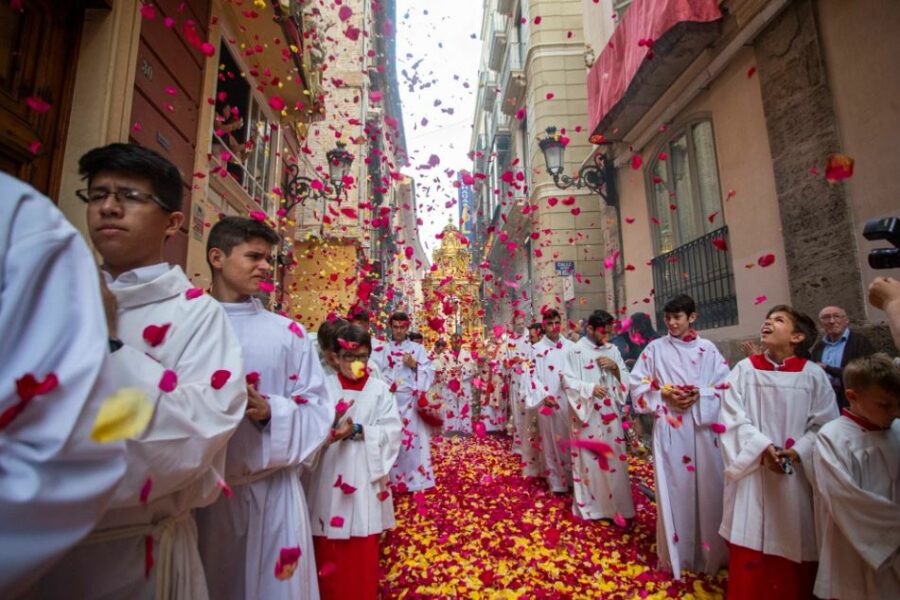
Valencia is preparing to celebrate a particularly significant Corpus Christi this Sunday. The city marks this year the 700th anniversary of the first documented reference to this solemnity, a feast that over the centuries became the main religious and civic expression of the Valencian capital, popularly known as the festa grossa.
According to the Archdiocese of Valencia, the first preserved mention of Corpus Christi appears in a book of the Consell de la Ciutat dated 1326. That document regulated the city’s festive calendar and already included the celebration of Corpus Christi among the days on which ordinary activities were suspended.
A devotion that quickly took root in Valencia
The feast of Corpus Christi was instituted for the whole Church by Pope Urban IV in 1264 and was later confirmed by the Council of Vienne in 1311. In the territories of the Crown of Aragon its spread was rapid, favored by the strong Eucharistic devotion of the time.
Historian Rafael Narbona, Professor of Medieval History at the Universitat de València, explains that the celebration soon found great popular acceptance. The first manifestations were simple, centered on the Mass and small processions linked to the Cathedral, but devotion to the Blessed Sacrament grew until it acquired an extraordinary dimension.
Its definitive consolidation came in 1355, when Bishop Hugo de Fenollet and the jurats of Valencia agreed to organize a great general procession through the city streets. Over the following decades a fixed route was established and resources allocated to a celebration that would become one of the most important in the entire Crown of Aragon.
A public catechesis for the whole city
The Valencian procession gradually incorporated elements intended to transmit the faith to the entire population. Biblical figures, allegorical representations, dances, music and processional floats turned Corpus Christi into a true public catechesis.
Traditions that have survived to the present day, such as the dance of the Moma or the dances of els caballets and els arquets, were born in that context as popular expressions at the service of a celebration whose center was always the exaltation of the real presence of Christ in the Eucharist.
According to Narbona, the Valencian Corpus Christi also succeeded in bringing together all sectors of society around the Blessed Sacrament. Civil authorities, clergy, religious orders, artisans and citizens took part together in a public manifestation of faith that expressed the unity of the community under the protection of Christ.
Valencia prepares a historic celebration
The commemoration of the seventh centenary will feature a special program of events this year. The Archbishop of Valencia, Monsignor Enrique Benavent, will preside on Sunday over the solemn pontifical Mass in the Cathedral and, in the afternoon, the traditional Eucharistic procession through the historic center of the city.
Read also: Why some bishops will not be with Leo XIV in Madrid during the Corpus Christi Mass
The celebrations will also include some of the most characteristic traditions of the Valencian Corpus Christi, such as the presentation of the floral pomells to civil and religious authorities, the procession of the historic Rocas, the Nit d’Albaes, various popular performances and concerts.
On the occasion of this anniversary, several floral monuments will also be installed at different points along the procession route.
The largest monstrance in the world
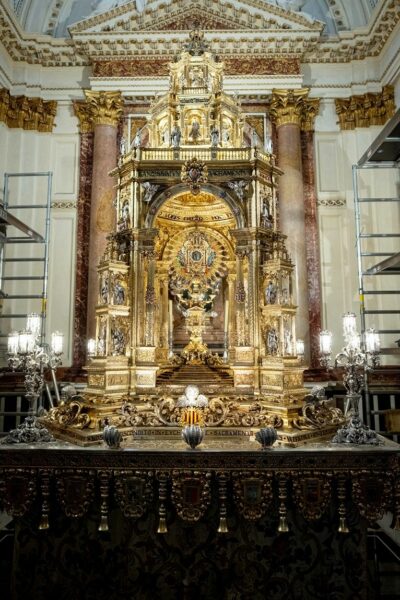
The high point of the day will come with the departure of the processional monstrance from Valencia Cathedral—considered the largest in the world. The monumental work, created by Francisco Pajarón Suay thanks to the contributions of generations of Valencians, will travel the streets accompanied by thousands of faithful, confraternities, associations and authorities.
Seven centuries after the first documentary reference of 1326, Valencia continues to celebrate Corpus Christi as one of its most emblematic feasts. The solemnity keeps alive a tradition that has spanned eras and generations, preserving intact its essential meaning: to render public worship to Jesus Christ present in the Eucharist.