


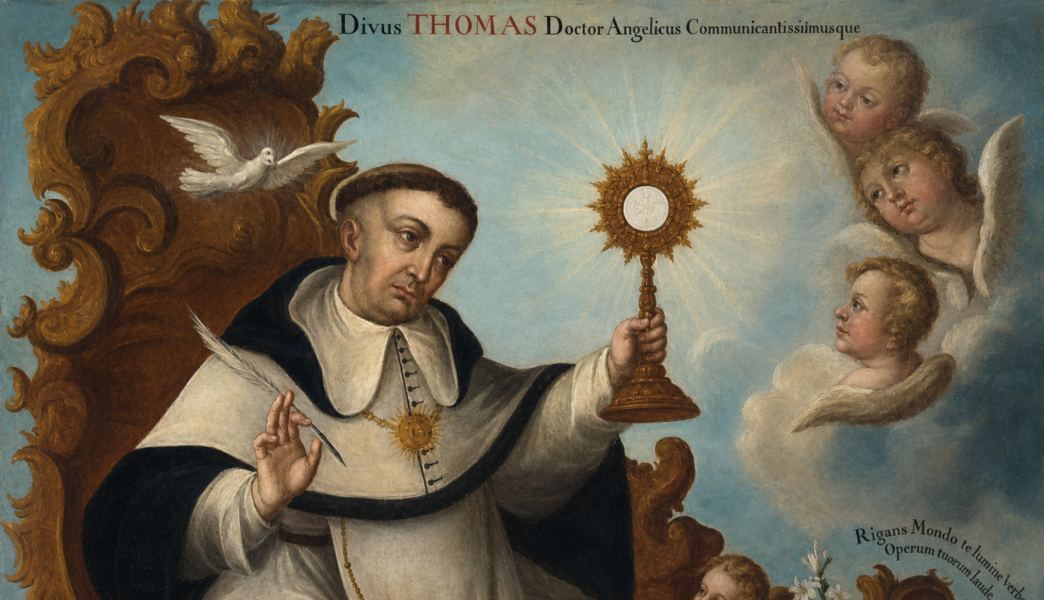
The solemnity of Corpus Christi occupies a singular place in the Church’s liturgical calendar. Born in the thirteenth century to render particular homage to the Most Blessed Sacrament, this celebration not only gave rise to one of the most important feasts of the liturgical year, but also to some of the most profound texts in the entire Catholic tradition. At the request of Pope Urban IV, Saint Thomas Aquinas composed for this feast a series of hymns that, more than seven centuries later, continue to resound in the Church’s liturgy and eucharistic adoration.
Yet the history of these hymns begins before the Angelic Doctor. The solemnity of Corpus Christi had already begun to take shape in the diocese of Liège thanks to the impetus of Saint Juliana of Mont-Cornillon, whose visions and efforts contributed decisively to the creation of a feast dedicated specifically to honoring the real presence of Christ in the Eucharist. A proper liturgical office already existed there for the celebration, but it would be the work of Saint Thomas that would ultimately become the universal expression of the eucharistic faith of the Latin Church.
A feast born to honor the Most Blessed Sacrament
The real presence of Christ in the Eucharist had been professed by the Church since apostolic times. Nevertheless, during the twelfth and thirteenth centuries eucharistic devotion acquired extraordinary momentum. Processions with the Blessed Sacrament, adoration outside of Mass, and theological reflection on the sacrament occupied an ever more important place in the life of Christendom.
In this context arose the initiative to establish a feast specifically dedicated to the Body and Blood of Christ. In 1246, Bishop Robert of Thourotte instituted the celebration in the diocese of Liège, where Saint Juliana had worked tirelessly to promote it.
Years later, the eucharistic miracle of Bolsena, which occurred in 1263, further strengthened devotion to the Most Blessed Sacrament. The following year, Pope Urban IV promulgated the bull Transiturus de hoc mundo, by which he extended the solemnity of Corpus Christi to the whole Church.
To provide the new feast with a complete set of liturgical texts, the Pontiff turned to the greatest theologian of his time: Saint Thomas Aquinas.
The commission to the Angelic Doctor
Posterity remembers Saint Thomas chiefly for the Summa Theologiae and for his decisive contribution to Catholic philosophy and theology. Leo XIII described him as “the bulwark and special glory of the Catholic faith,” while tradition honored him with titles such as Angelic Doctor and Universal Doctor.
Yet the intellect of the Angelic Doctor was not confined to university lecture halls or to the great theological disputes. When Urban IV entrusted him with the texts for the new solemnity, Thomas achieved something extraordinary: he transformed the Church’s eucharistic doctrine into liturgical poetry.
From his pen came the Pange Lingua, the Lauda Sion, the Sacris Solemniis, the Verbum Supernum, and the Adoro te devote. The first four were composed for the liturgy of Corpus Christi; the last, probably intended for personal prayer, would ultimately become one of the best-known eucharistic prayers in the Catholic tradition.
The reception of these texts was so widespread that they gradually supplanted earlier local offices. Although some churches in the region of Liège preserved for centuries elements of the primitive office associated with Saint Juliana, the hymns of the Angelic Doctor ultimately became the official voice of eucharistic devotion in the West.
The Pange Lingua: a synthesis of eucharistic faith
Among all the hymns composed for Corpus Christi, the Pange Lingua holds a privileged place.
Its title comes from the opening words of the text: Pange lingua gloriosi Corporis mysterium (“Sing, O tongue, the glorious mystery of the Body”). Through six stanzas, Saint Thomas traverses the entire economy of salvation: the Incarnation of the Word, the Redemption, the Last Supper, and the institution of the Eucharist.
The hymn contemplates Christ as King and Savior, born of the Virgin to redeem the world through the sacrifice of the Cross. The Eucharist thus appears as the culmination of the redemptive work and as the legacy Christ leaves to His Church before His Passion.
The fourth stanza contains one of the most celebrated formulations of sacramental theology:
“The Word made flesh, by His word, changes the true bread into His flesh and the wine into the blood of Christ.”
In a few lines, the Angelic Doctor expresses the doctrine of transubstantiation: beneath the appearances of bread and wine, Jesus Christ is truly, really, and substantially present.
“Let faith supply the defect of the senses”
The best-known verse of the Pange Lingua summarizes one of Saint Thomas’s fundamental insights:
Praestet fides supplementum sensuum defectui.
“Let faith supply the defect of the senses.”
The senses perceive only the external appearances of the bread and wine. They cannot by themselves grasp the change that occurs during the consecration. Therefore, the believer relies on a higher certainty: the word of Christ.
The same teaching is developed with special beauty in the Adoro te devote:
“Sight, touch, and taste are deceived concerning Thee; only hearing believes with certainty.”
This affirmation does not imply an opposition between reason and faith. Quite the contrary. Saint Thomas maintains that reason helps to understand and deepen the revealed mysteries, yet he also recognizes that faith enables adherence to realities that surpass the natural capacities of the human intellect.
The Eucharist is precisely one of those mysteries. The Christian believes because he trusts in the word of Him who said: “This is my body” and “This is my blood.”
The Tantum Ergo and eucharistic adoration
The last two stanzas of the Pange Lingua acquired such great relevance over time that they began to be used as an independent hymn under the name of Tantum Ergo.
For centuries they have accompanied blessings with the Blessed Sacrament, eucharistic expositions, and numerous acts of adoration.
In them is found one of the best-known expressions of Catholic eucharistic spirituality:
“Let us therefore venerate, bowed down, so great a Sacrament; and let the ancient figure yield its place to the new rite.”
The reference contrasts the figures and sacrifices of the Old Testament with their definitive fulfillment in Christ. What was once announced through signs finds its fullness in the sacramental presence of the Lord.
It is not surprising that these stanzas have accompanied for generations the processions of Corpus Christi, eucharistic adoration, and the liturgy of Holy Thursday. In them converge the doctrinal depth and poetic beauty that characterize the entire work of the Angelic Doctor.
Theology turned into prayer
The Church was already celebrating Corpus Christi before Saint Thomas Aquinas. Hymns, offices, and expressions of devotion to the Most Blessed Sacrament already existed. Yet it was the Angelic Doctor who gave the solemnity the liturgical language with which the Church continues to celebrate it today.
His hymns are not merely a literary jewel of the thirteenth century. They are a synthesis of Catholic faith concerning the Eucharist, a sung catechesis that has traversed the centuries without losing its relevance. In them, the doctrinal precision of the theologian is united with the contemplation of the mystic and the beauty of the poet.
That is why they continue to occupy a central place in the liturgical life of the Church. Because in their verses is found not only an explanation of the eucharistic mystery, but also an invitation to adore it.