


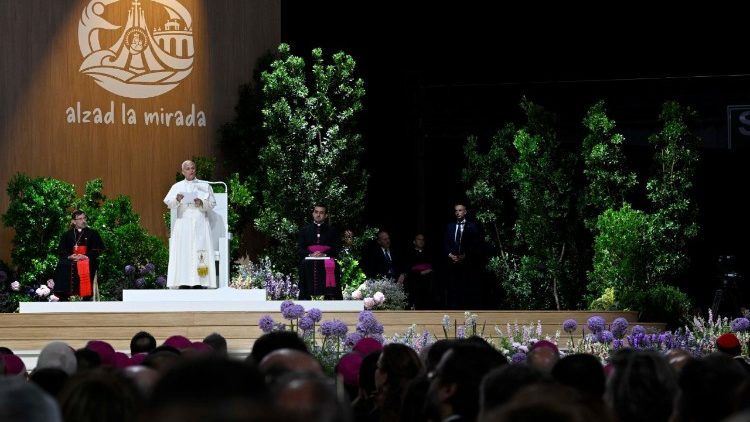
After presiding over the massive Corpus Christi celebration in Plaza de Cibeles, Pope Leo XIV met this Sunday afternoon with representatives from the worlds of culture, art, economics, academia, and sports at the Movistar Arena in Madrid. Before thousands of attendees, the Pontiff defended Christianity’s contribution to public life, reclaimed Europe’s spiritual roots, and encouraged those present to “weave networks” capable of strengthening the social fabric from the dignity of the person.
The event brought together some of the best-known figures in Spanish cultural and social life. Among the participants were actor Antonio Banderas, flamenco dancer Sara Baras, athletes Carolina Marín and Teresa Perales, CEOE president Antonio Garamendi, UGT and Comisiones Obreras general secretaries Pepe Álvarez and Unai Sordo, as well as representatives from the academic, business, and cultural sectors.
A dialogue between Church and society
The gathering, held under the motto “Weaving networks with the worlds of culture, art, economics, and sports,” was structured around various testimonies and dialogue panels addressing issues related to education, work, culture, social cohesion, and the challenges of the contemporary world.
After listening to the participants’ interventions, Leo XIV took the floor to reflect on the responsibility of those who shape society through culture, economics, sports, and education.
The Pope began by highlighting Spain’s cultural richness and the deep imprint left by entire generations on its cities, monuments, universities, churches, and artistic expressions.
“What legacy are we leaving to the future, and what kind of community are we building?” he asked the attendees.
“What does it mean to be truly human?”
Leo XIV stated that today’s society has an extraordinary capacity to produce, innovate, and communicate, but warned of the risk of losing sight of the ultimate meaning of what it generates.
“We can be experts in the means and effective at producing, yet uncertain about why, for what purpose, with whom, and for whom we produce,” he noted.
From that reflection, he placed the anthropological question at the center of the debate and recalled that the human person remains the Church’s fundamental path.
“Today we see that the decisive question remains the same: what does it mean to be truly human?” he affirmed.
University, business, art, and sport
Using the image of the networks that give the event its name, the Pope called for real collaboration among the different spheres of social life and urged each to maintain its vocation of service to the common good.
“Let the university not turn its back on the world of work or renounce truth. Let business activity not see the employee as just another factor in the equation of its interests. Let art not be aimed only at elites. Let sport not be reduced to spectacle or turned into mere business,” he stated.
He also called for technological development to take into account the elderly, the poor, and those who lack a voice in society.
“Would Europe be the same without the mark of faith?”
One of the most significant moments of the address came when Leo XIV reclaimed Christianity’s historical contribution to the building of Europe.
Recalling that faith inspired hospitals, schools, works of charity, and a fundamental part of Europe’s cultural heritage, the Pope posed a direct question to the attendees:
“Can we seriously believe that the Europe we so love would be itself without the mark of faith? Why fear that eternity might permeate everyday life?”
He then recalled one of the most emblematic expressions of Saint John Paul II:
“The cry of my predecessors still resounds: do not be afraid, open wide the doors to Christ. Jesus Christ takes nothing away and gives everything.”
“New threads to weave new networks”
In the final part of his speech, Leo XIV invited those present to become protagonists of a cultural and social renewal based on truth, solidarity, and human dignity.
“I therefore invite you to create new threads to weave new networks that harmonize all spheres of life,” he affirmed.
The meeting concluded with the Pontiff greeting the participants and with a call to strengthen the bonds between faith, culture, and society—one of the central axes of Leo XIV’s first full day in Madrid.
Below is the complete address of Leo XIV:
Your Eminence,
dear friends:
It is a pleasure to meet you in this place, a space that not only hosts sporting, artistic, and cultural activities, but also the deep emotions of the human being: joy, admiration, enthusiasm, and hope, as well as sadness and frustration.
In this beautiful country, it is impossible not to admire the mark of creativity that runs through its history and shapes its identity. A beauty visible in its cities, its streets, its monuments, its squares and gardens, its universities and churches, in its music, painting, dance, and gastronomy. Here one also perceives the soul of the generations that transformed the landscape and gave it its own face, revealing in every stroke the intelligence and will that reside in the human soul.
After contemplating with care these wonders created by previous generations, an inevitable question arises that challenges us all: what legacy are we leaving to the future, and therefore, what kind of community are we building?
I have listened with great interest to each of the panelists’ interventions; I agree with you. Our society, indeed, possesses an extraordinary capacity to produce, innovate, and communicate; however, it seems we still need to learn to safeguard the soul of what it generates. Otherwise, we run the risk of being experts in the means and effective at producing, yet uncertain about why, for what purpose, with whom, and for whom we produce. In this context, the Church, aware of both its successes and its errors throughout history, longs to remain in dialogue with the contemporary world.
In humanity’s DNA is rooted the desire for goodness, beauty, and truth; and from this deeply human aspiration and our centuries-old experience, the Church proposes paths for a dignified life and the common good. To this end, Saint Paul VI affirmed before the United Nations that regardless of one’s opinion of the Bishop of Rome, his mission is well known. As an “expert in humanity,” the Church does not turn away from anything truly human (cf. Gaudium et spes, 1). For this reason, “the attitude of dialogue is an integral part of her vocation” (Magnifica humanitas, 2). Today we see that the decisive question remains the same: what does it mean to be truly human?
The Church shares with humility, but also with firmness, what it has discovered in the experience of faith: that Jesus Christ answers the great questions about human life and its fulfillment, already in this world and culminating in eternity. “Therefore, the human person always remains ‘the Church’s primary and fundamental way’ and the heart of every authentic path of integral human development” (ibid., 50). And so she cannot disregard culture, because through it, man as man “is” more (cf. Compendium of the Social Doctrine of the Church, 554).
And precisely because “culture” evokes “cultivation,” as suggested by the etymological root shared by both terms, we are called to ask ourselves what we are sowing today, what is flourishing and what is silently withering in our society; what values we are preserving and which we are allowing to die. These are deep, necessary questions that cannot be ignored.
To address these questions, a social dialogue is needed that we can compare to the art of weaving networks, which involves encounter, listening, dialogue, and respect.
In the various sectors of human activity, we must care for the language used—written, oral, and in the digital environment, also that of images—because communication is never neutral. Every expression speaks, transmits; it can wound or heal, destroy expectations or open horizons, sow division or awaken hope in the possibility of building together something genuinely human.
Thus, weaving networks is a dialogue between institutions centered on human dignity. This means, for example, that the university should not turn its back on the world of work or renounce truth; that business activity should not see the employee as just another factor in the equation of its interests; that art should not be aimed only at elites; that sport should not be reduced to spectacle or turned into mere business; that technological progress should take into account the elderly, the poor, and those who have no voice.
Our contribution to the dialogue, from a Christian vision of life, knows that the Creator has woven the human being with threads of love, for he was created in the image and likeness of God, who is love (1 Jn 4:8). Here lies the foundation of inalienable human dignity, whose absolute respect is the basis of dialogue.
Secondly, weaving networks means creating together. “Faith,” affirmed Pope Benedict XVI, “is love and therefore creates poetry and creates music. Faith is joy and therefore creates beauty” (Catechesis, 21 May 2008). We have all experienced something beautiful that changed us inwardly: a song, a poem, a silent church, a voice, a glance, even a basketball game shared with friends.
It is not strange, then, that the proclamation of the Good News and the awareness of being brothers and sisters is expressed in the form of a saeta during Holy Week, mystical poetry, literary mastery in authors such as Lope de Vega, Saint Teresa of Jesus, or Saint John of the Cross, Calderón de la Barca, or in the serene prose of Saint Thomas Aquinas, from whom we have inherited the beautiful hymns of Corpus Christi, which we celebrate today. All of this shows the bond between the material and the spiritual that constitutes our existence.
Weaving networks means, thirdly, serving in a disinterested way. An objective look reveals that men and women moved by faith have built hospitals and schools, launched solidarity initiatives, and spoken a language that dignifies people. Therefore, one may honestly ask whether the world—and Europe in particular—would have forged its identity without the spiritual mark that has permeated its history. This is not a provocation, but an invitation to consider whether eternity, which broke into time and space through the Incarnation of Jesus Christ, can once again be reconciled with the everyday.
Can we seriously believe that Europe—which we so love—would be itself without the mark of faith? Why fear that eternity might permeate everyday life? The cry of my Predecessors still resounds: Do not be afraid! Open wide the doors to Christ! Jesus Christ takes nothing away and gives everything.
I want to ask aloud: Who is being excluded despite their virtues and abilities? We cannot ignore that the condition of the poor represents a cry that, throughout human history, constantly challenges our lives, our societies, political and economic systems, and the Church (cf. Dilexi te, 9).
Indeed, Christ restores to the common good the place that belongs to it as a wise arbiter that calms the greed of some and nourishes the hope of others, while desiring to save them all.
This Church, “expert in humanity,” although sometimes it swims against the current, insists that “economic and institutional structures are just only insofar as they serve the integral development of the person and promote the responsible participation of all” (Magnifica humanitas, 34).
Allow me finally to draw your attention to a world that, as you know, is not unfamiliar to me: that of sport. Let us think how many of us learned respect for the opponent on a playing field rather than by listening to a speech. How many athletes teach us to lose without hating, to win without humiliating, or to rise after falling.
On this, Saint John Paul II, as athlete and pastor, declared: “In these times when unfortunately various forms of violence, and therefore of hatred, tend to tear apart the fabric of social solidarity, you [athletes] contribute, for your part, to giving luminous witness to cohesion, peace, union—in a word, to ‘knowing how to be together.’” [1] These words are more relevant and timely than when they first resounded.
Dear friends: I therefore invite you to be new threads to weave new networks that harmonize all spheres of life, to weave a renewed society where time is imbued with eternity, culture safeguards memory and fosters dialogue, education promotes the search for truth with a critical spirit, art awakens wonder and generates noble emotions, business recognizes the dignity of the person, and work continues to be a motor of hope.
Let us be new threads, heeding the counsel of Saint Paul: “Rejoice with those who rejoice; weep with those who weep. Live in harmony with one another; do not be haughty but associate with the lowly; do not claim to be wiser than you are. Do not repay anyone evil for evil. Take thought for what is noble in the sight of all. If it is possible, so far as it depends on you, live peaceably with all” (Rom 12:15-18). For in all this lies the future of our “magnificent humanity.” Thank you very much.
Let us all then be builders of this new community.
Blessing
Thank you very much; congratulations to all.