


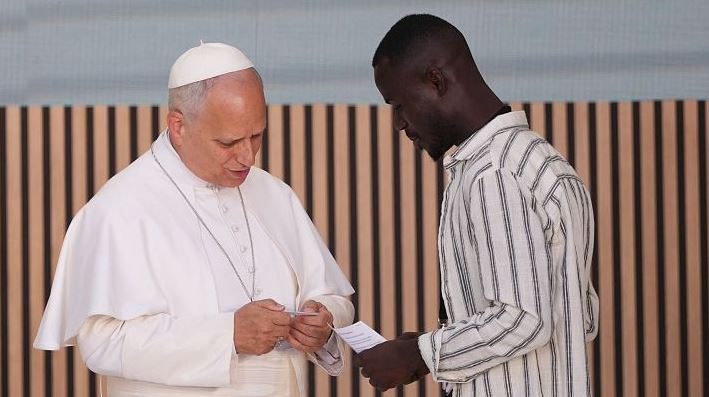
The visit of Leo XIV to the CEDIA 24 Hours center of Cáritas Madrid was accompanied by three personal testimonies that preceded the Pontiff’s address. A mother who immigrated from Cuba, a young Senegalese man who rebuilt his life in Spain, and a volunteer who works with victims of trafficking shared their experiences before the Pope and presented him with various symbolic objects related to their stories.
The ribbon of two children born in Madrid
The first to speak was Niurka, a 33-year-old Cuban woman who arrived in Spain less than a year ago, pregnant and without close relatives in the country.
During her testimony, she explained that she was welcomed at Hogar Santa Bárbara, a facility of the Archdiocese of Madrid for pregnant women or mothers with young children in vulnerable situations. There, her children Ares and Atenea were born, and they later received Baptism.
As a memento of that experience, she gave the Pope a ribbon bearing the names of the two children, similar to those placed on newborns in hospitals. She explained that the object represented a particularly difficult period in her life and the support she received during those months.
The residence card of a Senegalese immigrant
The second testimony came from Khadry, an immigrant from Senegal who arrived in Spain in 2020, in the midst of the COVID-19 pandemic.
He recounted that the first months were marked by uncertainty and the difficulties arising from his new situation. Over time, he managed to enter the labor market and regularize his administrative status.
As a symbol of that process, he presented Leo XIV with a replica of his residence card. The document, he explained, represents the years of waiting, effort, and paperwork that culminated in obtaining authorization to reside legally in Spain.
During his testimony, he also expressed his desire to return temporarily to Senegal to reunite with his family and share this new stage of his life with them.
A pair of sandals as a symbol of accompaniment
The third testimony was given by Alicia, a volunteer with the Proyecto Esperanza of the Adorers Religious, dedicated to accompanying women who are victims of trafficking and exploitation.
Speaking on behalf of numerous volunteers linked to the social pastoral care of the Archdiocese of Madrid, she explained some aspects of the work carried out alongside people in vulnerable situations.
As a gift to the Pontiff, she presented a pair of sandals inspired by the biblical episode of Moses before the burning bush. She noted that the gesture was intended to represent respect for the people being accompanied and the shared journey with those going through especially difficult situations.
Three stories before the Pope’s message
The three testimonies were heard by Leo XIV before he delivered his address to the staff, volunteers, and users of the center.
Afterward, the Pontiff thanked them for the shared experiences and stated that they reflected “painful experiences, but above all, full of light.”