


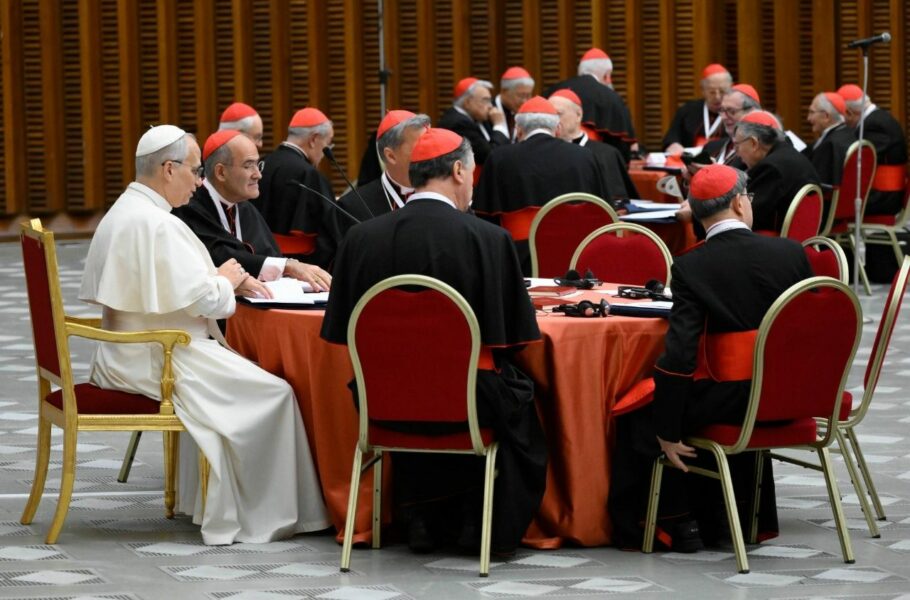
The next consistory convened by Pope Leo XIV for June 26, 27, and 29 will focus on reflection on the international situation, study of the encyclical Magnifica humanitas, and an update on the synodal process. This is evident from a letter sent on June 3 by Cardinal Giovanni Battista Re, Dean of the College of Cardinals, to all participating cardinals.
In the letter published by Messa In Latino, the cardinal states that the Holy Father wishes the meeting to be a space for mutual listening, discernment, and shared reflection on the challenges currently facing the Church. The goal is to gather the experience of cardinals from around the world and foster a frank exchange of views on issues relevant to ecclesial life.
Four major themes for the consistory
The first session will be devoted to a shared reflection on the international situation and the reality of local Churches. The cardinals will be invited to present the main sufferings, tensions, and challenges currently affecting the peoples and ecclesial communities under their responsibility, as well as the signs of hope and reconciliation they consider most significant.
The second and third sessions will focus on the encyclical Magnifica humanitas, recently published by Leo XIV. The Vatican has made specific working materials available to participants to prepare for the discussions.
During the second session, particular attention will be given to the fifth chapter of the document, titled “The Culture of Power and the Civilization of Love.” The letter highlights that the encyclical analyzes the growing polarization and conflict in the contemporary world and recalls that peace is not merely a moral ideal but an essential condition for the development of peoples.
The text also notes that the cardinals will be invited to reflect on how to reaffirm today the principle of the “superamento della teoria della guerra giusta,” that is, the overcoming of the just war theory, an expression the encyclical itself considers frequently invoked to justify armed conflicts.
The encyclical as a central axis of the pontificate
The third session will delve into the central proposal of Magnifica humanitas: interpreting the cultural and social transformations of our time in light of the Gospel in order to guide integral human development.
The prominence given to the encyclical during the consistory confirms that the document has become one of the main programmatic axes of Leo XIV’s pontificate. It is not merely a doctrinal reflection but a text the Pope wishes to make a reference point for the Church’s pastoral action and discernment in the coming years.
The synodal process returns to the table
The final session will include an update on the process of implementing the Synod and the preparation of the assemblies scheduled for 2027 and 2028. The cardinals will receive information on the various stages, criteria, and tools being developed to continue the synodal path.
This will be followed by an open dialogue between the members of the College of Cardinals and the Pope, with brief interventions of three minutes per participant.
The sessions contrast with the absence of other topics that had raised interest after the first consistory of the pontificate. At that time, the cardinals chose to focus their work on synodality and the evangelizing mission, leaving aside issues such as liturgy and the reform of the Curia.
Consistory and creation of new metropolitans
The letter also recalls that the consistory will be held on June 26 and 27 in the Paul VI Hall and the Synod Hall. The proceedings will conclude on June 29 in St. Peter’s Basilica, during the solemnity of Saints Peter and Paul.
On that day, at 9:30 a.m., Leo XIV will preside over the solemn Eucharistic celebration in the Vatican Basilica, during which he will bless the pallia and personally confer this liturgical insignia on the new metropolitan archbishops appointed over the past year.
The imposition of the pallium is one of the most significant moments of the solemnity of Saints Peter and Paul. This band of white wool, adorned with black crosses, symbolizes the communion of metropolitan archbishops with the Successor of Peter and the pastoral responsibility they exercise over the particular Churches entrusted to their care.
The letter sent by Cardinal Re further specifies that a concelebrated Eucharist for all the cardinals is not planned for Sunday, June 28, as had already been communicated previously.
The convocation reflects the Pope’s desire to turn consistories into genuine spaces for collegial consultation and discernment, in which the cardinals can contribute the experience of the particular Churches and collaborate more closely in guiding the universal governance of the Church.
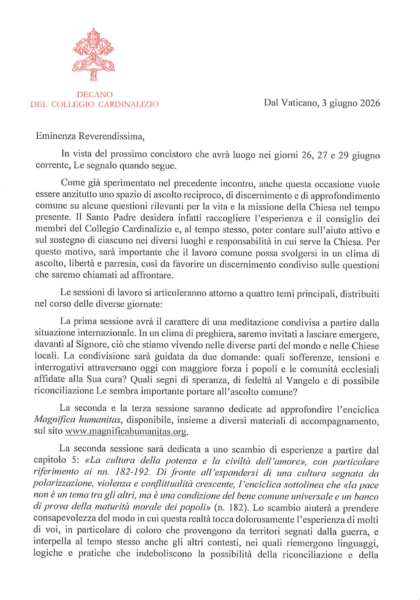
DEAN OF THE COLLEGE OF CARDINALS
Vatican City, June 3, 2026
Your Eminence:
In view of the upcoming Consistory, to be held on June 26, 27, and 29 of this year, I wish to inform you of the following.
As was already experienced in the previous meeting, this occasion is intended above all to be a space for mutual listening, discernment, and shared reflection on certain important issues for the life and mission of the Church at the present moment. The Holy Father indeed wishes to gather the experience and counsel of the members of the College of Cardinals and, at the same time, to count on the active help and support of each one in the various places and responsibilities in which they serve the Church. For this reason, it will be important that our common work take place in a climate of listening, freedom, and parrhesia, in order to foster a shared discernment on the issues we will be called to address.
The working sessions will be organized around four main themes, distributed over the different days.
The first session will take the form of a shared meditation on the international situation. In a spirit of prayer, we will be invited to present before the Lord what we are experiencing in the different parts of the world and in the local Churches. The sharing will be guided by two questions: What sufferings, tensions, and questions most strongly affect today the peoples and ecclesial communities entrusted to your care? What signs of hope, fidelity to the Gospel, and possible reconciliation do you consider important to present for our common reflection?
The second and third sessions will be devoted to a deeper study of the encyclical Magnifica humanitas, available, along with various supplementary materials, on the website magnificahumanitas.org.
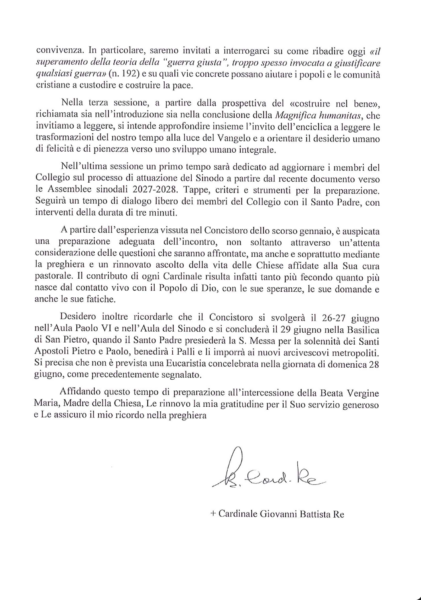
The second session will be dedicated to an exchange of experiences based on chapter 5, “The Culture of Power and the Civilization of Love,” with particular reference to numbers 182-192. In the face of the expansion of a culture marked by polarization, violence, and growing conflict, the encyclical emphasizes that “peace is not simply one issue among others, but a prerequisite for the universal common good and a sign of the moral maturity of peoples” (n. 182). The exchange will help us become more aware of how this reality painfully affects the experience of many of you, especially those from territories marked by war, while also challenging other contexts where languages, logics, and practices that weaken the possibility of reconciliation and coexistence are reappearing. In particular, we will be invited to reflect on how best to reaffirm today that “the theory of ‘just war,’ which has too often been used to justify any kind of war, has already been surpassed” (n. 192), and on what concrete paths might help peoples and Christian communities to safeguard and build peace.
In the third session, taking as a starting point the perspective of “building for the common good,” recalled both in the introduction and in the conclusion of Magnifica humanitas, whose reading we invite you to undertake, the aim is to jointly deepen the encyclical’s invitation to interpret the transformations of our time in light of the Gospel and to direct the human desire for happiness and fulfillment toward integral human development.
In the final session, an initial moment will be devoted to updating the members of the College on the process of implementing the Synod, in light of the recent document Toward the Assemblies 2027-2028: Stages, Criteria, and Instruments for Preparation. This will be followed by a time of open dialogue between the members of the College and the Holy Father, with interventions limited to three minutes.
In light of the experience of the Consistory held last January, thorough preparation for the meeting is strongly recommended, not only through careful consideration of the issues to be addressed, but also, and above all, through prayer and renewed attention to the life of the Churches entrusted to your pastoral care. The contribution of each cardinal is, in fact, all the more fruitful the more it arises from living contact with the People of God, with their hopes, their questions, and also their difficulties.
I also wish to remind you that the Consistory will be held on June 26 and 27 in the Paul VI Hall and the Synod Hall, and will conclude on June 29 in St. Peter’s Basilica, when the Holy Father will preside over the Mass of the solemnity of Saints Peter and Paul, bless the pallia, and confer them on the new metropolitan archbishops. It is specified that a concelebrated Eucharist is not planned for Sunday, June 28, as previously indicated.
Entrusting this time of preparation to the intercession of the Blessed Virgin Mary, Mother of the Church, I renew my gratitude for your generous service and assure you of my remembrance in prayer.
† Cardinal Giovanni Battista Re
Dean of the College of Cardinals