


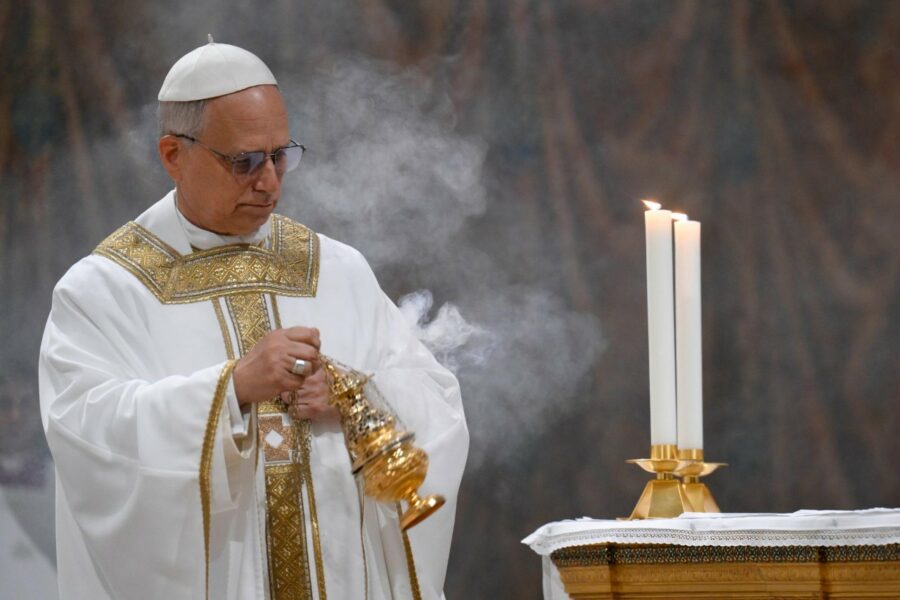
Pope Leo XIV defended this Wednesday the importance of rite, signs, and symbols in the liturgical life of the Church, emphasizing that they are not accessory or merely ceremonial elements, but an essential reality through which God communicates his grace to the faithful. During the General Audience held in St. Peter’s Square, the Pontiff warned against a superficial understanding of the liturgy and encouraged rediscovering the spiritual richness of the sacred celebrations.
Continuing his cycle of catechesis dedicated to the documents of the Second Vatican Council, Leo XIV focused his reflection on the constitution Sacrosanctum Concilium, specifically addressing the meaning of rite, sign, and symbol in the Christian liturgy.
Rites are not an external covering
The Pope recalled that the early Church and the Church Fathers clearly understood that liturgical rites do not constitute a mere external covering of the sacramental mystery nor a set of arbitrary ceremonies. On the contrary, he affirmed that they are the ecclesial mediation through which the divine gift reaches humanity.
“The rite gives form to the liturgical action and, through it, to our life,” explained Leo XIV, noting that authentic participation in the liturgy involves the commitment of the whole person—body, mind, and heart—and not the passive attitude of a mere spectator.
According to the Pontiff, it is precisely through the sacred rites that the faithful are formed to listen to the Word of God, to give thanks, to adore, to live ecclesial communion, and to recognize the action of divine grace in their lives.
A response to activism and the haste of the modern world
Leo XIV highlighted that the rite introduces man into a logic different from the productivity and efficiency that dominate contemporary society. In the face of the frantic pace of modern life, the liturgy offers a space of gratuity and contemplation.
“With the solemn sobriety of its rhythms, the rite interrupts frantic activities, leading us back to what is essential,” the Pope stated. Thanks to this, he added, the believer discovers a different experience of time and space, learns to recognize the primacy of grace, and finds a pause capable of regenerating the heart.
The importance of signs and symbols
He also recalled that the constitution Sacrosanctum Concilium teaches that the sanctification of man is accomplished through sensible signs that manifest invisible spiritual realities.
As an example, he mentioned the symbolism of water, present from creation, through the flood, the crossing of the Red Sea and the Jordan, up to the water that flows from Christ’s side and finds its full sacramental expression in Baptism.
The Pope emphasized that liturgical symbols are not mere intellectual representations, but actions capable of transforming those who participate in them, generating ecclesial belonging, and fostering authentic relationships within the Christian community.
Recovering the sense of the sacred
Drawing on a reflection by Romano Guardini cited by Francis in the apostolic letter Desiderio desideravi, Leo XIV noted that one of the great challenges of current liturgical formation is to help contemporary man recover his capacity to understand symbols.
For this reason, he encouraged the faithful to allow themselves to be educated by the rites of the Church, avoiding arbitrariness and caring for the beauty of the celebrations. He also insisted on the need for authentic mystagogical catechesis that allows the spiritual depth of the liturgy to be discovered and fosters a true encounter with God.
“The experience of a living and devout liturgy, accompanied by appropriate mystagogical catechesis, is the best help to awaken in all an openness to the encounter with God,” the Pontiff affirmed at the conclusion of his catechesis.
Below are the words of Leo XIV at the General Audience:
Dear brothers and sisters:
Continuing with the catecheses on the conciliar Constitution Sacrosanctum Concilium (SC), we wish to pause and reflect on some elements that constitute the sacred liturgy, such as rite, sign, and symbol.
The Second Vatican Council, benefiting from the valuable work of the liturgical movement, has helped us rediscover a truth very much alive in the consciousness of the early Church and in the teaching of the Fathers. The rites of the Christian liturgy are not an external covering of the sacramental ministry, nor a set of arbitrary ceremonies, but the ecclesial mediation through which the divine gift reaches us. Precisely for this reason, the Council invites us to understand the Mysterium fidei that is realized in the liturgy through the rites and prayers (cf. SC, 48).
The rite gives form to the liturgical action and, through it, to our life, generating in us a spiritual sensitivity that makes us capable of savoring the presence of God through Jesus Christ. Naturally, this happens if we do not remain on the sidelines or as silent spectators (cf. ibid.) with regard to the liturgy, but rather participate with our whole being—body, mind, and heart—in obedience to the Lord’s command. Through the sacred rite we are formed in listening to the Word of God, in thanksgiving and adoration, in fraternal sharing, and in ecclesial communion. We discover that we are an assembly of many faces, gathered by the same faith.
The rite involves us in a well-defined sequence of gestures and prayers, which at times may contrast with our individual tendency toward spontaneity. Its logic does not consist in constraining freedom within schemes. On the contrary, with the solemn sobriety of its rhythms, the rite interrupts frantic activities, leading us back to what is essential. We thus discover another dimension of action, not governed by productive calculations, and another experience of time and space. In the rite we experience a logic of gratuity, we find a rest that regenerates the heart, we recognize that divine grace precedes us, and we learn to live at a rhythm inhabited by the Holy Spirit.
The grammar of the rite is interwoven with the signs and symbols proper to the liturgy. In it, as the Council affirms, “sensible signs signify and, each in its own way, bring about the sanctification of man” (SC, 7). The Catechism of the Catholic Church deepens the value of these signs, recalling that “their meaning is rooted in the work of creation and in human culture, is shaped in the events of the Old Covenant, and is fully revealed in the person and work of Christ” (n. 1145). The sign of water is emblematic: from the origins of creation to the flood, from the crossing of the Red Sea to the Jordan, to the water that flows from Christ’s side and becomes the sacramental sign of immersion into his death and resurrection.
“Sign” and “symbol” are terms often used as synonyms. In reality, a sign is symbolic when it is capable of referring not only to an idea, but to an entire system of meanings and values. Thus, for example, when we are sprinkled with holy water, our awareness of the gift received in Baptism and our adherence to the new life in Christ is reawakened. Secondly, symbols have an essentially practical character, being above all actions: simpler and more common, such as kneeling and exchanging the sign of peace, or more demanding, such as the acts that constitute each Sacrament. Above all, symbols have a singular performative and transformative dimension, both toward the material elements that compose them and toward those who come into contact with them, generating belonging, touching the heart and mind, and fostering authentic ecclesial relationships.
In the Apostolic Letter Desiderio desideravi, Pope Francis, making his own an affirmation of Romano Guardini, identified “the first task of liturgical formation: that man may once again become capable of symbols” (n. 44). We need to allow ourselves to be educated by the rites of the liturgy, carefully and without arbitrariness safeguarding the beauty of our celebrations, and committing ourselves to authentic mystagogy. The experience of a living and devout liturgy, accompanied by appropriate mystagogical catechesis, is the best means to reawaken in all that openness to the encounter with God which, in the logic of the Incarnation, can only take place by involving the whole person: spirit, soul, and body (cf. 1 Thess 5:23).