


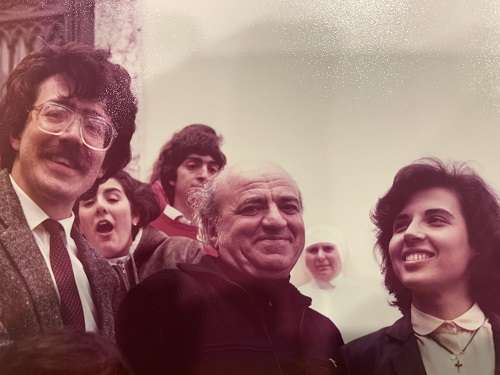
Two years after promising a «path of truth» to clarify the abuses committed by Jesuit priest Sauro De Luca, the Society of Jesus in Italy finds itself at the center of a new controversy. The decision not to publish the report prepared by an independent specialist and to replace it with an internal document has sparked criticism and reopened questions about the handling of one of the cases that have affected the Youth Eucharistic Movement.
The controversy arose after various Italian media outlets questioned the Jesuits’ decision to keep confidential the work carried out by Grazia Villani, the professional chosen to gather testimonies from victims and reconstruct the abuses attributed to De Luca, who died in 2012.
A priest influential for three decades
Sauro De Luca was a key figure in the history of the Youth Eucharistic Movement (MEG), an organization linked to the Society of Jesus and present throughout Italy, dedicated to the spiritual formation of children and young people.
For more than thirty years, between 1967 and 1998, he led the movement and became a reference point for several generations of young Catholics.
However, in 2024 several women publicly denounced having suffered abuse by the priest during the 1990s, when they were between 14 and 16 years old. The testimonies described abusive behavior committed in the context of spiritual accompaniment and personal encounters.
The promise to bring the whole truth to light
After receiving new complaints, the national director of the MEG, Jesuit Renato Colizzi, announced an initiative that was presented as an exercise in transparency.
In statements to the Catholic newspaper Avvenire, Colizzi explained that the Society had decided to undertake a «path of truth» and invited all possible victims or witnesses to provide their testimonies.
The task was entrusted to Grazia Villani, a specialist in victim support and independent of both the MEG and the Jesuit structure. The stated objective was to produce a comprehensive report that would clarify the facts and bring to light even the most uncomfortable aspects of the movement’s history.
Colizzi himself acknowledged at the time that the Society had not done everything it should have done when the first complaints began to emerge.
“We are aware that the Society has not done everything it should or could have done. That is why one chapter must address our own conduct,” he stated on that occasion.
From the independent report to the internal document
The situation took an unexpected turn when the work assigned to Villani was completed.
According to reports from various Italian media outlets, the Jesuits decided not to authorize the publication of the report prepared by the specialist. Instead, the Society released a much shorter document drafted under the supervision of the Jesuit provincial, Father Alessio Ronny.
Criticism has focused especially on the contrast between the expectations raised by the independent investigation and the content that was ultimately disclosed.
While the original report had been presented as an opportunity to confront the “uncomfortable truth of the facts,” the published document devotes only a few lines to describing the abuses and contains scant references to possible institutional responsibilities.
Unanswered questions
The main question raised by critics is straightforward: if the Society commissioned an independent investigation precisely to learn the whole truth, why not make the results of that work public?
There is also criticism that the final document attributes part of the errors to the mentality of an era in which certain behaviors were not properly addressed—an explanation some consider insufficient to understand how warning signs could have been ignored for years.
Another particularly sensitive aspect is the handling of the case in 2010. As Colizzi himself acknowledged, it was then that two victims filed formal complaints. Following an internal investigation, De Luca admitted his responsibility and was removed from public activity, remaining confined to a Jesuit community until his death two years later.
However, those measures were never accompanied by a public statement that would have alerted possible victims or fully clarified what had occurred.
Transparency and credibility
It is significant that it was the Society of Jesus itself that recognized the need to critically review its conduct and promised a process aimed at clarifying the facts in their full scope. Precisely for this reason, the decision not to publish the independent report has caused bewilderment even among those who had viewed positively the path initiated in 2024.
Victims have the right to know the whole truth about what happened. The ecclesial community also has the right to know how those in positions of governance acted when the first complaints began to surface.
Two years after announcing a “path of truth,” the question remains open: what does the report commissioned by the Jesuits themselves contain, and why can it not be known in its entirety?