


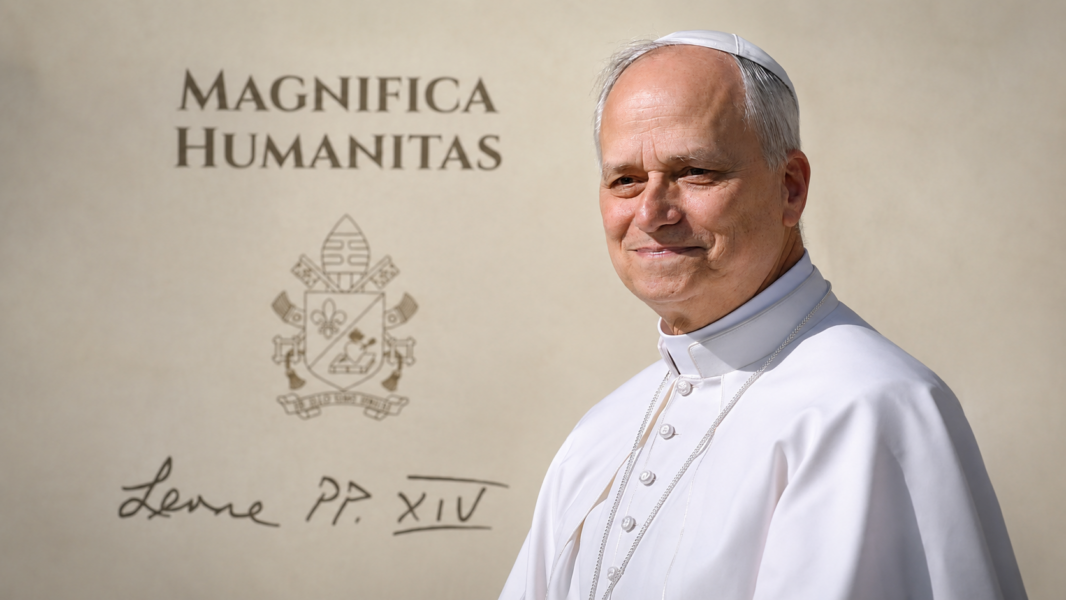
When the Holy See published last May Magnifica humanitas, the first encyclical of Leo XIV, the absence of an official Latin version drew attention. The situation was especially significant for a magisterial document of the highest level and fueled debate about the role that the language of the Church continues to play in Vatican communications.
While the Italian, Spanish, Portuguese, English, French, German, and Polish versions were published by the Holy See last Pentecost Monday, the Latin edition is still being prepared. According to various reports from the Vatican, several specialists are currently working on a version that respects both doctrinal precision and the linguistic requirements of ecclesiastical Latin.
The challenge of translating contemporary concepts
Unlike previous encyclicals, Magnifica humanitas pays special attention to issues such as artificial intelligence, algorithms, the transformation of work, and the ethical challenges arising from the technological revolution.
The presence of this contemporary vocabulary has forced the Latinists in charge of the translation to confront problems that are uncommon in traditional papal documents. Some concepts lack established equivalents in Latin and require the creation of new terms or the adaptation of expressions that allow the content of the text to be conveyed accurately.
Curiously, one of the most frequently repeated terms in the encyclical, “algorithm,” does not pose any particular difficulties. The word is already a Latinized form of a term whose remote origins lie in the Persian world and which was incorporated centuries ago into Western scientific vocabulary.
The limits of machine translation
According to information released by the German outlet, Katholisch.de, the speed with which the Holy See published the main modern translations of the document has led some observers to speculate about the possible use of artificial intelligence tools in certain phases of the editorial process.
However, experts note that this type of technology still shows significant limitations when it comes to translating into Latin. The grammatical complexity of the language, its historical evolution, and the need to maintain theological precision make a highly specialized human review indispensable.
Other translations still pending
The Latin version is not the only one that has yet to see the light of day. Among the translations still in preparation are also some considered strategic by the Holy See, such as the Chinese and Russian versions.
By contrast, the Arabic translation has already been completed and published along with the other versions officially released by the Vatican.
More than a linguistic issue
The delay of the Latin translation has relevance that goes beyond a mere philological question. Although encyclicals are usually disseminated initially in the main modern languages, the Latin version continues to be the definitive official reference for numerous specialists and scholars of magisterial texts.
For this reason, the future publication of the Latin version of Magnifica humanitas will be watched with particular attention by those who study the pontifical magisterium. In addition to providing the definitive reference text, it will allow verification of how the Church has decided to incorporate into Latin concepts born in the digital age and linked to one of the central issues of Leo XIV’s pontificate so far.