


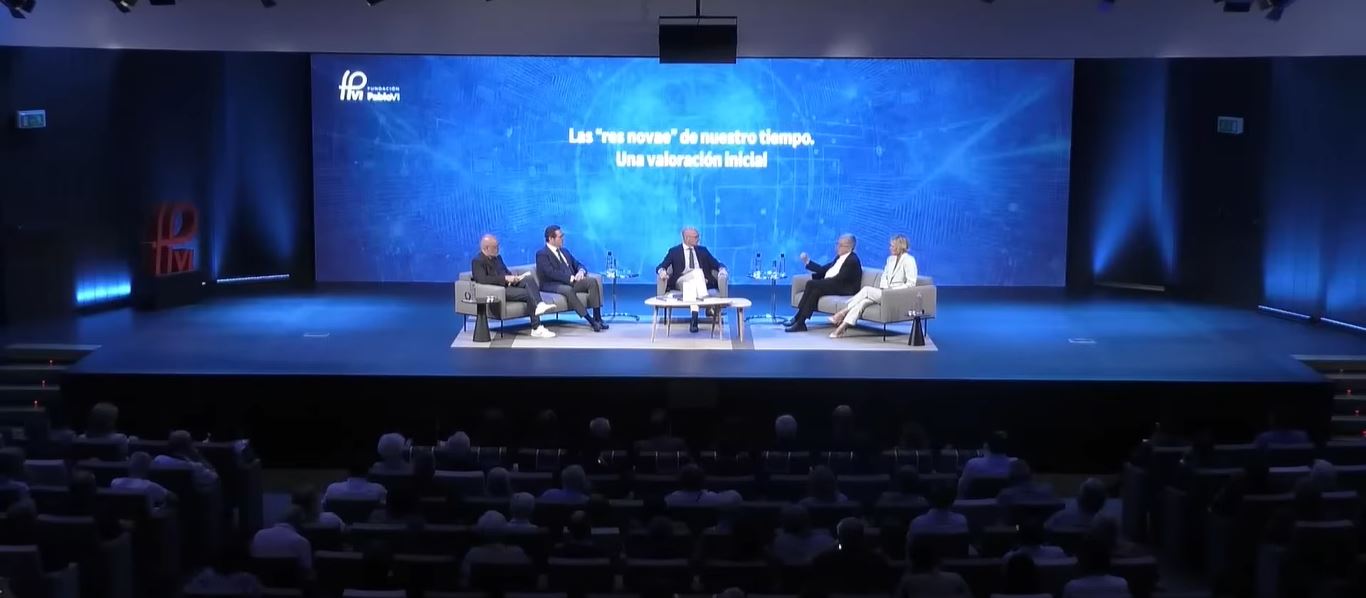
The Pablo VI Foundation hosted on Monday the presentation in Spain of Magnifica humanitas, the first encyclical of Pope Leo XIV, in an event that brought together representatives of the Church, the business world, trade unions and the technological sector to reflect on the challenges posed by artificial intelligence.
The meeting featured the participation of the president of the Spanish Episcopal Conference, Luis Argüello; the president of CEOE, Antonio Garamendi; the secretary general of Comisiones Obreras, Unai Sordo; and the former Secretary of State for Digitalization and Artificial Intelligence, Carme Artigas. All of them analyzed the ethical, social and economic implications of a technology that is profoundly transforming society.
The Church’s social doctrine in the face of the technological revolution
Much of the debate revolved around the reflections presented by Luis Argüello, who presented the encyclical as a new impetus for the Church’s social doctrine and a response to the challenges posed by the so-called fourth industrial revolution.
The president of the Episcopal Conference highlighted that the Gospel has a social dimension and stressed that Magnifica humanitas addresses fundamental issues such as human dignity, the common good, social justice and the principle of subsidiarity. In his view, the encyclical does not merely offer a reflection on artificial intelligence, but proposes an ethical framework from which to confront the changes of our time.
Argüello also warned of the emergence of “new forms of slavery” in the current context and defended the need to form consciences to respond appropriately to technological challenges. On several occasions he insisted that human dignity constitutes the foundation of the Church’s entire social doctrine and recalled that life is sacred from conception.
For the Archbishop of Valladolid, the document from Leo XIV invites us to look beyond immediacy and to build a horizon capable of guiding technological development at the service of the person.
An artificial intelligence at the service of the human being
The former Secretary of State for Digitalization and Artificial Intelligence, Carme Artigas, described the encyclical as a courageous and timely intervention at a decisive moment for the development of these technologies.
Artigas defended the possibility of regulating artificial intelligence and rejected the idea that its evolution is an inevitable process to which society must passively adapt. As she explained, the real challenge lies in deciding what use will be given to these tools and ensuring that they remain at the service of people.
The former government official also warned that automation will bring about significant transformations in employment, especially in administrative and bureaucratic tasks, although she also highlighted the opportunities that artificial intelligence offers for scientific research, medicine and business competitiveness.
Employment, social dialogue and epochal changes
Antonio Garamendi and Unai Sordo agreed in pointing out that artificial intelligence constitutes one of the greatest economic and labor challenges of the coming decades.
The president of CEOE defended the importance of social dialogue to address these changes and warned of the risk that people may be reduced to mere data within the new economic models. He also recalled that the encyclical does not propose a condemnation of technology, but rather a reflection on its responsible use.
For his part, the secretary general of Comisiones Obreras defined the current technological transformation as an “epochal challenge” and noted that, as in previous industrial revolutions, artificial intelligence will bring with it simultaneous processes of destruction, transformation and creation of employment.
Sordo defended the need to accompany these changes through training, regulation and mechanisms that allow a just transition for the affected workers.
A reflection for the future
The presentation of Magnifica humanitas has opened in Spain the debate on one of the issues that will mark the coming decades. The first encyclical of Leo XIV places artificial intelligence within a broader reflection on human dignity, work, social justice and the common good.