


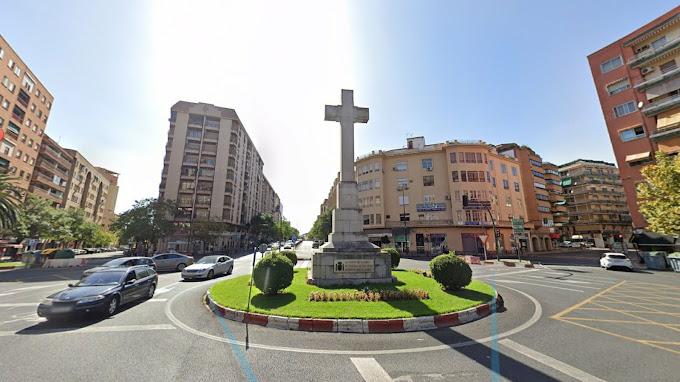
The Government has repeatedly demanded the removal of the Cruz de los Caídos in Cáceres and has granted the City Council a three-month deadline to eliminate the monument from public space. The new resolution, sent by the Secretaría de Estado de Memoria Democrática, has prompted an immediate response from the council, which has announced administrative appeals and legal actions to prevent its disappearance.
The decision comes after the Executive included the cross last April in the Catálogo de símbolos y elementos contrarios a la memoria democrática. Since then, the controversy has grown, as the monument is seen by its detractors as maintaining a link to Francoism, while its defenders consider it a symbol integrated for decades into the life of the city.
The Government rejects the religious character of the monument
One of the most controversial aspects of the case is the reasoning used by the Ministerio de Política Territorial y Memoria Democrática to justify the removal.
According to the Government, the Cruz de los Caídos cannot be considered a religious symbol, since its origin would be linked to the commemoration of those who died on the Nationalist side during the Civil War. The Ministry considers that the monument retains its original meaning and maintains a high symbolic value associated with the Franco regime.
Likewise, the Executive argues that the cross lacks sufficient artistic uniqueness to justify its permanence in public space and recalls that for decades it was used as the setting for official acts of exaltation of the regime.
The City Council announces a legal battle
In response to the ministerial order, the mayor of Cáceres, Rafael Mateos, has confirmed that the City Council will appeal the new resolution and will exhaust all legal avenues to defend the monument’s permanence.
The council had already challenged a previous resolution and believes the procedure presents significant legal flaws. In addition, it will request the suspension of deadlines while the corresponding appeals are processed.
Mateos has argued that the cross is part of the city’s urban landscape and constitutes a point of reference for several generations of cacereños. In his view, many residents no longer identify it with political exaltation, but rather with an element fully integrated into the history of Cáceres.
A cross at the center of political and cultural dispute
The controversy has intensified in recent months following the agreement reached between PP and Vox in Extremadura to promote the declaration of the Cruz de los Caídos as a Bien de Interés Cultural (BIC), an initiative aimed at ensuring its heritage protection.
Meanwhile, memorialist associations have welcomed the Government’s decision and are calling for the removal to be carried out as soon as possible, considering the monument one of the main Francoist vestiges remaining in the city.
The new resolution from the Secretaría de Estado de Memoria Democrática now opens a new chapter in a dispute that will likely end in the courts and goes beyond the specific case of Cáceres. At the heart of the debate lies a question that continues to generate division in Spain: the meaning of crosses present in public spaces and the place that Christian symbols should occupy in the country’s historical memory.