


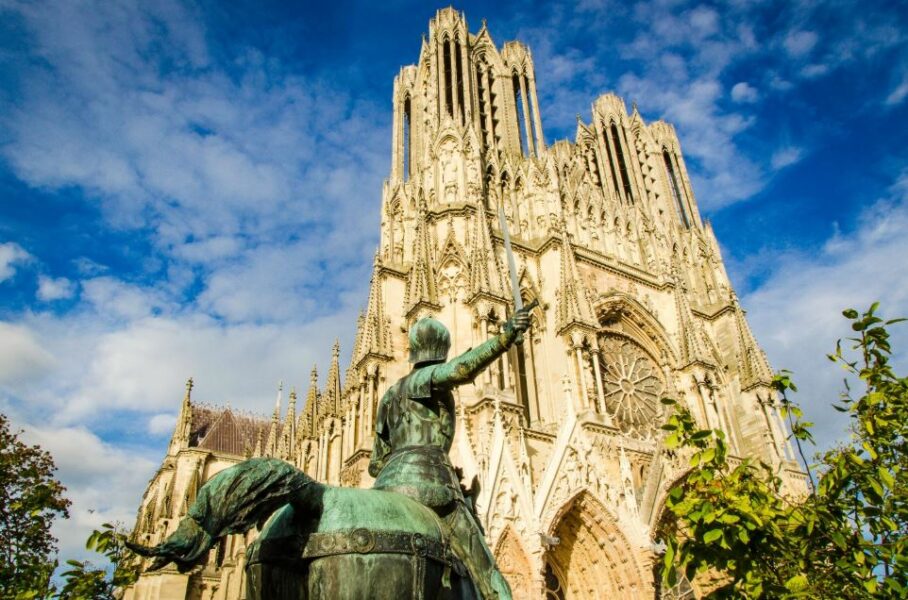
The traditional Joan of Arc Festivals in Reims, France, dedicated for decades to commemorating Saint Joan of Arc, are being held this weekend under a new communication strategy that has drawn criticism from those who denounce a progressive dilution of Christian references in French public space. Although the saint remains present in the events and historical reenactments, since 2025 the city has been promoting the event mainly under the name “Reims, the Legendary Epic.”
The change may seem merely terminological, but it affects the very heart of celebrations born to remember one of the most important figures in French history and spirituality. For generations, speaking of the Joan of Arc Festivals meant speaking of Joan of Arc. Today, however, her name appears less and less in the event’s main communication.
The saint who led the king to Reims
The relationship between Joan of Arc and Reims is inseparable. It was in this city that the mission the saint claimed to have received from Saint Michael, Saint Catherine, and Saint Margaret culminated: to lead the Dauphin Charles to his coronation to restore the legitimacy of the Kingdom of France.
After the liberation of Orléans, Joan accompanied the future Charles VII to Reims Cathedral, where on 17 July 1429 he was solemnly crowned king. That episode not only changed the course of the Hundred Years’ War but also made Reims one of the fundamental settings of the Joan of Arc epic.
For decades, the celebrations organized in the city expressly recalled this event through processions, medieval reenactments, historical parades, and acts dedicated to the memory of the Maid of Orléans.
From the Joan of Arc Festivals to a more neutral brand
Municipal authorities maintain that there is no intention to erase the figure of Joan of Arc and argue that the new name seeks to broaden the focus of the celebrations to include other elements of Reims’s historical heritage, especially those linked to the royal coronations.
However, the change in language has not gone unnoticed. The phrase “Reims, the Legendary Epic” pushes into the background a reference that for decades immediately identified the very reason for the festival.
Replacing a name directly associated with Saint Joan of Arc with a broader, more abstract formula reflects a growing trend in Western Europe: preserving historical and cultural elements while softening the religious references that gave rise to them and aligning them with the prevailing political narrative.
A saint at the heart of French identity
Joan of Arc is not merely a historical figure. Canonized by Benedict XV in 1920, she was proclaimed secondary patroness of France by the Holy See two years later.
Six centuries after her martyrdom, she remains one of the country’s most venerated saints and a figure closely tied to French national identity. Her witness of faith, her fidelity to the mission she said she had received from God, and her decisive role in the history of France continue to inspire admiration far beyond the religious sphere.
Now the real question is not whether Joan of Arc is still present in the festivities. What is at stake is the place she occupies in the very identity of a celebration born to remember her mission and her legacy.