


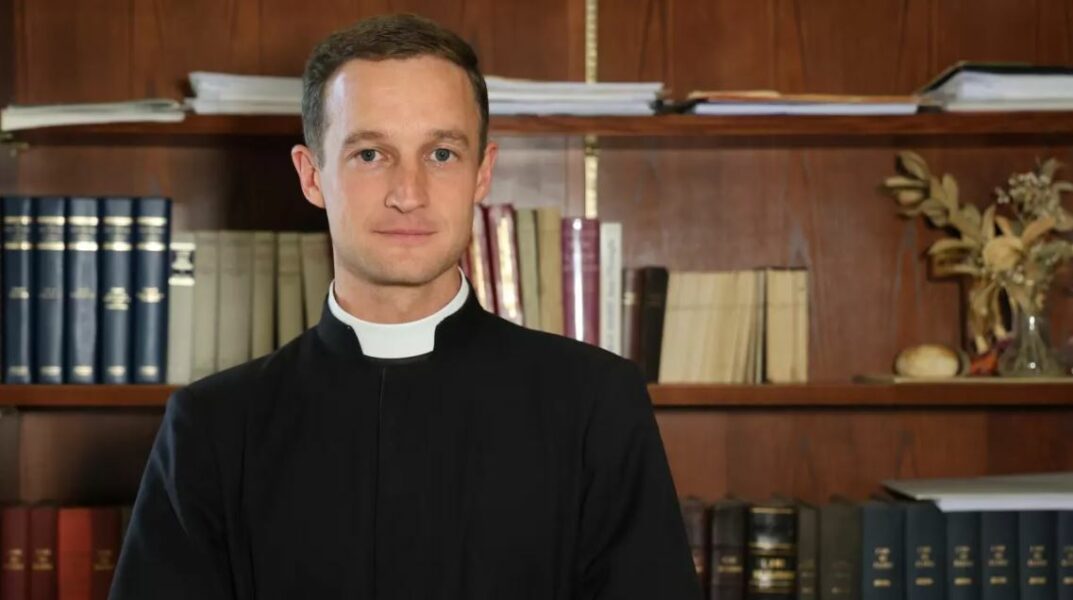
The Priestly Fraternity of Saint Pius X (FSSPX) announced that Father Marc Hanappier will be one of the four priests to receive episcopal consecration on July 1 in Écône. At just 35 years old, he is the youngest of the candidates chosen to join the episcopate of the fraternity founded by Archbishop Marcel Lefebvre.
He currently carries out his ministry at Saint Thomas Aquinas Seminary in Dillwyn, Virginia (United States), where he forms future priests and teaches some of the fundamental subjects of Catholic theology.
A family marked by religious vocations
Of French nationality, Marc Hanappier was born in 1990 into a Catholic family of ten children. Several vocations emerged from that same household: one of his brothers is a priest of the Priestly Fraternity of Saint Pius X, another belongs to the Capuchins of Morgon, and one of his sisters is a Dominican religious teaching at Saint-Pré.
He completed his priestly studies at the seminaries of Flavigny and Écône, where he received priestly ordination in 2013.
His first assignments were linked to the educational field. He carried out teaching duties at the school of l’Étoile-du-Matin, near Bitche, and later at Saint-Michel school, near Châteauroux.
In 2020 he was assigned to Saint Thomas Aquinas Seminary in Virginia. Before fully taking up his new duties, he spent a year in Scotland perfecting his English while also collaborating in parish apostolate.
He currently teaches mainly metaphysics and dogmatic theology, while also attending to various chapels on weekends. He speaks French and English fluently and has knowledge of German and Spanish.
Grace as the foundation of the Christian life
Hanappier’s homilies and conferences reflect a constant concern for the great doctrinal questions of the spiritual life. Among them, the role of divine grace in the sanctification of man stands out in particular.
In his preaching he insists that the entire Christian life is born of God’s initiative, yet at the same time requires a free response on the part of man. From this perspective, holiness is neither the exclusive fruit of human effort nor a passive reality, but the result of constant cooperation with grace.
This vision appears repeatedly in his interventions, where he emphasizes that God’s action must translate into a concrete transformation of life through growth in the virtues and daily fidelity to the divine will.
A spirituality centered on everyday holiness
Drawing inspiration from Saint Francis de Sales, Hanappier recalls that Christian perfection is not reserved for extraordinary circumstances or particular states of life, but can be attained in the faithful fulfillment of ordinary duties.
For him, the path of holiness consists in accepting one’s own vocation and seeking God’s will in the concrete circumstances of each person, avoiding the temptation to imagine that sanctification would be easier under other conditions of life.
This spirituality combines ascetic rigor and realism. In his homilies he insists that difficulties, falls, and personal limitations should not lead to discouragement, but rather to renewed confidence in God’s mercy and constant perseverance in the spiritual combat.
Marian devotion and the supernatural life
The figure of the Virgin Mary also occupies a prominent place.
Hanappier presents Our Lady as the perfect model of cooperation with grace and of total surrender to the divine will. In his reflections on Mary’s divine motherhood and virginity, he especially highlights her purity, her humility, and her absolute availability to God’s plan.
As he explains, the greatness of the Virgin cannot be separated from the perfection of her charity and her faithful response to the grace received. From this perspective, he proposes Mary as an example for every Christian called to grow in the supernatural life.
A theology professor for the new generation of priests
Unlike other candidates whose responsibilities have been linked mainly to the governance of districts or the direction of educational works, Marc Hanappier has developed a large part of his ministry in the intellectual and doctrinal formation of future priests.
His work at the Fraternity’s American seminary places him in direct contact with the new generations of traditionalist clergy. There he combines the teaching of philosophical and theological disciplines with ordinary pastoral care, an experience that has shaped the profile of the man now preparing to assume a new responsibility within the episcopal structure of the FSSPX.
Other profiles: